 Guide On Map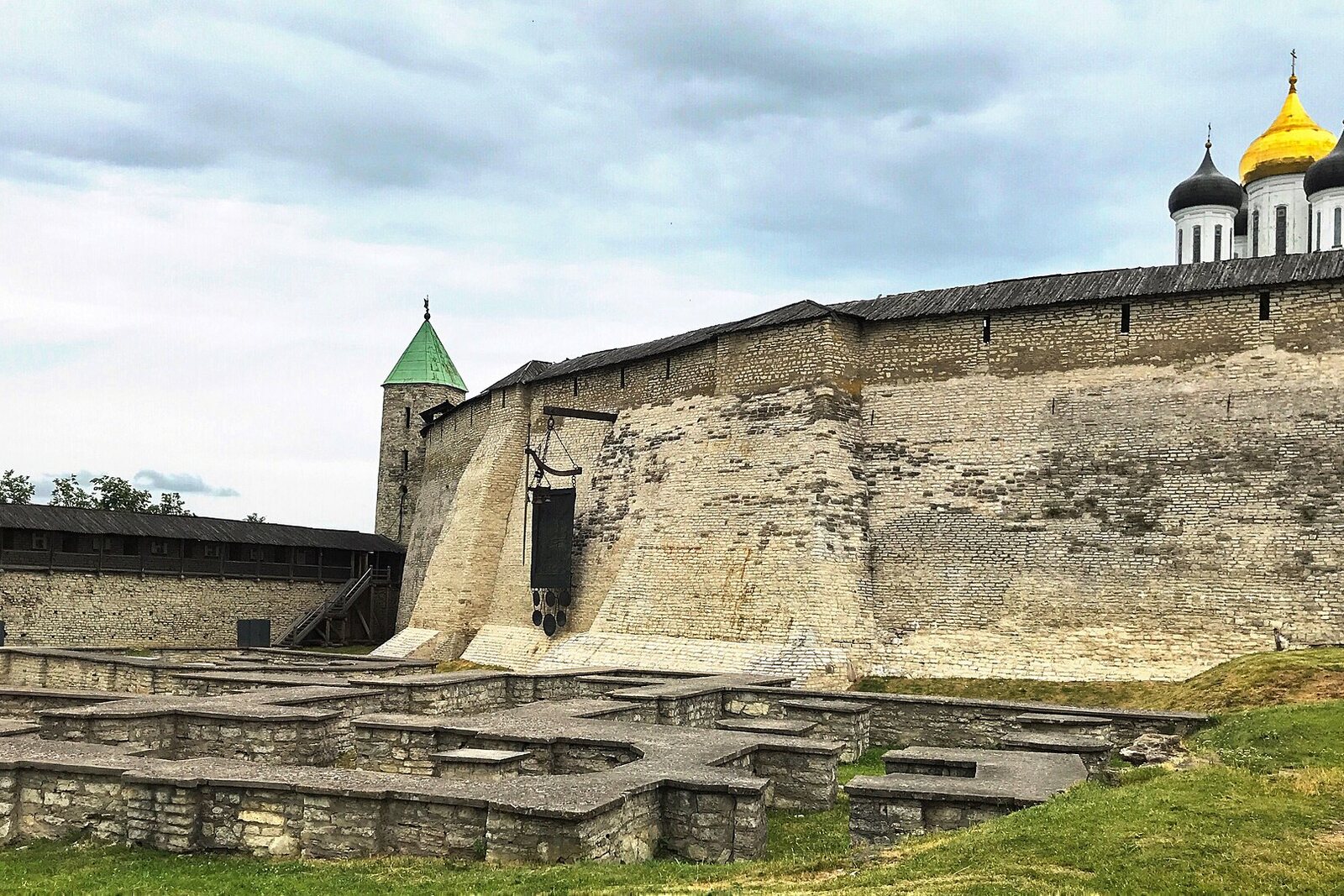
Look around first
What to notice
- Stone outlines of buildings
- Wall fragments
- Paths between the foundations
The story of the place
For a long time, this open area was hidden by the earthen embankment of a military fortification, and the structures that survived above it were later dismantled. Excavations brought the foundations of churches and secular buildings back from beneath the soil; in places, the masonry rose higher than human height. The stone remains and the paths between them belong to a territory with its own wall, adjoining the Pskov Krom and connected to it by a passage. The ruler's court, court of justice, and ecclesiastical administration were located here.
In twelve sixty-six, Dovmont came to Pskov—a prince of Nalshany Land who had been defeated in a Lithuanian internal conflict. He brought his relatives and a retinue of seventy men. Returning threatened him with reprisals; in Pskov, he sought refuge and new service.
Dovmont was baptized here under the name Timofey, and the people of Pskov placed him on the princely throne. A prince was invited to command the army and administer justice, so his position depended on the city itself. In twelve seventy, Grand Prince Yaroslav Yaroslavich replaced Dovmont with another military commander. The very next spring, the people of Pskov brought the exile back and let him rule until the end of his life.
South of the Pskov Krom, under Dovmont, they began fortifying the former posad. The princely court was established here, and the first stone churches began to be built. One was dedicated to Timofey of Gaza—the saint whose name Dovmont received at baptism. The medieval Tale of Dovmont reports that after defeating a Livonian army in twelve seventy-two, the prince built the Church of Feodor Stratilat here. Thus Dovmont's military service left stone churches on this site.
Dovmont ruled Pskov for a total of thirty-three years. After his last battle, he died during a plague epidemic in twelve ninety-nine and was buried in Trinity Cathedral. The people of Pskov revered him as the city's defender, and the fortified area with the princely court and churches received his name. Here, the word “town” meant a separate territory behind its own walls.
By the beginning of the sixteenth century, seventeen ecclesiastical and at least four secular stone buildings stood on one and a half hectares. Their close packing is explained by the area's purpose: the princely court, court of justice, and ecclesiastical administration were moved here, with a passage to the Pskov Krom left beside them.
In seventeen oh one, after the Russian army's defeat near Narva, Peter the First feared a Swedish advance on Pskov. On his orders, military builders dismantled the upper parts of several churches here, covered the buildings with earth, and built an artillery bastion above them. After the Great Northern War ended, the border shifted westward and the fortification lost its former purpose. In the twenties and thirties of the nineteenth century, the structures that remained above ground were dismantled because they had fallen into disrepair.
The buried walls lay beneath the bastion until the excavations. From nineteen fifty-six, archaeologists from the State Hermitage Museum uncovered the buildings one after another; beneath the embankment, some church walls remained more than four meters high. The archaeologists brought the outlines of fourteen structures to the surface. The low stone rectangles around you are the plan of the princely and ecclesiastical quarter, which was first turned into a battery and then excavated from beneath it.
Useful on site
The open part of Dovmont Town can be viewed from the grounds of the Pskov Krom; the Pskov Krom grounds are open from 08:00 to 21:00, with entry until 20:00. Changes are possible.
Checked: July 2, 2026. Check the official source before visiting.View the ruins from the paths and do not step on the masonry. To make out the quarter, it is more useful to take in several foundations at once than to examine a single stone outline.