 Guide On Map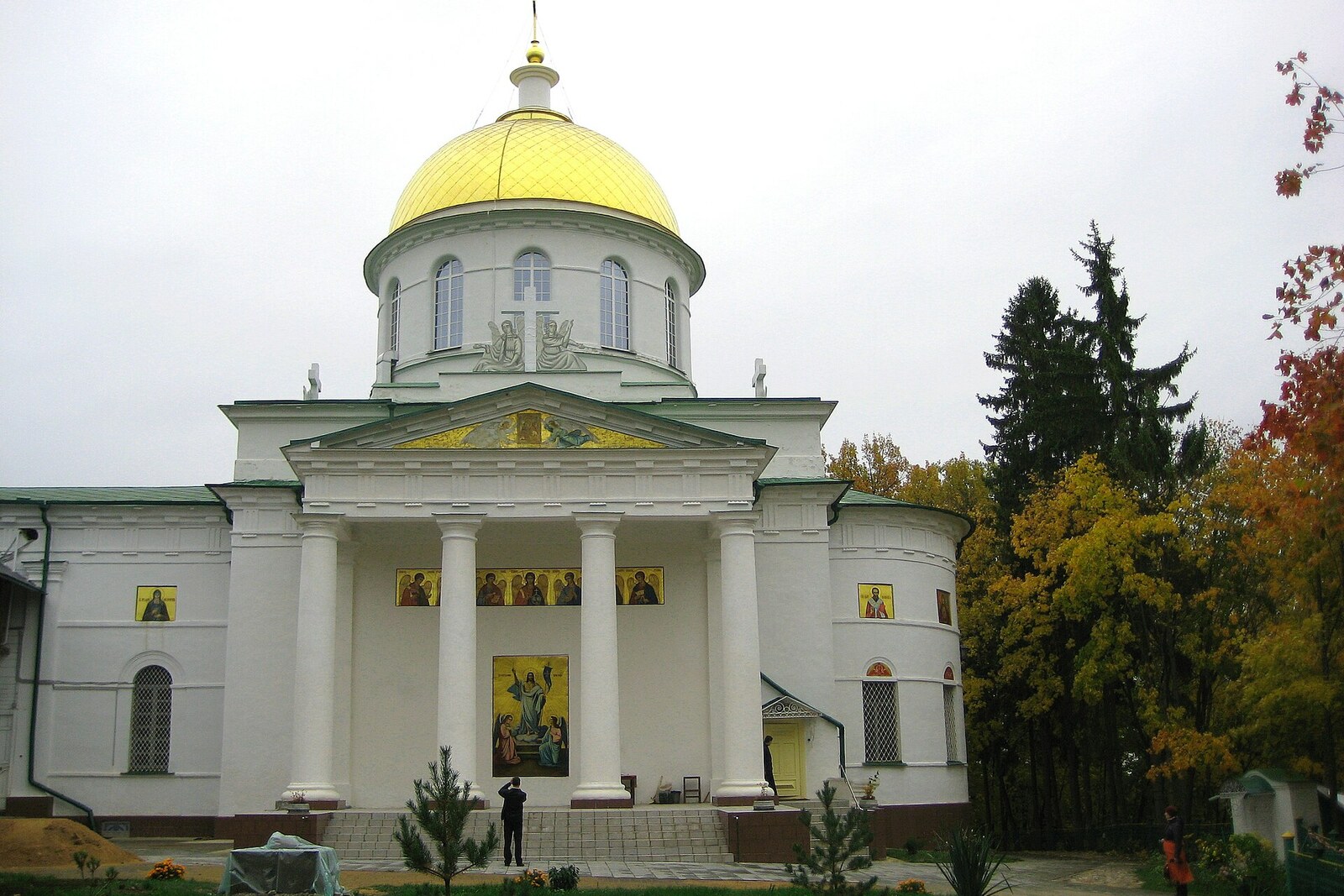
Look around first
What to notice
- St. Michael’s Cathedral
- Western portico
- Fortress wall
- Memorial plaques with the names of warriors
The story of the place
St. Michael’s Cathedral rose within the very line of the monastery’s defenses, taking the place of the weathered Brusovaya Tower. Its western portico is embedded in the fortress wall, and through the church you can leave the enclosure: in the stone wall, the church also became part of the route. The cathedral is dedicated to Archangel Michael, the protector of warriors; old memorial plaques still remain beneath its vaults.
Archimandrite Venedikt, the abbot of the Pskov-Caves Monastery, planned to place an obelisk to General Pyotr Wittgenstein in the future cathedral. The church was conceived as a personal monument to the commander who had turned the danger of a French advance away from Pskov Land.
In the autumn of eighteen twelve, Wittgenstein commanded a major formation of the Russian army—the First Infantry Corps. His soldiers held the northern direction while French troops occupied Polotsk. In October, the people of Pskov carried the Icon of the Dormition of the Mother of God from the Pskov-Caves Monastery to Pskov and processed around the city walls with it. That same day, Wittgenstein’s corps began its decisive assault on Polotsk and occupied the city during the night. The enemy’s advance toward the borders of Pskov Governorate stopped. The general himself wrote to the governor of Pskov that the townspeople’s prayers had been heard. This was his religious understanding of the victory, not an established cause of the battle’s outcome.
Venedikt chose the Pskov-Caves Monastery specifically for the memorial: the icon with which the people of Pskov associated their deliverance had been carried out from here. When Wittgenstein learned of the project, he appealed to the officers and soldiers of his corps. These men had gone through the battles near Klyastitsy and Polotsk and had lost comrades killed in action or dead of wounds. The survivors then raised thirty thousand rubles in donations. Slightly more than six thousand went toward a silver riza for the monastery icon, and about twenty-four thousand toward construction of the church.
Wittgenstein ordered the regiments to send lists of the dead to the monastery so that they would be commemorated annually. He then demanded in writing that depictions of his own exploits and everything that would glorify him personally be removed from the design. The obelisk was canceled. Two silver-plated copper plaques bearing the names of fallen soldiers were installed in the cathedral.
Emperor Alexander I, who approved the construction, ordered that the church be dedicated to Archangel Michael. In Orthodox tradition, Michael is the archistrategos—that is, the leader of the heavenly host and the protector of warriors. The cathedral was consecrated on June twenty-ninth, eighteen twenty-seven, on Wittgenstein’s name day.
The builders erected it directly along the line of the fortress enclosure. The rectangular Brusovaya Tower had previously stood here; by the nineteenth century, its upper tiers had already disappeared, and the remains were dismantled while the site was being prepared. The cathedral’s western portico is built into a section of the wall, and the church provides an exit beyond the fortress. Inside the active cathedral, the memorial plaques bearing the names of the dead remain. The obelisk to Wittgenstein, with which the entire construction began, is not here.
Useful on site
Viewing from the monastery grounds—during the monastery’s regular opening hours; interior access depends on services and instructions on site. Checked 2026-06-24.
Checked: June 24, 2026. Check the official source before visiting.Compare the building from the monastery side and from outside, if the open route allows it. During a service, observe the architecture without speaking or moving in front of worshippers.