 Guide On Map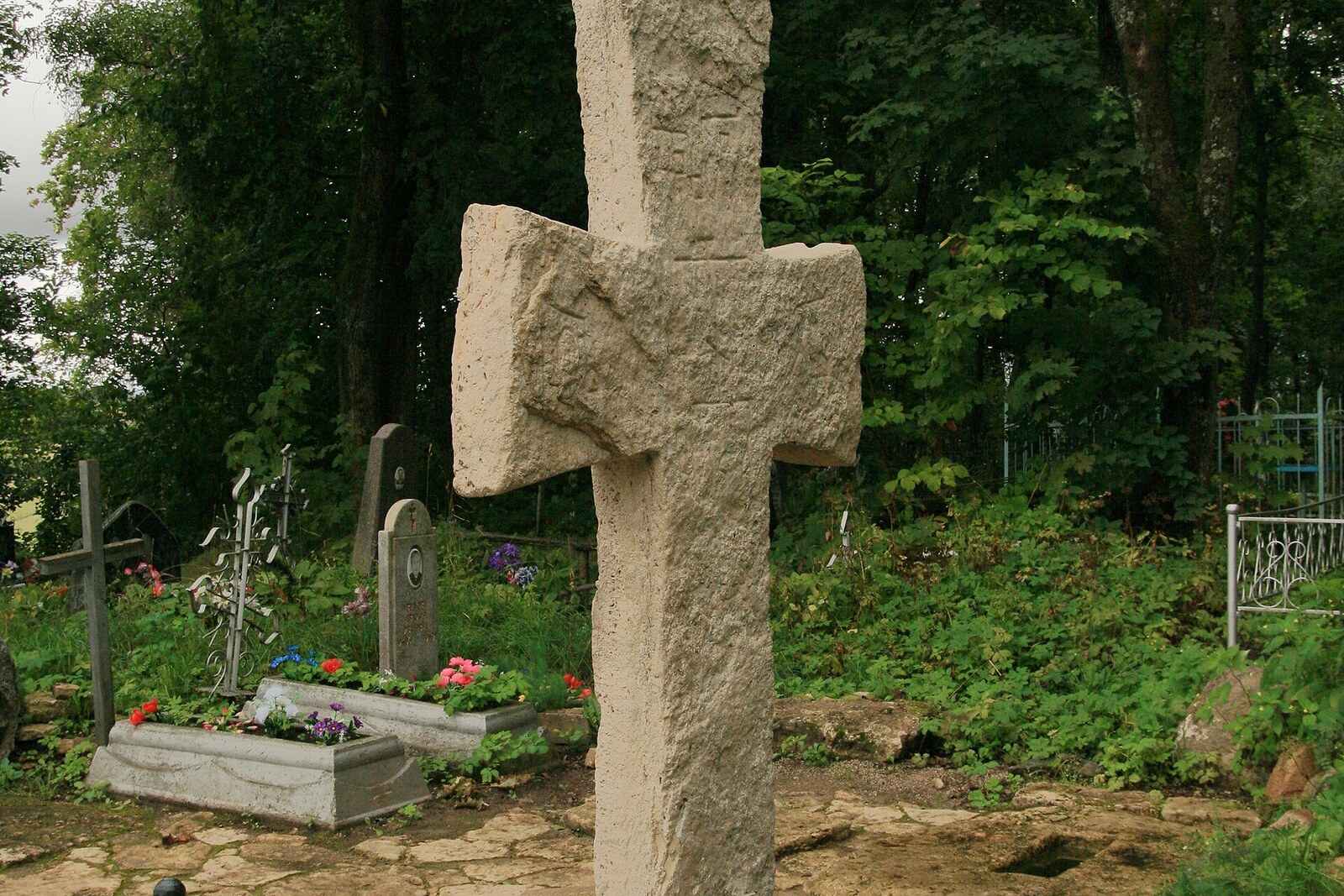
Look around first
What to notice
- Truvor's Cross
- Slab with three nested squares
- Cemetery by the entrance
- Promontory of the gorodishche
The story of the place
This promontory was the heart of early Izborsk, where craftspeople and merchants lived. Beyond the fortifications stood houses, a princely citadel, and a square for common assemblies. When the fortress was moved to Zheravya Hill, the old town was abandoned, and a cemetery appeared by the entrance. Rising among the graves is a limestone cross more than two meters high, erected after the relocation and probably marking the road to the abandoned town.
In August eighteen forty, Friedrich Kruse, a professor at the University of Dorpat, came to this cemetery with instructions to determine whether Truvor's grave could be found here. The result had to be presented to Finance Minister Egor Kankrin, so the local legend had to become either an archaeological fact or an honest report of failure.
Truvor was a Varangian prince from an ancient chronicle account. According to that account, the local tribes quarreled among themselves and invited three brothers to rule and judge them. Izborsk fell to Truvor. He arrived here in eight sixty-two, ruled for two years, and died. That is where his biography ends in the chronicle. The account itself was written down centuries later, so archaeology confirms the antiquity of Izborsk, but not the presence here of a particular prince.
The town beneath your feet did indeed exist. A settlement arose on this promontory at the turn of the seventh and eighth centuries. Craftspeople and merchants lived here; there were houses, fortifications, a princely citadel, and a square for common assemblies. In thirteen thirty, the people of Izborsk moved the fortress to Zheravya Hill. The old town was abandoned, and a cemetery remained near the entrance.
The large limestone cross was erected here after the relocation, in the fourteenth or fifteenth century. Carved on it is a formula common on medieval stone crosses: “The King of Glory Jesus Christ conquers.” Truvor's name does not appear on the stone. Most likely, the people of Izborsk marked the road to the abandoned town with the cross and recalled where Izborsk had once stood. Its height of more than two meters and its proximity to ancient graves gradually made it a fitting grave marker for the hero of the chronicle.
In the early nineteenth century, Evgeny Bolkhovitinov, the Archbishop of Pskov and a historian, surveyed the surrounding area in an attempt to identify Truvor's residence. It was probably after his work that the name “Truvor's Gorodishche” became established for the old town.
Kruse did not believe the large cross was genuine: its edges seemed too well preserved to him for a monument of the ninth century. Yet very nearby lay a long slab with three squares set one inside another. The professor decided that a prince's grave might lie beneath it. The slab was not lifted again: a few days before Kruse's arrival, it had already been raised by order of the governor-general. Beneath the stone, they found a decayed male skeleton without weapons, jewelry, or coins. It was impossible to determine the age of the burial. The cemetery continued to be used, old slabs were moved, and new burials ended up beside ancient ones. In his report, Kruse acknowledged that establishing the true location of Truvor's grave would hardly be possible.
The cross still marks the entrance to the town abandoned by the medieval people of Izborsk. Nearby lies the slab with nested squares in which Kruse sought a sign of a princely burial. This design is now explained more cautiously: perhaps the stone once served as a board for the game of mill.
Useful on site
Free exterior viewing during daylight hours; no specific museum hours are listed on the site's page. Checked 2026-06-24.
Checked: June 24, 2026. Check the official source before visiting.This is an active cemetery: do not step on the slabs, and keep quiet. At the edge of the gorodishche, watch your footing carefully.