 Guide On Map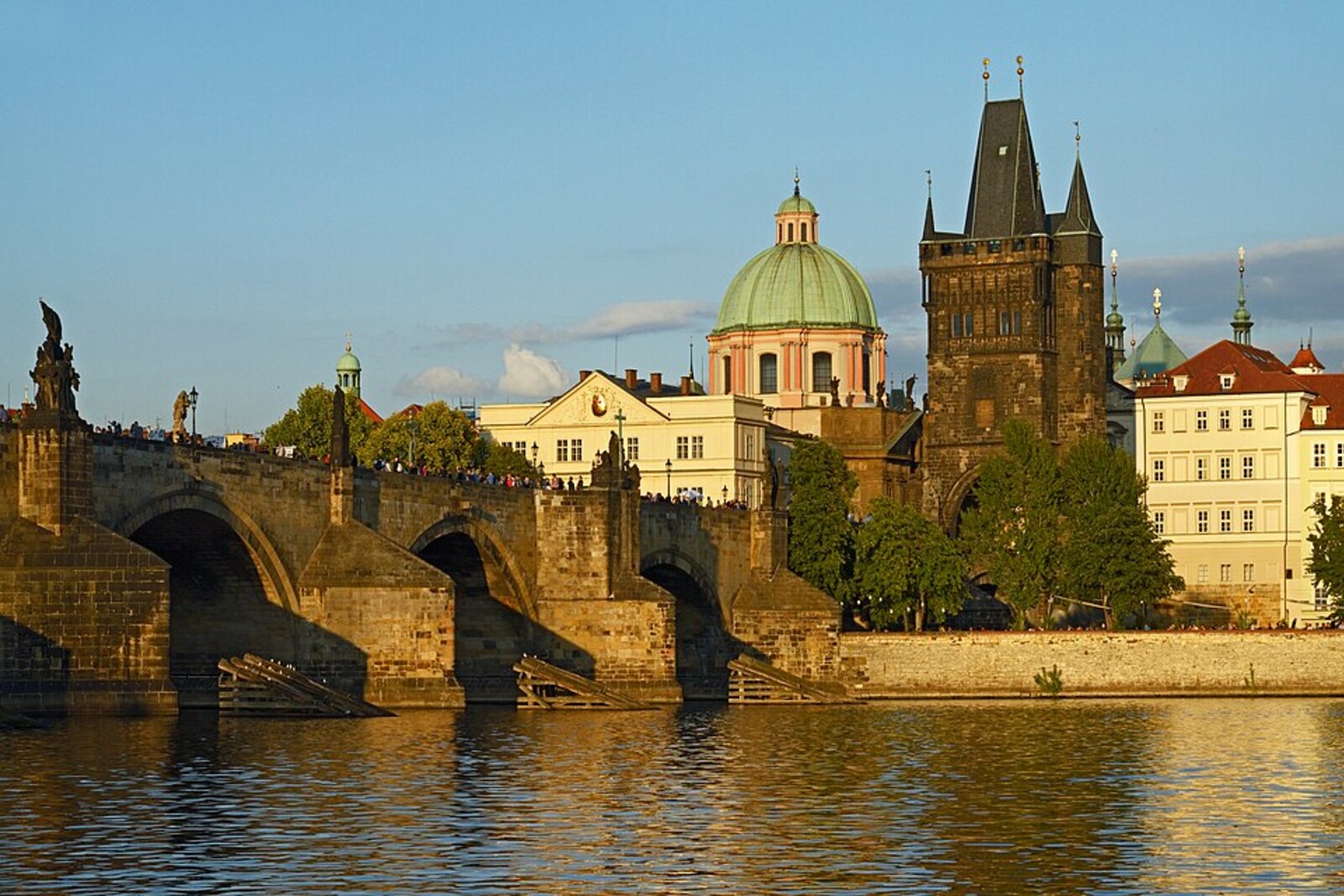
Look around first
What to notice
- Arched passage
- Figure of Karel IV
- Figure of Václav IV
- Viewing gallery
The story of the place
Today, people pass through the arch of the Old Town Bridge Tower to reach Charles Bridge, and climb its spiral staircase to the viewing gallery. The name is literal: the tower stands at the Old Town end of the bridge. In the second half of the fourteenth century, Petr Parléř's workshop built it as a ceremonial city gate on the way to the royal residence. Karel IV and his son Václav IV are depicted on the facade, and an iron portcullis was once lowered from the first floor to block the passage.
Royal processions passed through this gate. So did everyone crossing the Vltava between Old Town and Malá Strana. That is why, after the execution of the leaders of the Bohemian Revolt, Emperor Ferdinand II ordered the reprisals to continue here. The heads of twelve of the twenty-seven people executed were raised to the upper part of the tower and displayed in iron baskets. Families were allowed to bury the bodies, but these remains were not handed over to them: the warning was meant to remain above the busiest crossing.
For almost a year, the widow of the first man executed, Jáchym Ondřej Šlik, one of the revolt's leaders, asked for her husband's head to be returned. In May sixteen twenty-two, she obtained permission and buried it with his body. The other eleven heads remained on the tower for more than ten years.
Only exiles who had returned could take them down. In the autumn of sixteen thirty-one, Saxon troops briefly occupied Prague, and the relatives and associates of those executed entered the city with them. Mikuláš Diviš, a former scribe of the Old Town council, also came to the tower. A scribe drew up and kept city documents—this was his office and his source of income. Diviš lost his position and was exiled for life for taking part in the ceremonial welcome of Friedrich of the Palatinate, the king whom the rebels chose instead of Ferdinand II.
Diviš was now entrusted with restoring names to the remains above the gate. He remembered the order in which the heads had been displayed. The eleven skulls were taken down, carried to the neighboring customs house, and placed in separate boxes; Diviš labeled each one. The boxes were then placed in a common coffin and taken to the Church of Our Lady before Týn, where a requiem service was held.
Afterward, the coffin was handed over to several trusted people. The exiles understood that the Saxon troops might leave and the remains would again be displayed for desecration, so they kept the burial place secret. A few months later, the Saxons left Prague, and those who had returned had to leave the city again.
On the upper part of the tower on the bridge side, where the iron baskets hung, there are now neither fittings nor a memorial marker. The eleven boxes bearing names were taken away from here in sixteen thirty-one; where the trusted people hid them after the service at the Church of Our Lady before Týn remains unknown to this day.
Useful on site
The tower is open by season: January—March 10:00—18:00, April—May 10:00—19:00, June—September 9:00—20:30, October—November 10:00—18:00, December 10:00—19:30. The adult ticket price on the verification date is 250 Czech korunas; 138 steps lead to the gallery. Verified 2026-06-29.
Checked: June 29, 2026. Check the official source before visiting.View the facade from a distance without lingering beneath the arch; climbing the tower is not necessary for this story.