 Guide On Map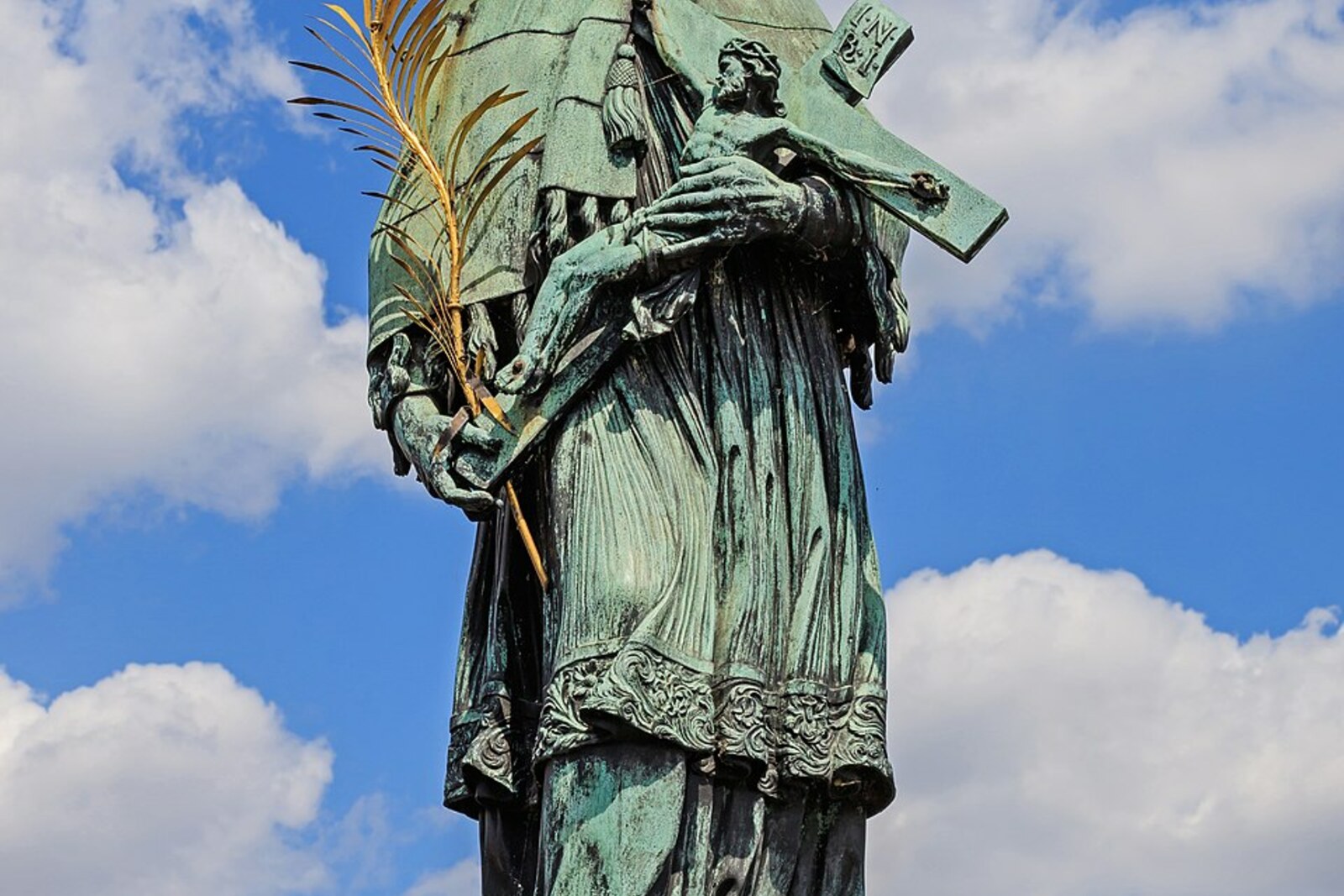
Look around first
What to notice
- Bronze figure of Jan Nepomucký
- Two reliefs on the pedestal
- Five stars around the head
- Cross with five stars
The story of the place
For a long time, the stone crossing here carried the only route across the Vltava between Old Town, Lesser Town, and Prague Castle. It was built to replace Judith Bridge, which had been swept away by a flood; Karel IV ordered construction to begin, and it was completed after his death. Merchants, royal processions, troops, and convicts passed here. A cross with five stars is set into the parapet nearby, and the bridge received its present name only much later.
At the bronze figure of Jan Nepomucký, people rub two reliefs on the pedestal. The one on the right shows a person being thrown from the bridge. The one on the left shows a woman at confession. These scenes tell two different versions of the same death: the first is based on historical documents, while the second appeared later as a legend.
In thirteen ninety-three, this man was called Jan of Pomuk. He was the general vicar of the Archbishop of Prague—a church lawyer who, on behalf of his superior, confirmed appointments and court decisions. King Václav IV was waiting for the abbot of the wealthy Kladruby Monastery to die. The king intended to dissolve the monastery, transfer its lands to a new bishopric, and thereby weaken his opponent, Archbishop Jan of Jenštejn.
When the abbot died, the monks immediately elected a successor. On March tenth, Jan of Pomuk confirmed their choice. He was doing precisely the job for which he was employed, but with one signature he blocked the king's path to the monastery's lands.
Ten days later, Václav ordered the archbishop's closest officials seized. Jan of Jenštejn himself managed to escape. His vicars were tortured to force their submission; Jan of Pomuk did not survive the torture. The sources do not allow us to say with certainty whether he was still alive when the king's men brought him here. One thing is beyond doubt: the dying Jan, or his body already, was thrown from this bridge into the Vltava.
On April seventeenth, the body was found downstream. Later, the remains were transferred to St. Vitus Cathedral. The king never obtained Kladruby Monastery, and the fleeing archbishop took a written accusation of murder to the pope in Rome.
A century and a half later, chroniclers replaced the dispute over the monastery with a more understandable story: that Jan was Queen Sophia's confessor, and Václav killed him for refusing to reveal what he had heard in confession. This is a legend, and it is the one Jan Brokoff placed on the left relief. The five stars around the saint's head also belong to the legend: supposedly, they appeared over the water after the fall.
The bronze figure was cast in sixteen eighty-three—forty-six years before Jan's canonization. It is the oldest sculpture on the bridge to have survived here in its original form, and it later became the model for depictions of Jan Nepomucký on bridges across Europe. A little farther on, a cross with five stars is set into the parapet: it marks the traditionally named place of the fall. And on the pedestal, the documented murder and the later legend of the queen's confession still stand side by side.
On the night Jan died, this bridge was not yet called Charles Bridge. Praguers called it the Stone Bridge or the Prague Bridge, and construction was still under way. Its predecessor, Judith Bridge, was destroyed by a flood in thirteen forty-two. Karel IV, king of Czechia and emperor of the Holy Roman Empire, ordered a new stone crossing to be built and laid the first stone in thirteen fifty-seven. The builders finished it only in fourteen oh two, after Karel's death.
Until eighteen forty-one, it remained Prague's only bridge across the Vltava: merchants, royal processions, troops, and convicts crossed it between Old Town, Lesser Town, and Prague Castle. The name “Charles Bridge” became established only in eighteen seventy, following a proposal by the Czech journalist and poet Karel Havlíček Borovský. The name recalls the man who ordered the washed-away bridge replaced; Karel IV himself called his crossing the Prague Bridge.
Useful on site
The pedestrian bridge is open as a public urban space without a ticket. Crowds interfere most with reading the place in the middle of the day; the surface may be slippery in rain and in winter. Checked 2026-06-29.
Checked: June 29, 2026. Check the official source before visiting.Do not stop in the middle of the dense flow of people; choose a free spot by the parapet to look at the river and the reliefs.