 Guide On Map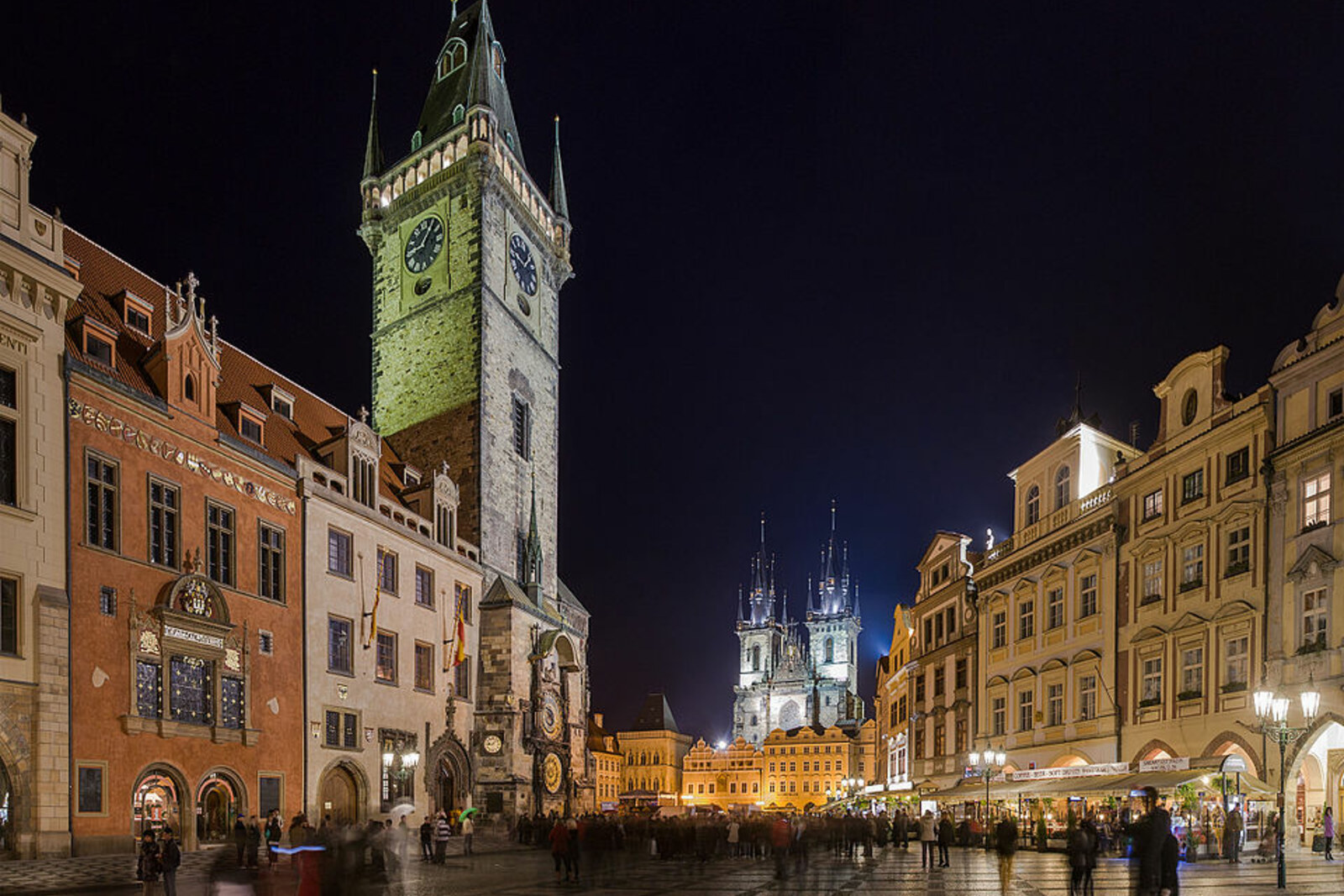
Look around first
What to notice
- Large Renaissance window
- Small barred windows
- Crosses in the pavement
- List of names on the wall
The story of the place
On either side of the large Renaissance window, small barred windows remain: the prison was behind them. A list of the dead is laid out on the nearby wall, and crosses in the pavement mark the spot; they appeared here only in nineteen oh four. In this way, the Town Hall facade preserves traces of those whom the city government once held behind these walls.
“Old Town” means “belonging to Old Town.” Before seventeen eighty-four, Prague consisted of four towns with separate councils. The Old Town council met in this Town Hall; the court and prison were here as well. The main market stood before the building, so trade, municipal offices, and public punishments converged in one square.
Jan Kutnauer had much to lose here. His father left him houses and a shop in the Old Town market. Jan received an education, became a lawyer, and brewed and sold beer with his brother. Šimon Sušický, who raised him, also practiced law, served in the kingdom’s financial office, and ran a brewing business. Both belonged to the Protestant community of the Unity of the Brethren, which had only recently ceased to be persecuted in Prague.
In sixteen eighteen, representatives of the Bohemian nobility and the royal towns rose up against Ferdinand II, the Catholic king. They sought to preserve their religious rights and municipal self-government; the king sought to bring the councils back under his control and resume converting the country to Catholicism. Kutnauer and Sušický came to a meeting of the Old Town council and urged the councilors loyal to the king to join the revolt. At first, the councilors refused. A year later, the royal appointees were removed from the council, and Jan and Šimon themselves took seats there, in this very Town Hall.
In November sixteen twenty, Ferdinand’s armies defeated the rebels at White Mountain on the outskirts of Prague. The king chosen by the rebels fled, and Old Town capitulated. More than sixty participants in the revolt who had not managed to leave were arrested. Kutnauer and Sušický were locked in the Town Hall prison—its small barred windows still remain on either side of the large Renaissance window.
A special tribunal proposed the punishments, and Ferdinand signed fifty-one sentences, including twenty-eight death sentences. One condemned man was pardoned already at the scaffold. On June twenty-seventh, sixteen twenty-one, twenty-seven people died here: three noble lords, seven knights, and seventeen townspeople. The towns played a comparatively small role in the revolt, yet especially many of their representatives were deliberately among those executed. The main market before the Town Hall made it possible to turn the executions into a warning to all the kingdom’s city councils.
Most of the condemned were beheaded on a platform. Kutnauer and Sušický, together with one other member of the Unity of the Brethren, were sentenced to a more shameful death. Jan and Šimon were hanged from a crossbeam projecting from the window of the very Town Hall where they had earlier served as councilors.
Jan’s widow, Kateřina, buried her husband, took the children, and left for Meissen in Saxony. All of Kutnauer’s property was confiscated; later, Kateřina lost her own real estate as well for refusing to return the children to Czechia. The children could come to Prague only two decades later, after agreeing to convert to Catholicism. The elder son had to request a royal pardon separately. After that, he again joined a city council—this time that of the New Town.
The scaffold and the crossbeam disappeared. The crosses were first laid into the pavement here only in nineteen oh four, and a list of the dead was placed on the Town Hall wall. On it, the names of Jan Kutnauer and Šimon Sušický stand side by side—men who entered this building as councilors, waited for their sentence behind its bars, and were hanged from its window.
Useful on site
Town Hall: January–March daily 10:00–19:00, April–December daily 9:00–20:00. Tours of the historic interiors run on a separate schedule. The tower is more accessible than the other ascents thanks to an elevator. Checked 2026-06-29.
Checked: June 29, 2026. Check the official source before visiting.When the clock is in motion, it is especially crowded by the wall; the crosses and the overall facade are easier to view a little away from the crowd.