 Guide On Map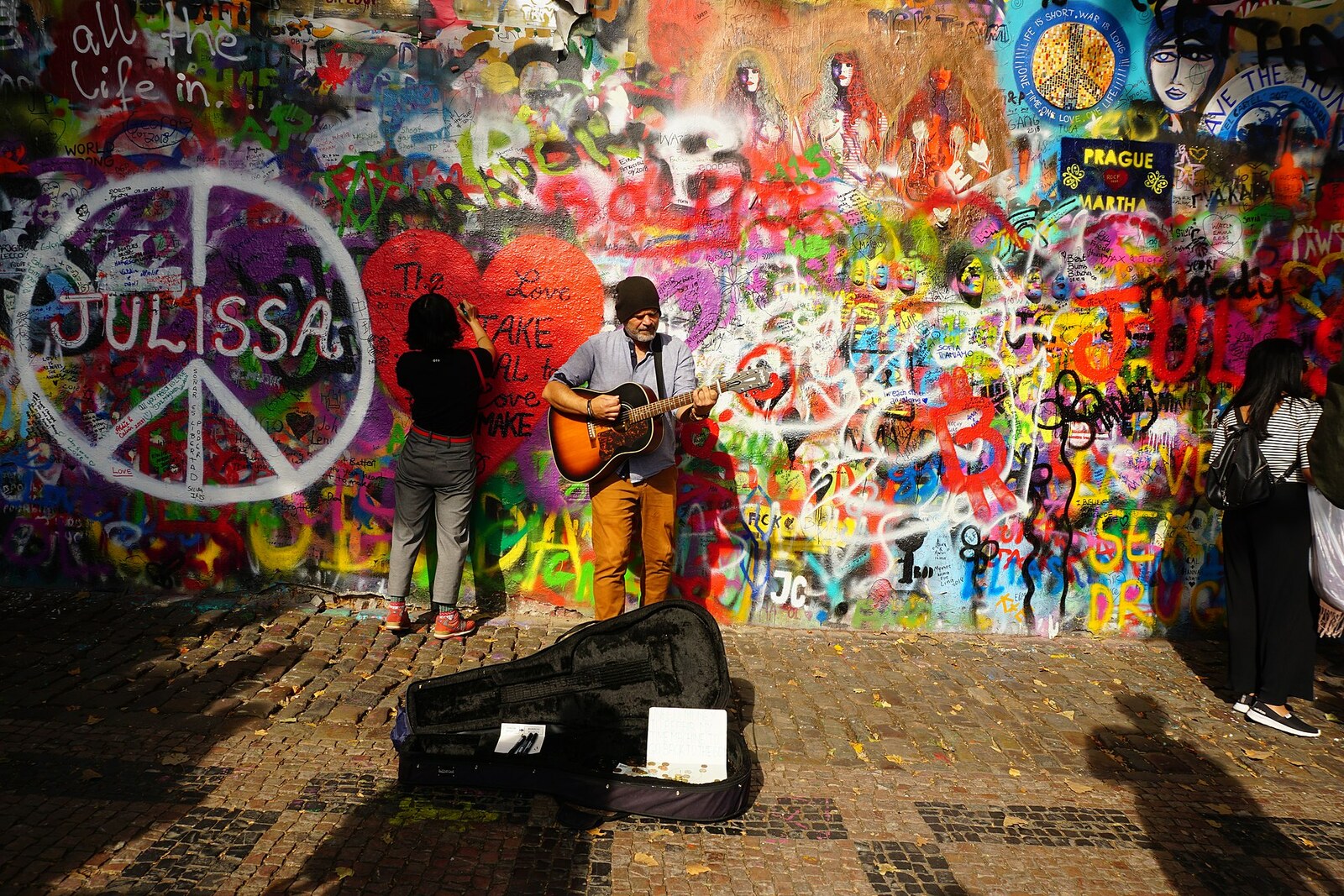
Look around first
What to notice
- Portrait of John Lennon
- Large wall compositions
- Sections with inscriptions in chalk and marker
- Wall of the Maltese Garden
The story of the place
In mid-December nineteen eighty, someone drew a chalk cross on a projecting stone and wrote: “For John Lennon.” The British musician, one of the founders of the Beatles, had been shot in New York a few days earlier. Candles, flowers, photographs, and lines from his songs appeared on the Prague projection. The stone came to resemble a gravestone, although Lennon was never buried here.
This corner was chosen because Prague residents had long left poems, declarations of love, and personal messages on the wall. As early as the nineteen seventies, it was called the Wailing Wall. After Lennon's death, the artist Stanislav Jiřčík replaced the chalk inscription with one made using a stencil, added the dates of Lennon's life and a portrait. That is how the musician's name became attached to the wall of the Maltese Garden.
In the spring of nineteen eighty-one, municipal services painted over the portrait and inscriptions with green paint. People restored them. They had to be painted over again, sometimes every day. After the first anniversary of Lennon's death, officials ordered the entire section, together with the symbolic gravestone, to be covered with an almost three-meter wooden screen. The screen was fastened to the wall with iron staples and set aside for ordinary posters.
At night, Jiří Wolf came here with friends. Wolf earned his living through manual labor and wrote children's fairy tales, and by then he had already spent three and a half years in prison for leaflets and inscriptions on walls. He understood well the cost of another such stunt. The men brought pickaxes, pried out the staples, and dragged the screen down into the middle of the street. Police officers chased them. The fugitives climbed over the gates in the wall, while residents of neighboring houses let them pass through windows and courtyards.
In the morning, workers put the screen back up. Wolf and his companions repeated the raid twice more; each time they managed to get away, and each time the boards were returned to their place. They did not manage to keep the wall open. But people began gathering by the closed monument every year, on December eighth. At first, they came with flowers, candles, and guitars; then people began signing petitions here against nuclear weapons and for the release of political prisoners. Police checked identification documents, summoned participants for questioning, and dispersed processions. Thus, the section where private poems had once been left became a place for regular public meetings.
The wooden screens were removed only in nineteen ninety. Beneath them, surviving fragments of the symbolic gravestone and the inscriptions from December nineteen eighty-one were found. New drawings soon covered them.
Neither the first chalk cross nor Jiřčík's portrait is visible now. The present image of Lennon and the other large compositions were created by later artists. In designated sections, visitors are allowed to leave inscriptions in pencil, marker, or chalk; the owners of the wall, the Order of Malta, have forbidden aerosol paint.
Useful on site
An exterior wall in open urban space; respect the current rules of the owners and the local residential environment.
Checked: June 28, 2026. Check the official source before visiting.Do not look for a single “authentic” image: the point of the wall lies precisely in its changeability. Do not draw on neighboring facades or private property.