 Guide On Map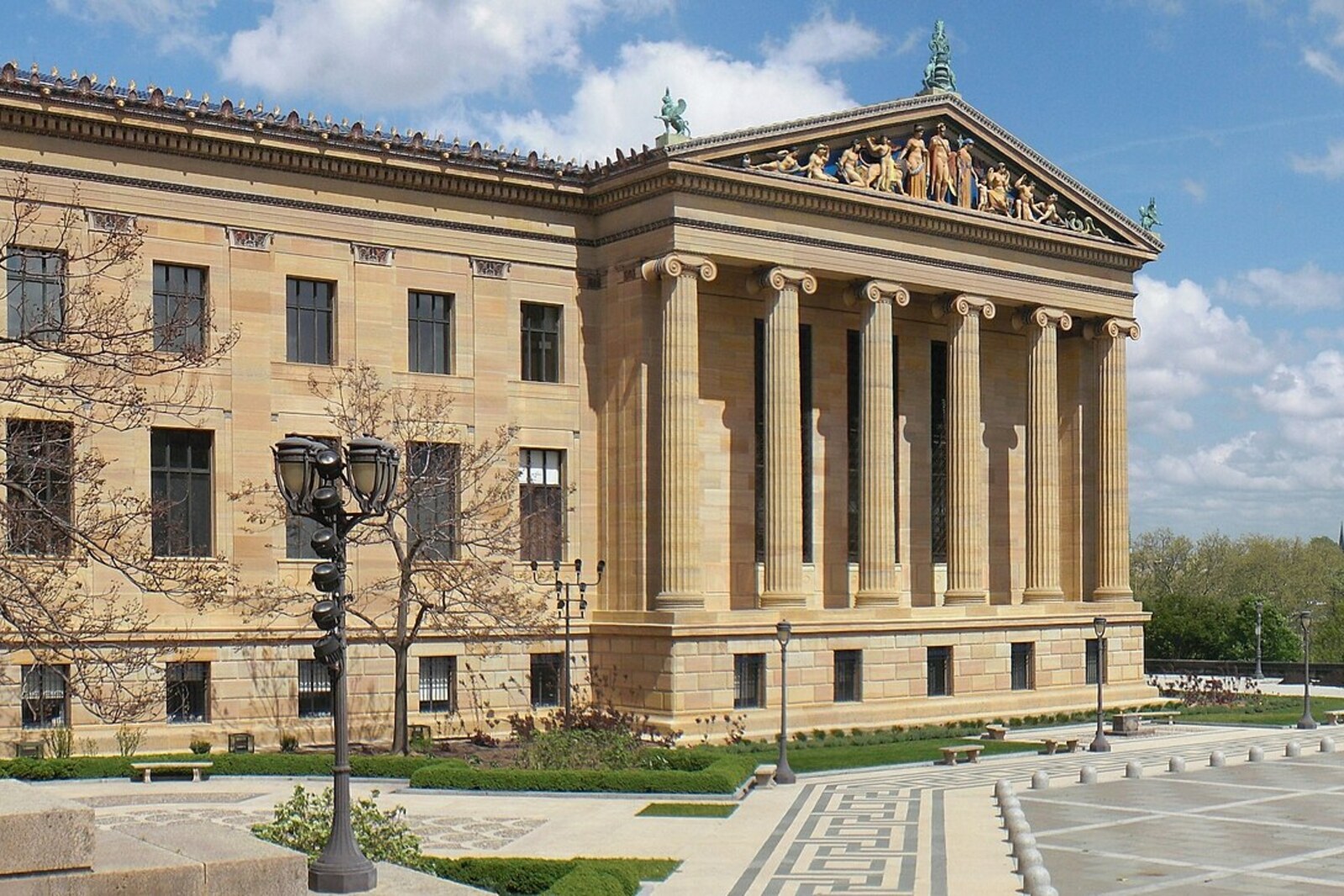
Look around first
What to notice
- Seventy-two granite steps
- Eastern terrace
- Marker with Rocky's sneaker prints
- Straight view along the Benjamin Franklin Parkway to Philadelphia City Hall
The story of the place
Seventy-two granite steps lead to the eastern terrace of the Philadelphia Museum of Art. The current building opened in nineteen twenty-eight for the city's collection of European, American, and Asian art. The architects extended the Benjamin Franklin Parkway's straight line with the staircase: from the upper landing, the avenue is visible all the way to Philadelphia City Hall. It was this long, open ascent that gave the museum entrance its second life.
In the early nineteen seventies, Philadelphia cameraman Garrett Brown was trying to free the motion-picture camera from rails and a heavy dolly. He made his living shooting commercials and short films, and paid for his first experiments with money earned in radio. To get a smooth moving shot, Brown built a suspension rig that attached to the camera operator's body, kept the camera balanced, and absorbed jolts while walking.
The invention had to be sold to film studios. In nineteen seventy-four, Brown spent two days shooting a demonstration reel of thirty shots that had previously been impossible without dollies, rails, or a crane. For the final experiment, his friend Ellen ran down the museum staircase, turned around at the bottom, and climbed back up. Brown followed her with the camera on his body. The footage preserved the smooth movement, the whole ascent, and the city behind Ellen.
Director John G. Avildsen was then preparing the low-budget Rocky and seeking permission to shoot at least a few days in Philadelphia: the producers proposed replacing the city with Hollywood. Sylvester Stallone, the screenwriter and lead actor, created Rocky Balboa, a little-known club boxer who is given a fight with the champion. Rocky strives to last until the final bell; two runs up the staircase were meant to show whether he had managed to prepare.
Avildsen saw Brown's reel. The staircase was already in the script, but now the director knew both the right location and the way to film the ascent in one continuous movement. He tracked down Brown and hired him to repeat Ellen's run with Stallone.
They were given about two hours to shoot at the museum. First they filmed the hero's early attempt, when the ascent was still difficult for him, then the run after training. By then, Brown's homemade rig had fallen; a bent shaft interfered with the motor. Director of photography Ralph Bode ran behind with two car batteries connected to the camera by wires. Only one take remained for the triumphant ascent.
Brown moved beside Stallone up the steps, then passed him at the upper landing so that the actor's face and the city would be in the frame. One wire went taut and jerked the camera at the most important moment. They did not reshoot it. Stallone himself came up with the idea of jumping on the final steps, and at the top he threw up his arms.
After the film's release in nineteen seventy-six, Stallone became a movie star, Avildsen received an Academy Award for directing, and two years later Brown was given a technical award for inventing the Steadicam. The museum staircase has been called the Rocky Steps ever since. People run up the same ascent, raise their arms at the upper landing, and stand on the marker with the film hero's sneaker prints. Ellen was the first to follow their path—in front of a camera that Garrett Brown was still only trying to sell.
Useful on site
The Main Building is open Monday, Thursday, Saturday, and Sunday 10:00-17:00, and Friday 10:00-20:45; closed Tuesday and Wednesday. Adult ticket — 30 dollars, seniors — 28 dollars, students — 14 dollars, visitors under 18 free. The steps are accessible outside without a ticket.
Checked: June 29, 2026. Check the official source before visiting.Climb at a comfortable pace; repeating Rocky's run is optional, especially in hot weather or on wet steps. The museum galleries require separate time, and it is best to check the location of the Rocky Statue before visiting.