 Guide On Map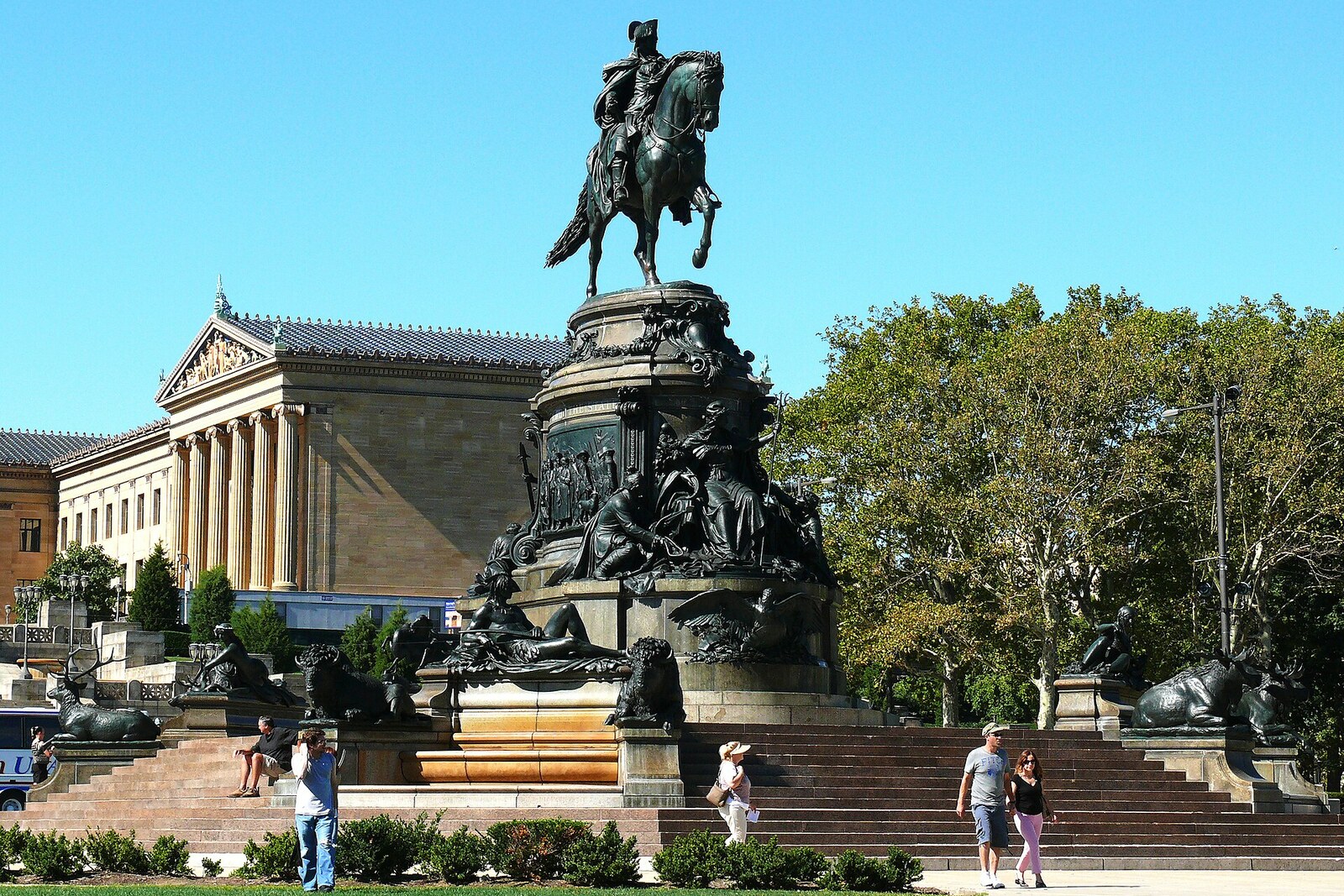
Look around first
What to notice
- Equestrian figure of Washington
- Four bronze rivers
- Figures of Indigenous people
- Granite steps
The story of the place
At Eakins Oval, the rider George Washington is raised above an entire bronze map of the country: around him are gathered participants in the American Revolutionary War, allegories, four rivers, Indigenous people, and animals, by which the sculptor represented its different parts. The monument was commissioned by the Pennsylvania Society of the Cincinnati, which brought together officers of that war and their descendants; Washington once led this society. Money was collected among the state’s residents for decades: the promised sums were insufficient, and the trustees preserved and invested what had already been received. The rider’s face was made from a copy of a mask taken from Washington during his lifetime, while below you can see the bronze rivers and granite steps.
In the winter of nineteen twenty-five, workers from the O’Neill Company surrounded this monument with scaffolding and began removing the bronze figures. They dismantled the granite base block by block, numbered every stone, and photographed the monument from all sides so that no damage would be missed during transport. It was moved only a few hundred meters—from the former entrance to Fairmount Park to the new oval in front of the Philadelphia Museum of Art, then under construction. The work took several months: the monument was reassembled here by October nineteen twenty-six.
The rider at the top is George Washington, commander of the Continental Army in the American Revolutionary War and the first president of the United States. Another of his roles also mattered to the patrons. The Pennsylvania Society of the Cincinnati brought together officers of that war and later their descendants; Washington led the society until his death. In eighteen ten, when people who had served under his command still remained among its members, they decided to erect a monument to him.
Money was raised through subscription books among Pennsylvania residents. Donations depended on the contributors’ own circumstances: one collector reported that farmers had promised money but would be able to pay only after the harvest. Then an economic downturn began, and many of the promised sums never arrived. For decades, the trustees kept and invested what they had collected, until in eighteen eighty they combined their capital with another city fund and commissioned work from the Berlin sculptor Rudolf Siemering.
Siemering raised Washington above an entire bronze map of the country. The middle tier holds allegorical groups and participants in the American Revolutionary War; below are four rivers, Indigenous people, and animals, by which the sculptor represented different parts of America. For the rider’s face, he used a copy of a mask taken from Washington during his lifetime.
While Siemering cast the figures in Germany, the patrons argued with Philadelphians over the installation site. At first, the park commission assigned a plot near Green Street. The society’s leaders decided that preparing the ground would cost too much and demanded that the monument be moved to the square in front of Independence Hall. City defenders of historic development opposed this, including the local chapter of the Colonial Dames of America: the huge equestrian composition would have obscured the restrained façade of the building where the Declaration of Independence was adopted.
The dispute went to court and continued for more than a year through appeals. In eighteen ninety-three, the city council revoked the permit to install it at Independence Hall. The society yielded and returned to the site near Green Street. The monument was unveiled there in eighteen ninety-seven and transferred to the city. Siemering did not come to the ceremony and never saw his monument in Philadelphia.
A quarter century later, the landscape architect Jacques Gréber was completing the plan for the Benjamin Franklin Parkway, which was meant to link the city center with the new museum district. City planners assigned the monument a place at the head of the parkway, directly in front of the museum, and O’Neill Company contractors moved it here.
The oval interchange itself bears the name Eakins. Thomas Eakins was a Philadelphia realist painter and teacher who painted city residents, from rowers to surgeons. Washington, the four bronze rivers, and the granite steps are older than both the oval and the museum building. Before you are the same blocks that workers numbered, transported from Green Street, and assembled again on this site.
Useful on site
An open monument at Eakins Oval. Access may change because of city events, closures, and work around the oval. Reassigning the coordinates requires GIS verification when the route is rebuilt.
Checked: June 29, 2026. Check the official source before visiting.The composition is surrounded by traffic, so view it only from accessible pedestrian areas and do not take shortcuts across the roadway. The overall silhouette is best seen from a distance; the animals, when approached safely.