 Guide On Map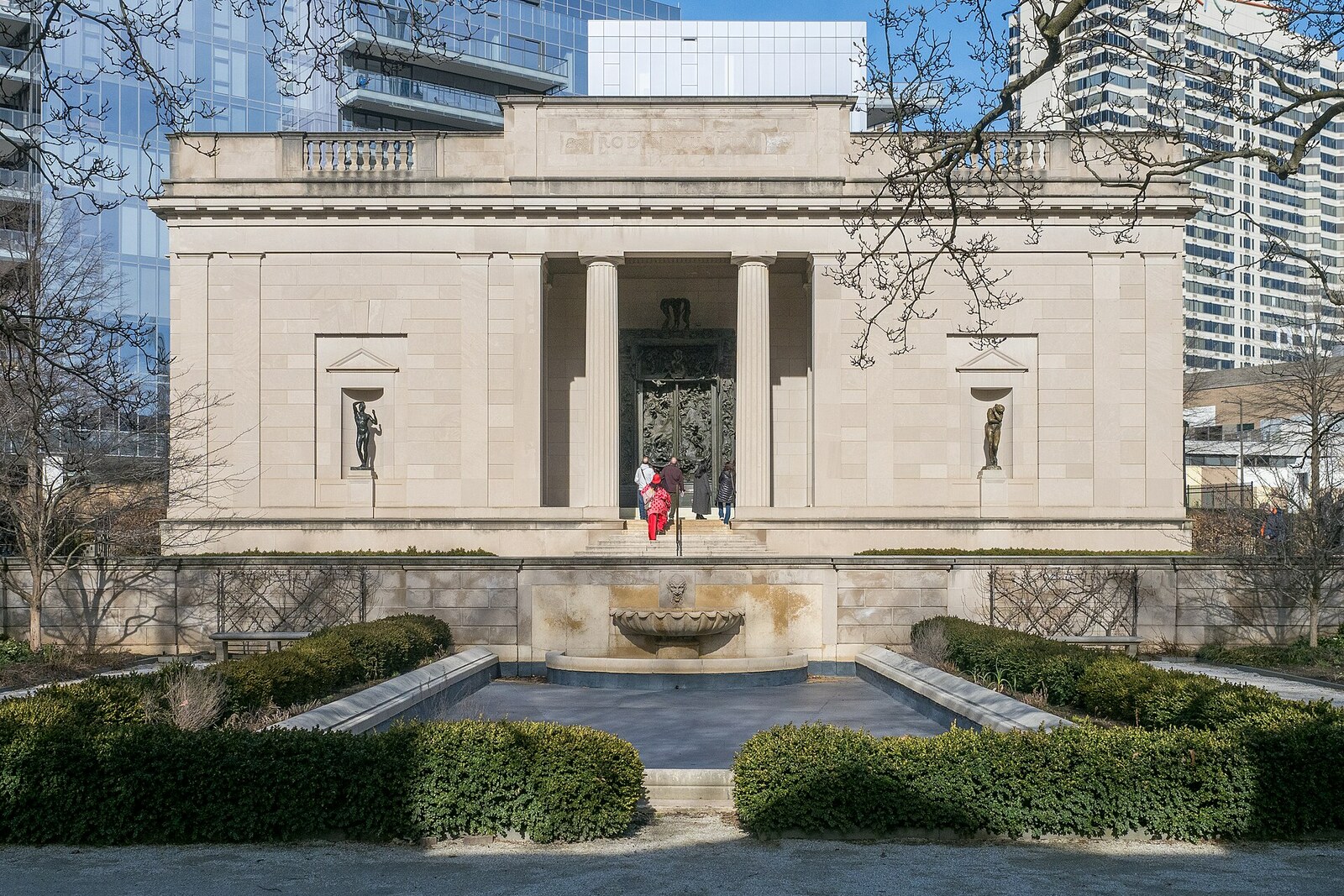
Look around first
What to notice
- The bronze The Thinker
- The bronze The Gates of Hell
- The entrance arch
- The garden
The story of the place
In the fall of nineteen twenty-four, Jules Mastbaum, owner of the country’s largest chain of movie theaters, came with his wife Etta to the Musée Rodin in Paris and bought his first bronze by Auguste Rodin. The French sculptor portrayed the human body without its customary formal smoothness: he left surfaces rough, heightened gesture and pose, and made the figure reveal fear, desire, or tension.
At first, Mastbaum intended to place the most recognizable works, including The Thinker, in the lobbies of his movie theaters. It was a familiar setting for him: he had made his fortune selling tickets and expanding his cinema chain. But within a few months, he decided to open a separate museum for the people of Philadelphia. Over two years, Mastbaum acquired more than one hundred fifty sculptures, as well as Rodin’s drawings, letters, and books.
Rodin himself had already died by then. He had bequeathed his works to the French state and authorized bronze casts to be made from the plaster models he left behind. That is why some of the bronzes here were made after the artist’s death, but according to the procedure he established and with the permission of the Musée Rodin.
Mastbaum’s principal commission was The Gates of Hell. Rodin worked on this enormous composition for thirty-seven years, but it was not cast in bronze during his lifetime. In nineteen twenty-five, Mastbaum paid for two copies: one for Philadelphia, the other for the Musée Rodin, which was then desperately short of money. The first bronze version of The Gates of Hell appeared precisely because of this commission.
For the future museum, Mastbaum turned to Jacques Gréber, the designer of the Benjamin Franklin Parkway. Gréber chose a site on the Benjamin Franklin Parkway and planned the garden, while the architect Paul Philippe Cret designed the building. That is how the collection came to be here, on the boulevard conceived with Paris in mind. The entrance arch repeats the facade that stood at Rodin’s estate in Meudon, and The Thinker was installed much as its French counterpart was installed by the sculptor’s grave.
On May twelfth, nineteen twenty-six, the city accepted Mastbaum’s offer. Under the original agreement, he intended to give Philadelphia the building while keeping the works in the family’s ownership. Negotiations had not yet ended when Mastbaum died in December, at the age of fifty-four, from complications after an appendectomy. Construction had not even begun.
Etta Mastbaum, who had taken part in that first trip to Paris, had to carry on. She changed the terms of the gift: she included both the building and the entire collection, secured the completion of construction, and transferred everything to the city on the condition that the city would maintain the museum. On November twenty-ninth, nineteen twenty-nine, Etta opened it together with her three daughters.
This agreement remains in force today: the building and the works belong to Philadelphia, while the Philadelphia Museum of Art manages the collection. The bronze The Gates of Hell at the entrance was Mastbaum’s commission; behind it is the collection that Etta refused to leave as family property.
Useful on site
Open Monday and Friday through Sunday 10:00-17:00; closed Tuesday, Wednesday, and Thursday. Suggested contribution: adults — 15 dollars, seniors — 14 dollars, students — 7 dollars, visitors under 18 — free.
Checked: June 29, 2026. Check the official source before visiting.The garden and outdoor sculptures make for a stop of their own if you are not going into the galleries. The remaining works require a separate museum visit; do not try to see the collection between crossings.