 Guide On Map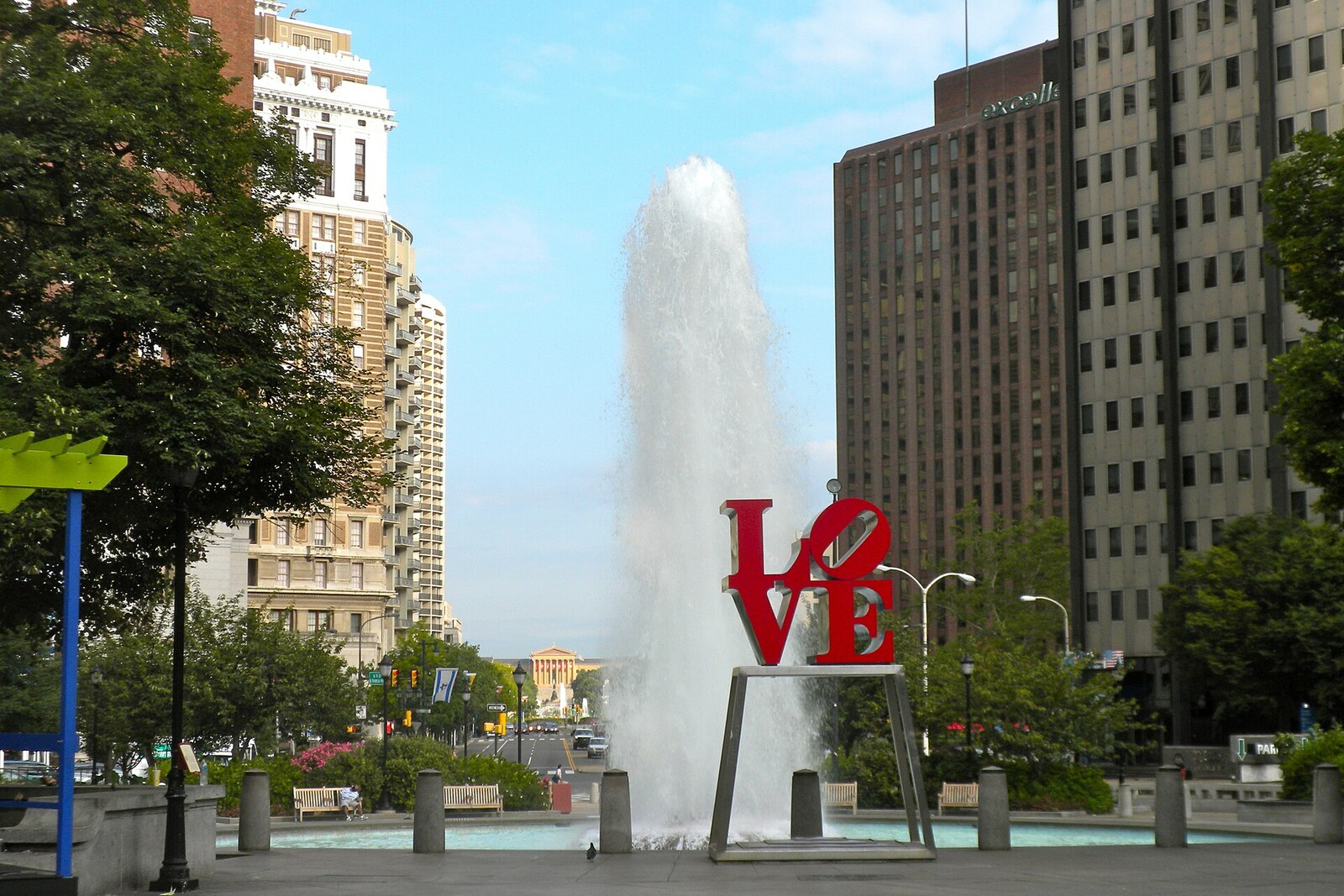
Look around first
What to notice
- Red sculpture of four letters
- Tilted rounded letter
- Plinth
- Oval fountain
The story of the place
The city officially calls the square by Philadelphia City Hall after John F. Kennedy, but its other name grew from Robert Indiana’s work. Four massive aluminum letters stand in two rows on a plinth; the rounded letter O is tilted, and an oval fountain is nearby. The sculpture arrived for the bicentennial of independence, and its red, green, and purple colors were restored later.
On Wednesdays from spring through fall, velvet ropes are set up in front of the red letters. The city gives couples half an hour, provides a ceremony coordinator, and they marry or renew their wedding vows here. On other days, lines wait in the same spot for photographs. This use of the square grew out of the story of a work Philadelphia once lost because of unpaid bills.
Officially, the park is called John F. Kennedy Plaza (LOVE Park), after the president of the United States who was assassinated in nineteen sixty-three. The square was dedicated to him four years later. The informal name “LOVE Park” came from Robert Indiana’s aluminum sculpture.
In the mid-nineteen sixties, Indiana compressed the English word “love” into four letters arranged in a square: two above and two below, with the rounded letter O tilted. The artist worked with words as independent images. The Museum of Modern Art in New York printed the design on a Christmas card, followed by posters, a postage stamp, and three-dimensional versions.
The sculpture came to Philadelphia in nineteen seventy-six, when the country celebrated the bicentennial of independence. Indiana lent it to the city, and the organizers placed the letters in the city’s main square beside Philadelphia City Hall. After the anniversary, the sculpture remained for another two years. Residents grew used to meeting by it and having their pictures taken against the word, especially fitting in Philadelphia, a city whose name translates as “brotherly love.”
But to the artist, it was a work for sale. His New York gallery believed the city intended to buy the sculpture; city employees believed the loan term had simply been extended. From June nineteen seventy-six through January of the following year, the gallery sent monthly bills to the authority created for the anniversary celebrations. No reply came, and then the authority closed.
For more than a year, the gallery director and Indiana’s representative, Rachel Chodorow, tried to arrange a purchase and even offered to help raise the money. The artist himself did not want to take the sculpture away: he believed its place had already been established in Philadelphia. But the city offered an amount that, according to the gallery, did not even cover fabrication, and officials refused to pay the requested forty-five thousand dollars. Another possible buyer was found in New York.
In April nineteen seventy-eight, a gallery truck arrived at night. By morning, nothing remained on the plinth. Newspapers demanded an explanation for why a familiar work had been allowed to be taken away. Joseph LaSala, the city representative occupied with preparing the budget, admitted that he had learned of the gallery’s ultimatum only three days earlier and had not managed to secure a decision.
Fitz Eugene Dixon Jr., owner of the Philadelphia 76ers basketball club and chair of the city’s arts commission, read these explanations. He called LaSala and ordered the sculpture brought back, promising to pay for the purchase from his own funds. The gallery agreed to thirty-five thousand dollars. Indiana was paid for the work, Dixon gave the sculpture to the city as a gift, and in May the letters were raised onto the plinth again.
For the reconstruction of the square in two thousand sixteen, the city used both names on its signs: Kennedy Plaza and LOVE Park. After restoration, the sculpture regained its original red, green, and purple colors—blue had appeared on it by mistake during earlier repaintings. The city now owns the work once taken away for nonpayment, and on Wednesdays ropes off space beneath it for wedding vows.
Useful on site
Open urban space. The visitor center, fountain, and events operate on their own seasonal schedules; check the city’s current announcements.
Checked: June 29, 2026. Check the official source before visiting.The sculpture is easy to see without entering anywhere, but people taking photographs often linger around it. Step aside to take in not only the word, but also its position on the city axis.