 Guide On Map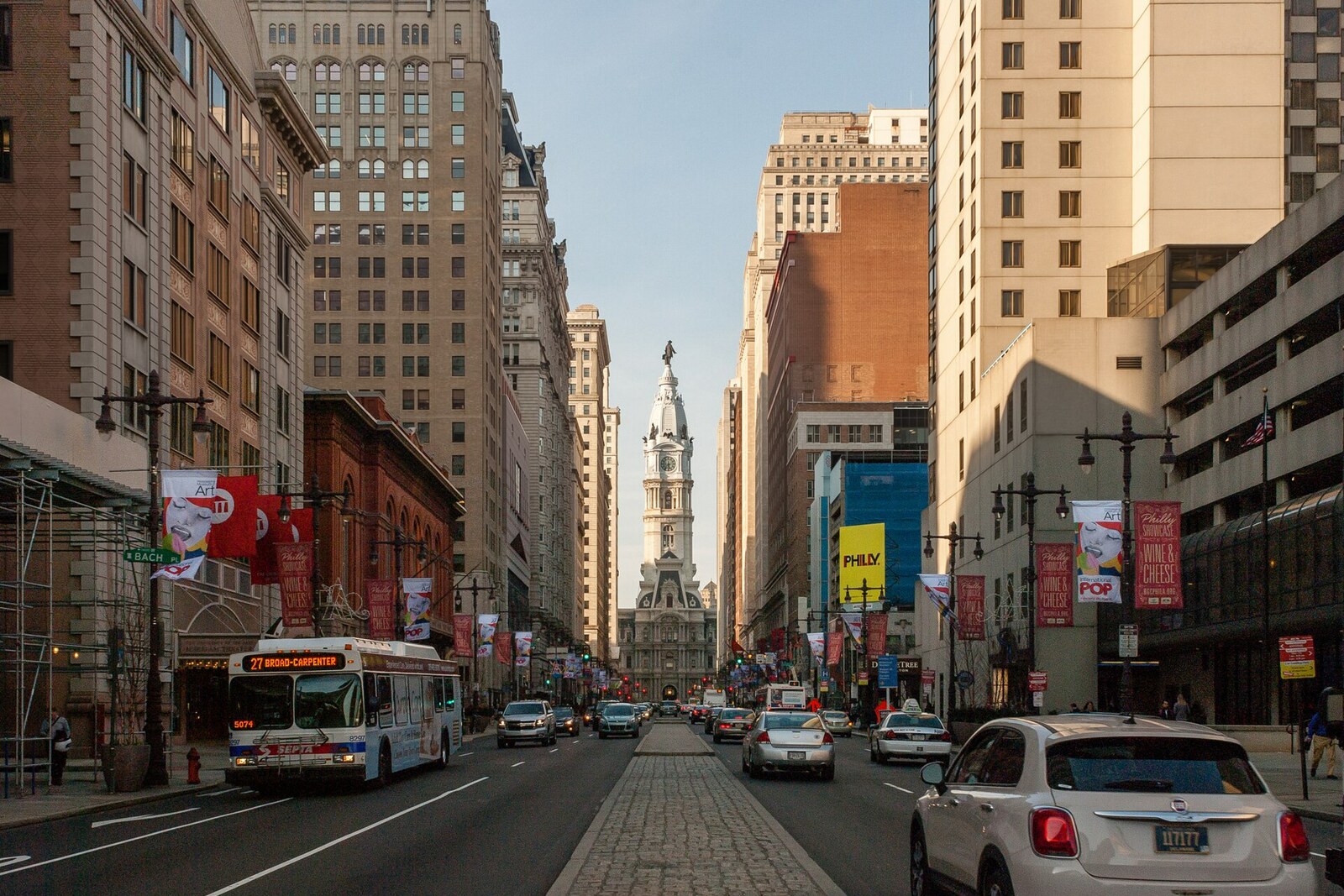
Look around first
What to notice
- The stone façade of Philadelphia City Hall
- The park fountain
- Glass entrances to the subway
The story of the place
The Dilworth name on the west side of Philadelphia City Hall belongs to Richardson Dilworth—a lawyer, district attorney, and mayor who sought a complete overhaul of city government. He wanted to demolish City Hall itself.
Dilworth came to politics from private legal practice: city positions had then been handed out for decades to supporters of the Republican Party organization. In nineteen forty-seven, he ran for mayor and, during the campaign, publicly named one hundred twenty-eight officials, ward leaders, and judges, stating the alleged amounts of their bribes. For a lawyer, this meant accusing by name people on whom contracts and appointments in the city depended. He lost the election by a wide margin.
After his speeches, the City Council created an investigative commission. A grand-jury investigation followed, and further revelations continued for several years. In nineteen fifty-one, residents approved a new city charter: a substantial share of appointments was moved to professional competitive selection, and departments were placed under a single manager. That same year, Dilworth's ally Joseph S. Clark Jr. became mayor, while Dilworth himself became district attorney. The nearly seventy-year dominance of the former party organization ended. Four years later, Dilworth won the mayoral election and moved into the building whose way of operating he had earlier tried to change from the outside.
Philadelphia City Hall came to stand here after Philadelphia merged with the county in eighteen fifty-four: the city's population immediately doubled, and the old municipal premises no longer had enough room. In eighteen seventy-one, residents voted to select Penn Square—the former Centre Square at the intersection of Broad Street and Market Street—for the new building. By the middle of the twentieth century, the huge stone structure was considered outdated and inconvenient for traffic. Dilworth, who was redesigning transportation and the city center, supported replacing it with a modern complex.
The calculations stopped that project. City Hall's masonry is more than six meters thick in places; dismantling it would have cost about as much as new construction. Architects spoke out against destroying the building. Dilworth got as far as a prepared demolition contract, but refused to sign it. City Hall remained, and he finished his work as mayor in nineteen sixty-two.
The City Council gave the western square his name for his reforms and the renewal of the city center. When the former sunken square was replaced by the present park in nineteen fourteen, the dedication was retained. The surface was raised to sidewalk level, a fountain was built that becomes an ice rink in winter, and glass entrances to the subway and trolleys were opened. Beneath the park, the transit lines converge; Dilworth had sought their transfer from private hands while serving as mayor, and that work was completed only after he left office.
His name now appears above the entrances to the trains, and just beyond them stands Philadelphia City Hall, whose demolition contract he left unsigned.
Useful on site
Dilworth Park is open daily 06:00-01:00. The fountain usually operates from April through October, and the ice rink from mid-November through the end of February. Tours of the City Hall tower run on weekdays 10:00-14:45, depend on the weather, and are not suitable for wheelchairs.
Checked: June 29, 2026. Check the official source before visiting.View the square from several sides: the Octavius V. Catto Memorial is at pedestrian level, while the details of Philadelphia City Hall require stepping farther back and looking up. The surface near the fountains may be wet.