 Guide On Map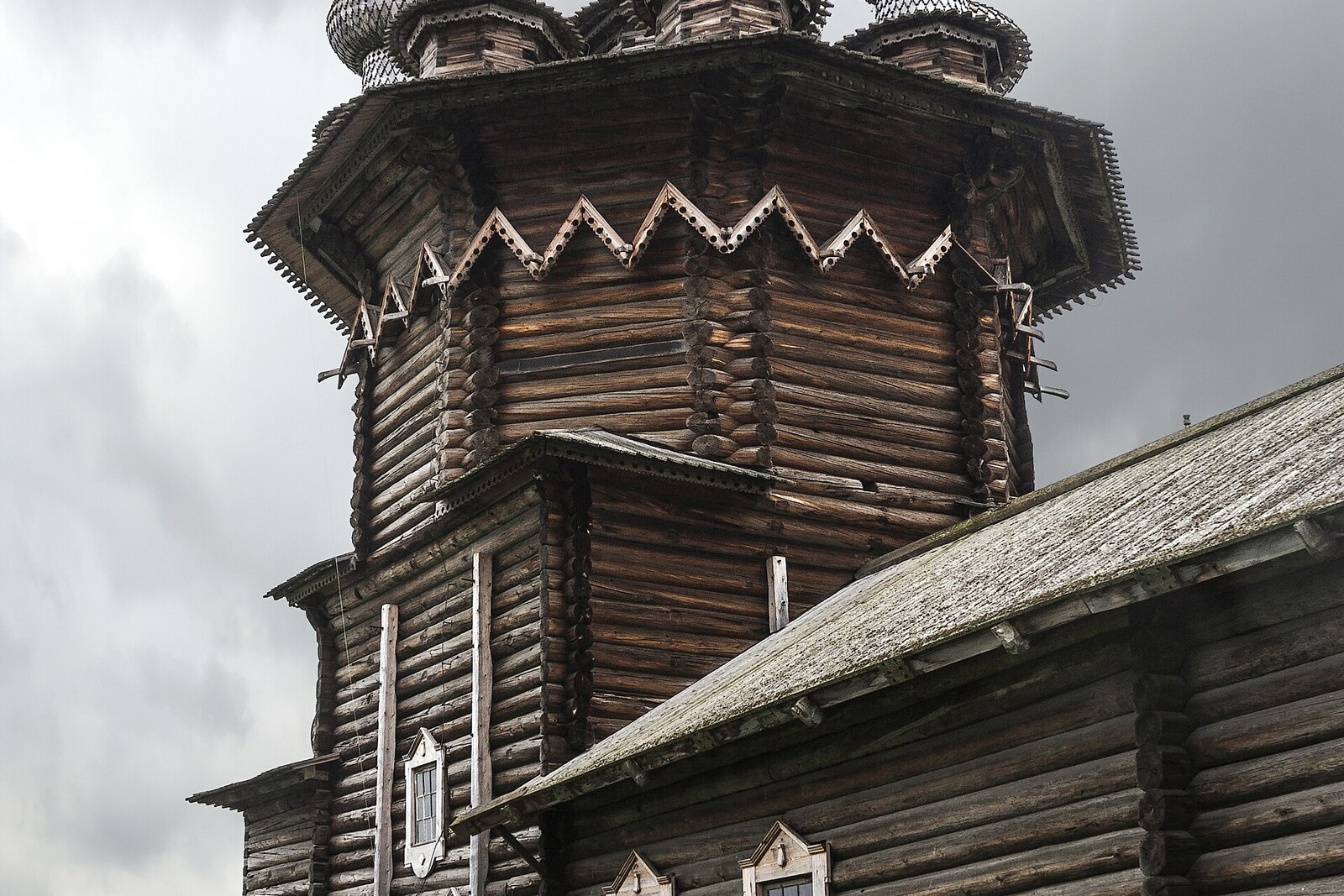
Look around first
What to notice
- Iconostasis
- Royal Doors
- The icon Savior All-Merciful to the right of the Royal Doors
The story of the place
Inside the Church of the Intercession, the altar area is separated by an iconostasis, a wall of sacred images. The Royal Doors open in its center, and Savior All-Merciful stands to their right among the other icons. This image was painted as early as the sixteenth century and returned here after a long absence, taking its place in the present iconostasis.
The Church of the Intercession was the winter church of the Kizhi parish. Services were held in the Church of the Transfiguration from Easter until October fourteenth, and then they moved here, to the building with stoves. During the cold months, farmers and fishermen from the surrounding villages gathered here. That is why, after a fire destroyed both old churches in sixteen ninety-three or sixteen ninety-four, they began by rebuilding the warm Church of the Intercession. Until the Church of the Transfiguration was completed twenty years later, the Church of the Intercession remained the main church of Kizhi Pogost.
The Intercession is an Orthodox feast that falls on October fourteenth. According to church tradition, during a service in Constantinople, the Mother of God appeared to those at prayer and spread her veil over them, as a sign of protection. At Kizhi Island, the feast day coincided with the parish's move under the roof of its winter church.
Inside was a sacred image for which the Kizhi watchman probably once substituted a copy for the original. The icon Savior All-Merciful was painted as early as the sixteenth century and came from the former Church of the Intercession, which had burned down after being struck by lightning. In the nineteenth century, the original stood in the warm St. Nicholas Side Chapel, while a richly decorated copy, an exact reproduction of the venerated image, was made for the summer Church of the Transfiguration.
In nineteen forty-three, the Finnish art historian Lars Pettersson described the Kizhi icons and marked them before their removal to Finland. Each church had its own number, so it was later possible to establish where a particular image had been taken from. One important detail survived in his records: in March, the Kizhi carpenter Nikita Grigoryevich Manshin, then serving as the watchman of Kizhi Pogost, transported Savior All-Merciful from here to the church in Velikaya Guba.
The watchman had access to the closed churches and was responsible for their property. When the removal began, the copy from the Church of the Transfiguration ended up in Finland. After the war, it was returned to Petrozavodsk together with other icons. The original disappeared. It bore none of Pettersson's evacuation numbers, which means it did not pass through the Finnish inventory.
In nineteen seventy-two, among items removed from the attic of the Church of the Intercession and stacked in a museum barn, staff members discovered an old icon. Research showed that it was the original Savior All-Merciful. No document exists in which Manshin confessed to the substitution. Researchers consider it the most likely explanation: the watchman removed the ancient icon from the inventory and left a copy in its place.
In nineteen seventy-three, the found image was installed in the present iconostasis, to the right of the Royal Doors. That is where the icon that disappeared during the war is now located; the copy returned from Finland is kept in the museum collection.
Useful on site
The museum grounds are open year-round: 01.11–30.04 10:00–16:00; 01.05–11.05 10:00–18:00; 12.05–31.08 08:00–19:00; 01.09–30.09 10:00–17:00; 01.10–31.10 10:00–16:00. The basic ticket usually includes the interior of the Church of the Intercession, but actual access depends on the museum's routing and the selected product.
Checked: June 24, 2026. Check the official source before visiting.Do not expect to see the service inscriptions on the backs of the icons: they may be inaccessible to visitors. If the church is closed, compare its volume and windows with those of the summer church.