 Guide On Map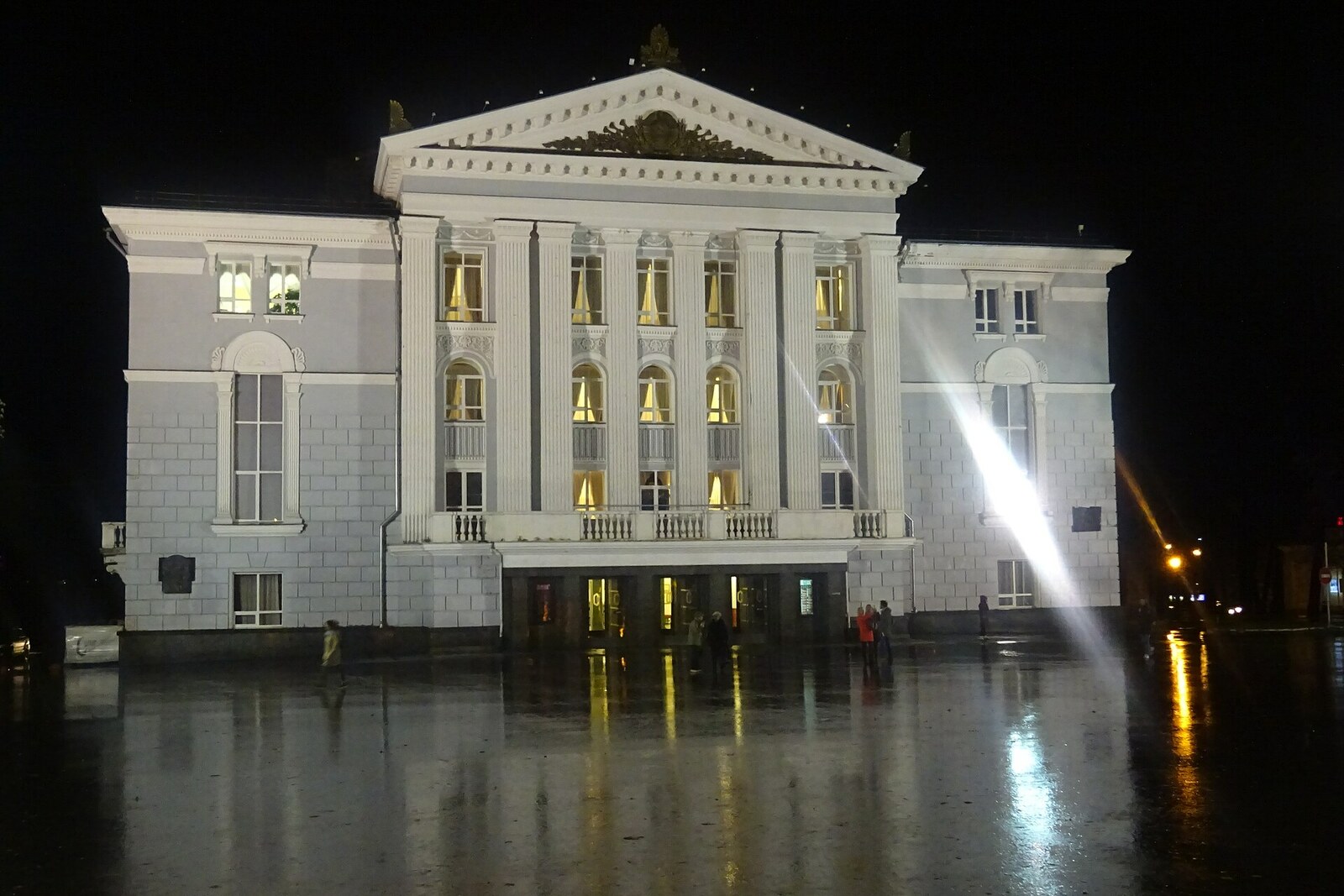
Look around first
What to notice
- The theatre’s main facade
- The auditorium
- The stage opening
The story of the place
The name on the theatre’s main facade was given when the Perm troupe had already staged all three of Tchaikovsky’s ballets and most of his completed operas. Later, this stage hosted the complete cycle of his musical theatre. During reconstruction, new rooms were built around the old building, but the stage volume itself was kept unchanged. Behind the present facade remains the historic space, framed by later theatre spaces.
In January nineteen forty-two, the composer Aram Khachaturian was living in evacuation in the Urals, without work. His family lacked food and warm clothing. In a letter to his brother, he admitted: “Nobody needs me.” A month later, Khachaturian was summoned to Molotov. The Kirov Theatre, evacuated from Leningrad—today’s Mariinsky Theatre—had occupied the building of the Perm Opera and Ballet Theatre and was planning to stage his ballet.
Before the war, Khachaturian had written the ballet Happiness, but now the composer was almost completely reworking the music for a new production, Gayane. The theatre put him up at the nearby Tsentralnaya Hotel, placed a piano in his room, provided meals, and gave him an assistant. Over six months, Khachaturian wrote about seven hundred pages of score. Meanwhile, the choreographer Nina Anisimova was rehearsing the production on this stage with the Leningrad troupe.
Shortly before the premiere, the theatre director demanded that another dance be added to the final act. Khachaturian refused: the score was finished, only a few days remained before the premiere, and the composer’s ulcer had worsened. Yet when he returned to the hotel, he sat down at the piano. He began work at three o’clock in the afternoon and finished at two o’clock at night. On the title page, he left an irritated note: “Damn it, for the sake of the ballet!”
The music was brought here in the morning. The number, initially called Kurdish Dance, was first performed on the stage of the Perm Opera and Ballet Theatre; by evening, Anisimova had created the choreography, and a dress rehearsal took place another day later. On December ninth, nineteen forty-two, the Leningrad artists gave the premiere of Gayane. The dance Khachaturian had not wanted to write became known to the public as Sabre Dance.
A few months later, Khachaturian received the first-degree Stalin Prize for Gayane—one hundred thousand rubles—and gave the money to the defense fund. In the late nineteen forties, Sabre Dance became an international hit and began to eclipse his other works. Khachaturian himself was angered by this: abroad, he was presented almost as the composer of a single melody.
The name on the facade belongs to another composer. Pyotr Ilyich Tchaikovsky, a native of Votkinsk in the Kama region, did not work here. The theatre was given his name in nineteen sixty-five: by then, the Perm troupe had already staged all three of Tchaikovsky’s ballets and most of his completed operas. The chief director Iosif Keller decided that one sign was not enough and secured productions of the remaining operas. As a result, all three ballets and all eight of the composer’s completed operas were performed on this stage in different years.
The sets from the first Gayane have not survived. During the reconstruction of the nineteen fifties, new rooms were built around the old building, while the dimensions of the historic stage were left unchanged. Behind the present facade is the same stage volume where Sabre Dance was first performed and where Tchaikovsky’s complete theatrical cycle was later completed.
Useful on site
Performances—according to the playbill; the box office and services operate according to the theatre’s current schedule, and it is best to buy tickets in advance.
Checked: June 24, 2026. Check the official source before visiting.A performance or tour requires separate planning, but the story of this stop can also be followed from outside. During performances, do not linger near service entrances or audience passageways.