 Guide On Map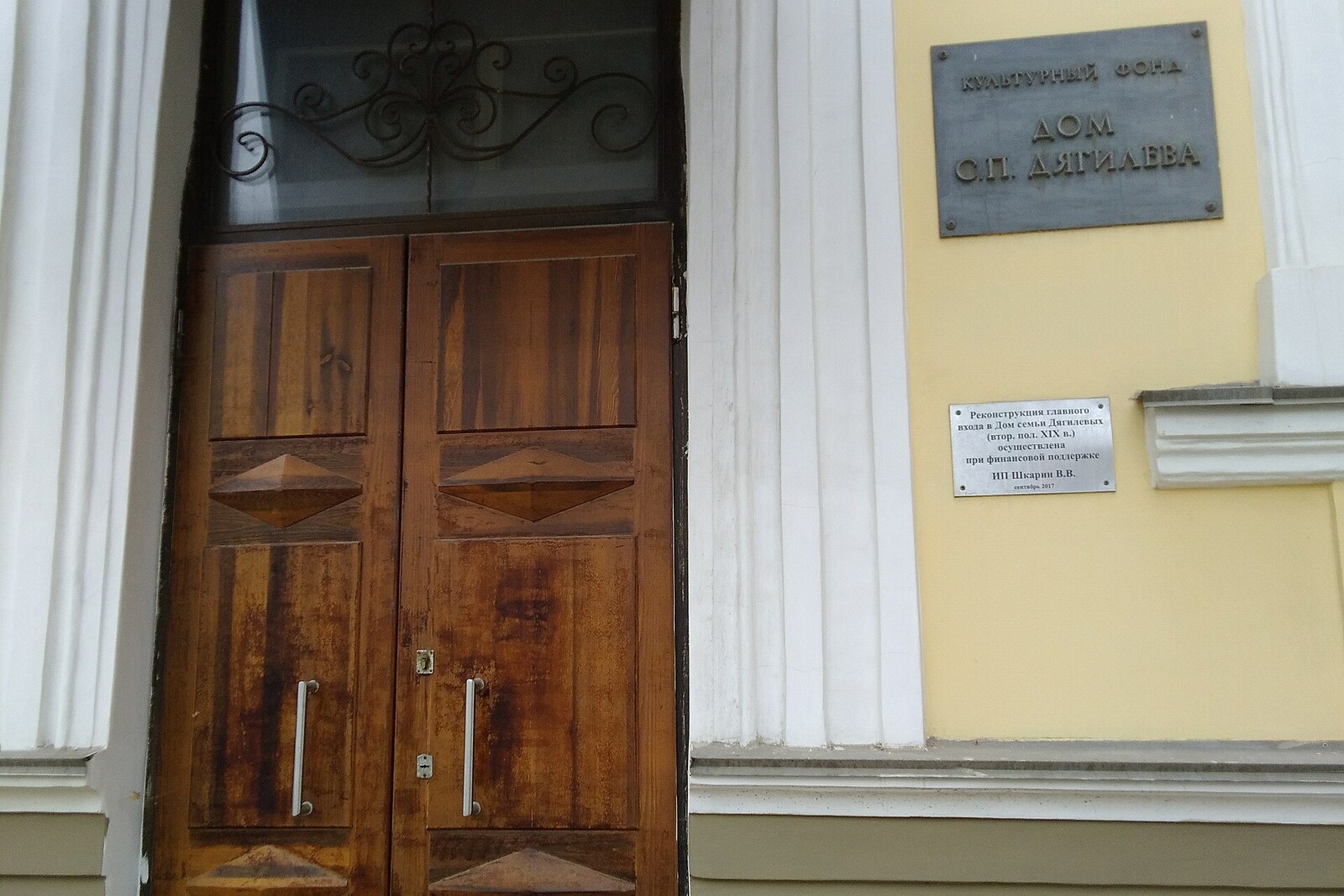
Look around first
What to notice
- Old facade
- Gymnasium wing
- High hall of the former courtyard
- Diaghilev monument
The story of the place
The old facade conceals a house where gymnasium classrooms and museum rooms coexist. When the mansion was a residence, it had thirty rooms, while a wing and stables stood in the courtyard and a garden grew there. Later, a roof was raised over the courtyard to create a high hall, and a classroom wing was added. Even before school classes began here, amateurs of chamber and operatic music gathered here together with visiting performers.
Sergei Diaghilev came to this house because of his father's debt. His father, Pavel Pavlovich Diaghilev, served as a colonel in the privileged Cavalier Guard Regiment, hoped to receive a unit of his own to command, and lived on an officer's salary. But he borrowed from moneylenders, renewed promissory notes at new interest rates, and eventually owed nearly two hundred thousand rubles. The creditors could then have destroyed both his career and the family's accustomed way of life.
Sergei's grandfather, the Perm distiller Pavel Dmitrievich Diaghilev, agreed to pay his son's debts, but set a condition: Pavel Pavlovich had to leave the Cavalier Guard Regiment and move his family from St Petersburg to Perm, where life cost less. Pavel Pavlovich found a way not to leave military service—he received the post of commander of the local reserve battalion. In the early eighteen eighties, he settled with his wife and three sons in his father's house on Sibirskaya Street.
The house was designed for a large family: thirty rooms, a wing, a courtyard, stables, and a garden. Income from the Diaghilevs' land and distilleries made it possible to maintain all this. Sergei's birth mother died after childbirth. He was raised by his father's second wife, Elena Valeryanovna; all his life, the stepson called her Mom. She sang, recited, and made sure the children studied music seriously.
By the time Sergei arrived, the house already had its own undertaking. In eighteen seventy-four, his uncle Ivan Pavlovich Diaghilev, a lawyer and musician, founded the Perm Music Circle. He wanted to perform demanding chamber and operatic music in the city, which lacked both permanent professional ensembles and a music school. Ivan gathered amateurs, invited touring performers, and rehearsed their parts with them. Rehearsals took place here, in the rooms of the Diaghilev mansion.
When Ivan had to leave for the family estate of Bikbarda and give up the Circle, Pavel Pavlovich took his place. He conducted the choir and sang, Elena Valeryanovna performed solo parts, and Sergei accompanied his parents on the piano. On Thursdays, musicians, artists, and educated townspeople came to the house. From here, the Circle's participants went on to public benefit concerts; once the choir grew to one hundred fifteen people, and more people wanted to enter the hall than there were seats. The nickname the Perm Athens referred specifically to these gatherings, not to the triangular cornices above the windows.
For Sergei, art here was a collective undertaking from the very beginning. It required finding performers, bringing professionals and amateurs together, holding rehearsals, obtaining a venue, and gathering an audience. After Perm Gymnasium, he left for St Petersburg, studied law, and tried composing music, but chose another profession—he became an impresario, a person who brings artists together and creates a project for them, finds money, a stage, and an audience. Diaghilev organized art exhibitions, published the magazine World of Art, and then brought Russian painting, music, opera, and ballet to Europe. His Ballets Russes brought composers, artists, choreographers, and dancers together in one performance—just as the Diaghilevs had previously brought different performers together in the rooms of this house.
The family's debts eventually caught up with the mansion itself. In eighteen ninety-one, the Diaghilevs' property began to be sold off, and the owners left. The city planned to place a bank here, but in eighteen ninety-four handed the rooms over to a girls' progymnasium. The inner courtyard was roofed over and turned into a high hall, and a classroom wing was added later. Since then, children have studied in the house continuously.
In the nineteen eighties, the building was slated for demolition. The school principal, Raisa Zobacheva, pressed for repairs and, together with the teachers, began collecting the family's documents and belongings. In nineteen eighty-seven, several school display stands became a museum; the collection was then expanded with items from the Diaghilevs' former estates, theater programs, and photographs. The school was named after Sergei Diaghilev.
Gymnasium classrooms still stand behind the old facade. The museum occupies some of the rooms, and the hall contains a monument to Diaghilev by Ernst Neizvestny. The house has retained the surname of a man who had not yet staged ballets or managed a company here: here he sat at the family grand piano while his father conducted and his stepmother sang.
Useful on site
Access inside is irregular: the museum is located in a gymnasium building, so it is best to confirm a visit in advance; exterior viewing is available from the street.
Checked: June 24, 2026. Check the official source before visiting.A school operates in the building, and a museum visit should not be considered freely accessible: arrange it in advance. Without an appointment, view the house from outside without disturbing students and staff.