 Guide On Map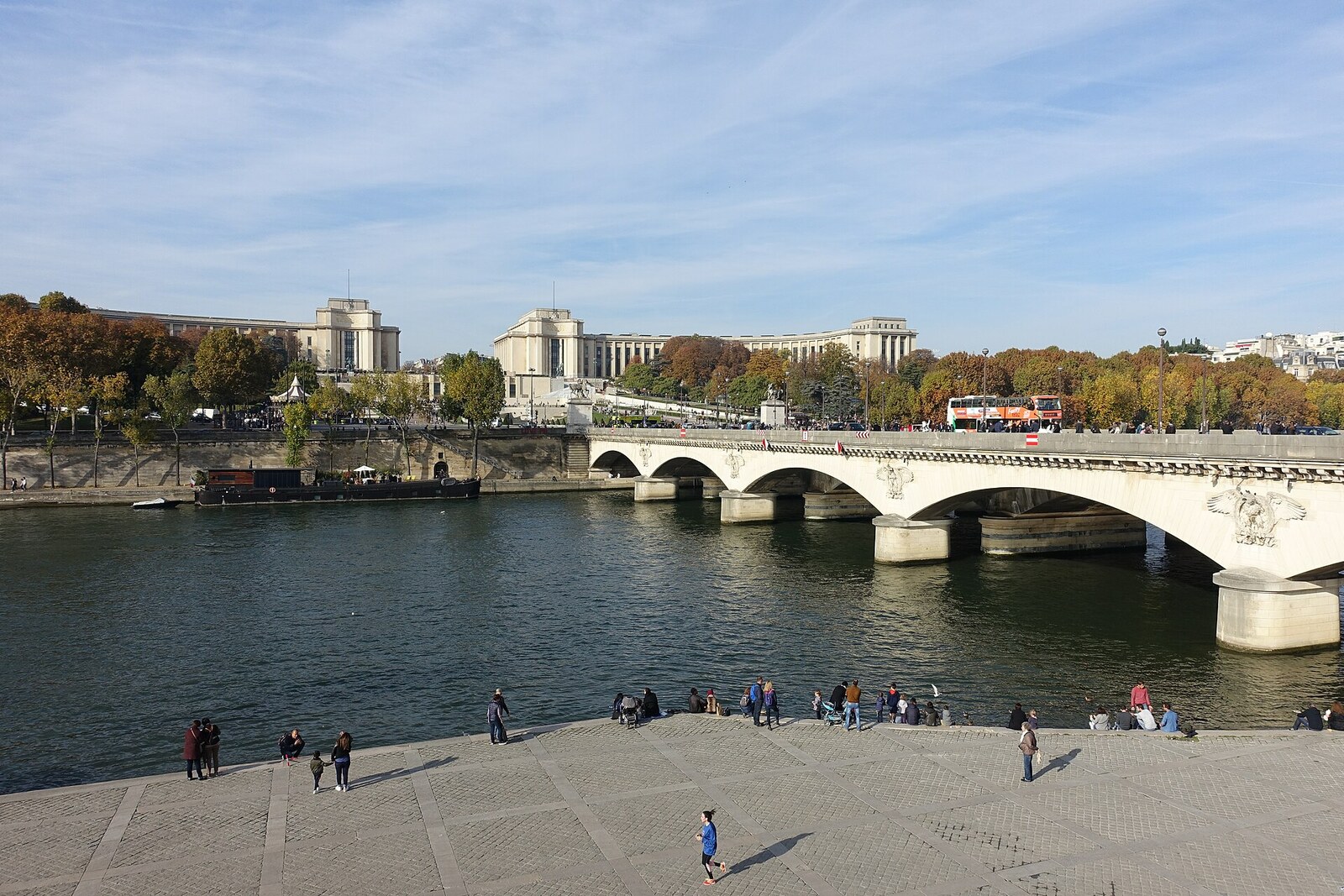
Look around first
What to notice
- Stone arches
- Imperial eagles
- Seine
- Eiffel Tower
The story of the place
Pont d’Iéna links Chaillot Hill with the Champ de Mars. When construction began, the Eiffel Tower did not yet exist: on the left bank, a straight road led across the field to the École Militaire. The future crossing was proposed to be named the Champ de Mars Bridge or the École Militaire Bridge. Napoleon I chose the name of his victory for it.
Jena is a city in German Thuringia. On October fourteenth, eighteen oh six, the French army routed Prussian-Saxon troops there. That same day, the main Prussian army was defeated at nearby Auerstedt. The French entered Berlin, and Prussian fortresses and corps capitulated one after another.
The Prussian cavalry general Gebhard Leberecht von Blücher tried to lead the surviving units to the Baltic Sea. He was pursued to Lübeck, where he was forced to surrender. Two months later, Napoleon signed a decree in Warsaw: the bridge being built opposite the Champ de Mars would be called the Jena Bridge. Its stone arches were laid in eighteen oh eight and completed by eighteen fourteen.
In the summer of eighteen fifteen, Blücher returned to Paris as a field marshal and commander of the Prussian army that took part in Napoleon's final defeat at Waterloo. Here he was met by the new crossing, named after an earlier Prussian defeat. Blücher ordered sappers to place mines in the lower parts of the piers.
The French diplomat Talleyrand invoked a term of Paris's capitulation that promised to preserve city property. The British commander, the Duke of Wellington, Blücher's recent ally at Waterloo, asked him three times to postpone the demolition. Blücher refused. He wrote explicitly that destroying the bridge had become a national matter and that backing down would bring him reproaches from the Prussian army and the country.
On July tenth, the sappers detonated three charges. They chipped part of a pier, cracked several stones, and threw one sapper into the Seine, but the arches held. The military began preparing a new mine. That same day, the Prussian king Frederick William III and the Russian emperor Alexander I arrived in Paris. The king demanded that the work stop, and Alexander declared that he would not allow the destruction of Parisian monuments. Blücher yielded.
The bridge was preserved, but the name “Jena” was removed. It was renamed the École Militaire Bridge, and the imperial eagles on the arches were replaced by the royal letter “L.” In eighteen thirty, the former name was restored. In eighteen fifty-two, new eagles by the sculptor Antoine-Louis Barye appeared in place of the letters—the very ones on the sides of the arches.
In nineteen thirty-seven, engineers widened the crossing by adding concrete arches on both sides. The stone center, beneath which Blücher's sappers had placed mines, remained in its place.
Useful on site
Open city bridge; temporary restrictions on traffic, bicycle flow, or access are possible during events and security measures.
Checked: June 28, 2026. Check the official source before visiting.Listen on the pedestrian section without blocking the way; the structural details are easier to examine closer to the bank.