 Guide On Map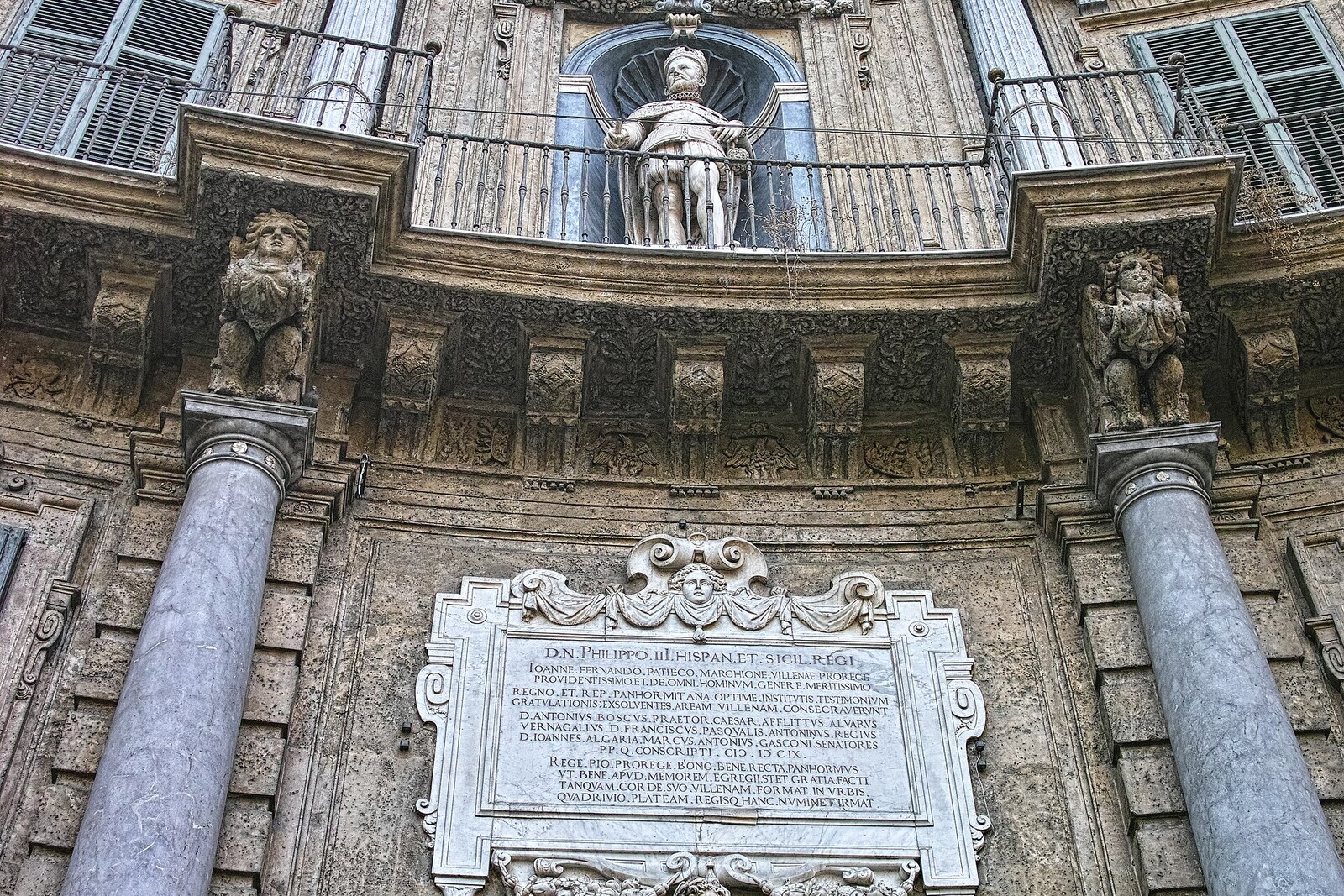
Look around first
What to notice
- Four concave façades
- Fountains
- Statues of the seasons
- Statues of Spanish kings
The story of the place
Via Maqueda crosses the former Cassaro here, now Corso Vittorio Emanuele, and divides Palermo's old center into four districts. Above the fountains, the tiers rise from the seasons to Spanish kings and the female patron saints of the districts. This exterior decoration of the new city hub was commissioned after the senate laid Via Maqueda across the old street.
The corners of the four buildings at this intersection have been cut off. Stonemasons turned the cuts into concave façades with fountains and statues. These façades make up Quattro Canti—“the four corners.” The space between them is officially called Piazza Vigliena.
In sixteen hundred, the city senate laid Via Maqueda across the old Cassaro, now Corso Vittorio Emanuele. The new intersection divided Palermo's historic center into four districts. Eight years later, the Spanish viceroy of Sicily, Juan Fernández Pacheco, Marquis of Villena, commissioned the architect Giulio Lasso to design this place. The patron's title remained in the official name, while the townspeople named the square after its four façades. At the bottom of each is one of the seasons, above it a Spanish king, and at the top a female patron saint of the district that begins beyond that corner.
The four districts converged here, and city organizers held events meant for the public in the center of the intersection. An old Palermo saying listed them without embellishment: “festivals and gallows at Piazza Vigliena.”
On July thirtieth, seventeen eighty-nine, Giovanna Bonanno, a seventy-five-year-old widow and beggar known as The Old Vinegar Lady, was hanged here. Alms kept her fed, while her reputation as a witch brought her clients. Bonanno learned that a lotion made by the pharmacist Saverio La Monica against lice contained arsenic and could kill if swallowed. She began buying the preparation and selling it to women as “the secret vinegar drink,” a way to get rid of a husband.
The investigation linked six poisonings to this trade. A lengthy record of Bonanno's testimony from October ninth, seventeen eighty-eight, survives: she herself told the judges where she had obtained the liquid and what she sold it for. Intermediaries and buyers were tried alongside her. On April thirtieth of the following year, the judges sentenced Bonanno to death and separately specified the place of execution: a high scaffold was to be erected at the Piazza Vigliena intersection. The appeal was rejected on July twenty-seventh; three days later, the sentence was carried out.
Nothing remains of the scaffold. It stood at the exact point where Via Maqueda and the former Cassaro intersect, between the same four concave façades.
Useful on site
Open urban space with no ticketing system.
Checked: June 24, 2026. Check the official source before visiting.This is an active intersection: view the façades one at a time from a safe edge and watch the traffic.