 Guide On Map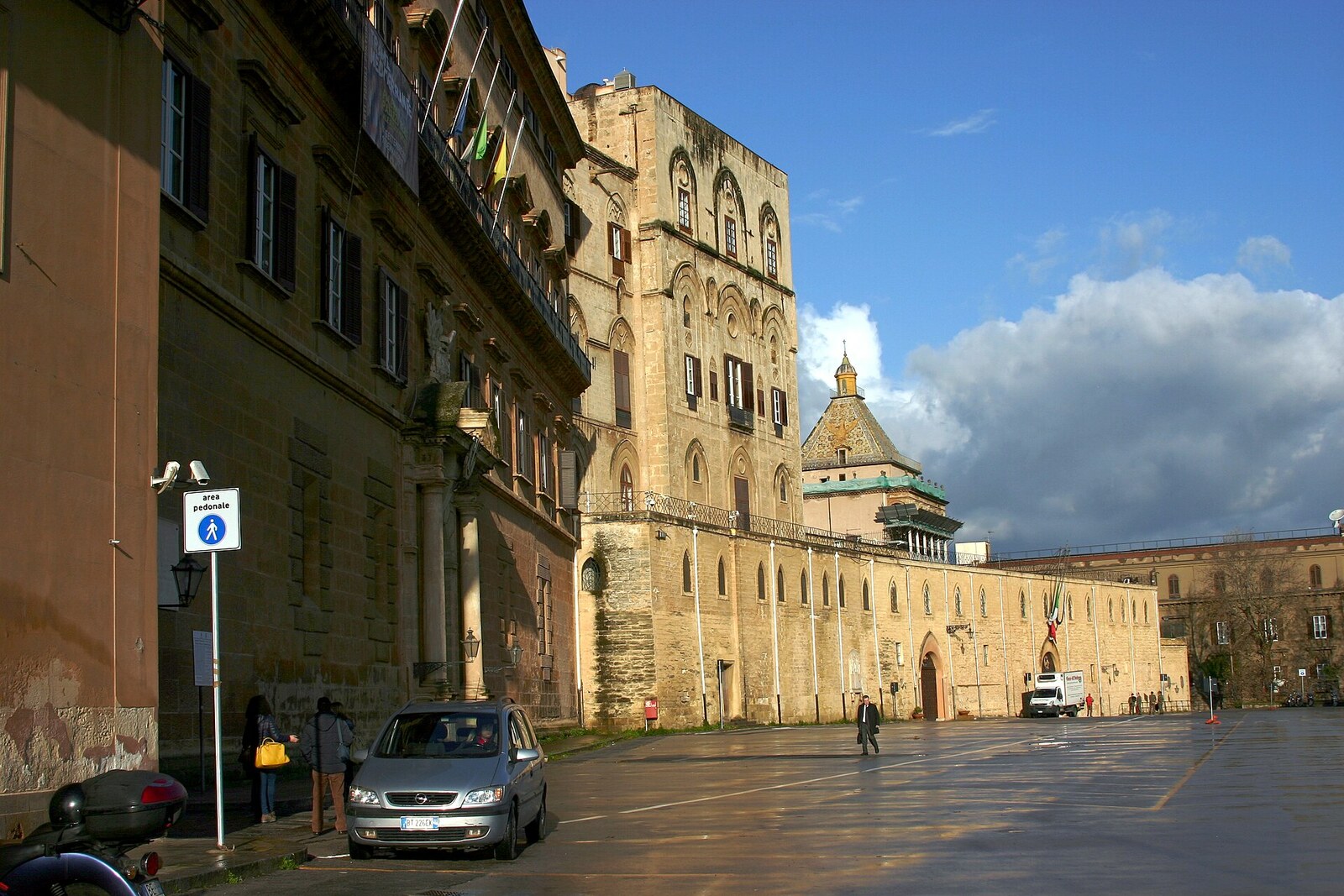
Look around first
What to notice
- Maqueda Courtyard
- Pisan Tower
- Joaria Tower
The story of the place
The present open courtyard was built in sixteen hundred, after the viceroys had dismantled a large share of the old structures. The Pisan Tower and Joaria Tower remain at its edges, solitary surviving parts of what was once a belt of towers. This residence housed the treasury, archive, and mint; silk was woven here, advisers lived here, and prisoners were held here.
The Normans were descendants of people from northern France who conquered Sicily in the eleventh century. They took Palermo in ten seventy-two. An Arab qasr—a fortress that protected Palermo from the landward side—already stood on the highest part of the city. Roger II, the first king of Sicily, turned it into a residence that housed his family, advisers, treasury, archive, mint, silk workshops, and prison. This rebuilding gave it its present name: the Norman Palace.
On March ninth, eleven sixty-one, the prison helped seize everything else. The conspirators were planning to overthrow Roger's son, King William I. They were led by two royal relatives. Simon of Taranto, Roger II's illegitimate son, sought the return of the Principality of Taranto, which William had taken from him after ascending the throne. Tancred, Roger's illegitimate grandson, had grown up in the palace and knew its passageways; the king had previously held him prisoner here for taking part in a rebellion.
They had an accomplice inside: a palace official in charge of political prisoners. He opened the cells, released the prisoners, and handed out weapons to them. Simon led this group through familiar corridors. William, Queen Margaret of Navarre, and their children were caught in the palace and locked up as prisoners themselves. The attackers looted the chambers and scattered the state documents kept here. Muslim courtiers, including treasurers, officials, and eunuchs in royal service, were killed during the takeover itself. The violence then spread beyond the palace and turned into pogroms against Palermo's Muslims.
They wanted to replace the king with his nine-year-old son Roger, son of William I. The boy was declared the new ruler, but the conspirators immediately began arguing over who would actually make decisions for the child. Meanwhile, the townspeople and the high clergy demanded William's release. An armed crowd gathered at the palace, and the rebels realized that they could not hold out.
Little Roger died during the retreat. The sources agree on the fact of his death but differ over its cause. According to one version, the boy was struck by a stray arrow. A chronicler hostile to William claimed that the king himself beat his son to death. It is impossible to establish this reliably. A few days later, the father buried the child whom the conspirators had managed to proclaim in his place.
Simon of Taranto and Tancred left the palace and took refuge in Caccamo Castle. In exchange for ending the rebellion, they were allowed to leave the kingdom. William first pardoned Matteo Bonello, the organizer of the conspiracy, then lured him back to court and ordered him blinded and his tendons cut. Bonello soon died, and his estates were confiscated. Tancred survived exile, returned to Sicily, and, almost thirty years later, did become king—after the death of William's legitimate heirs.
The corridors through which Simon led the armed prisoners no longer exist: later viceroys demolished a substantial part of the Norman buildings. The present Maqueda Courtyard did not appear until sixteen hundred. The Pisan Tower and Joaria Tower survive from the former system of towers. The royal archive, ransacked on the morning of March ninth, has not survived.
Useful on site
Daily; Mon–Sat from 08:30, last entry at 16:30; Sun and holidays from 08:30, last entry at 12:30.
Checked: June 24, 2026. Check the official source before visiting.Do not judge the palace only by its exterior volume: the meaning of this stop emerges through the sequence of interior spaces.