 Guide On Map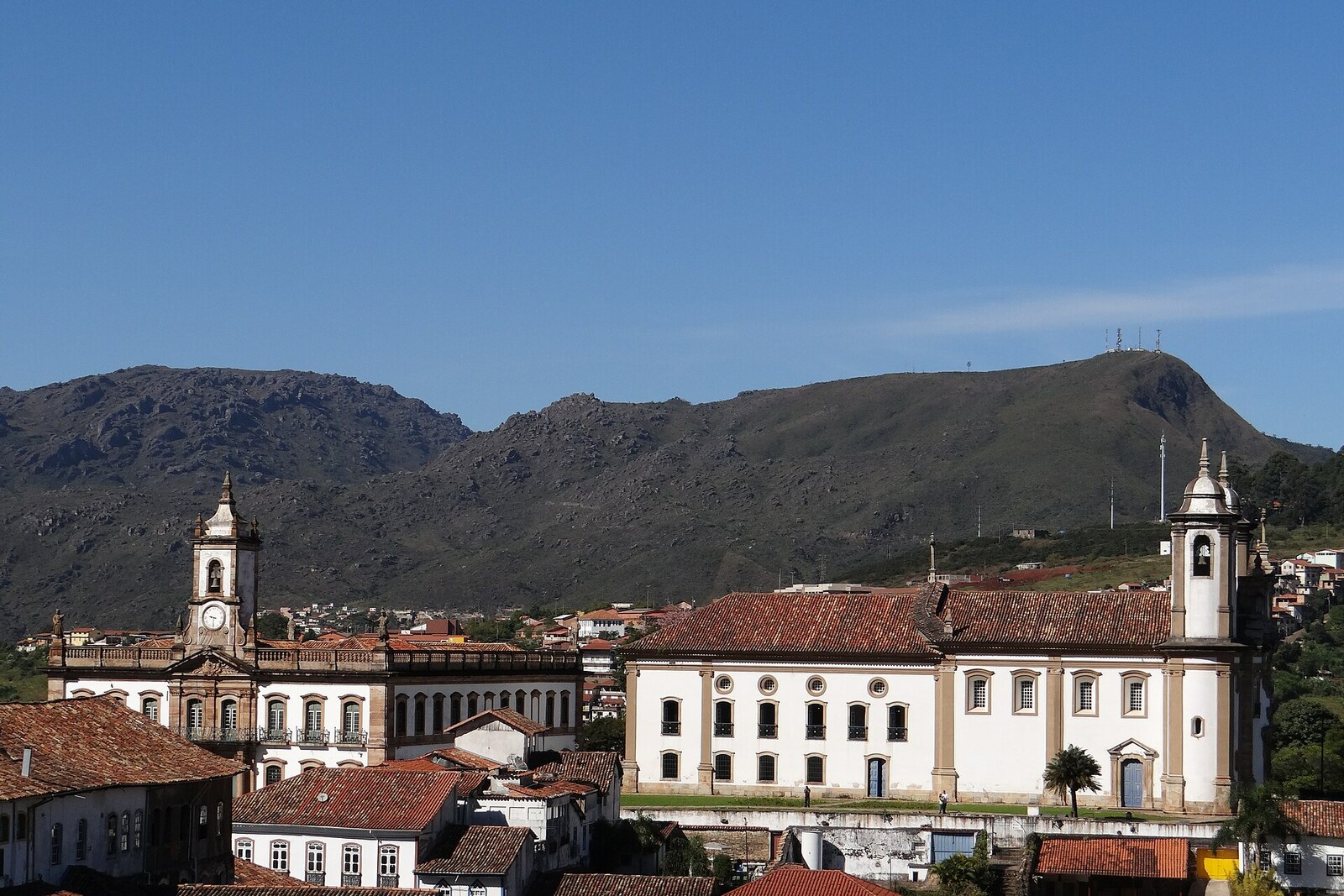
Look around first
What to notice
- Bronze statue
- Granite column
- Palácio dos Governadores
- Façade of the Museu da Inconfidência
The story of the place
The square lies on Morro de Santa Quitéria, which once divided two mining settlements that grew into Ouro Preto. The main roads of the gold province converged through it, so the royal court chose this open site for its main square. On one side of the hill stood the Palácio dos Governadores; on the other, a town hall with a jail was being built. The city's busiest route ran between the authorities and the roads. Above the square rises a granite column nineteen meters tall.
The bronze figure in the center of the square appeared one hundred two years after the severed head of that same man was raised here on a tall pole.
In seventeen ninety-two, Ouro Preto was called Vila Rica—“Rich City”—and the square was still Morro de Santa Quitéria. The hill divided two mining settlements from which the city grew; the main roads converged here. At one end, the Palácio dos Governadores already stood; at the other, a town hall with a jail was being built. The royal court chose the busiest and most conspicuous site in the capital of the gold province.
The man's name was Joaquim José da Silva Xavier. He served as an alferes, a junior cavalry officer, and patrolled the road along which gold was carried to the coast. His military pay gave him a steady income; in addition, he treated and pulled teeth. Hence the nickname Tiradentes—“tooth-puller.”
By the end of the eighteenth century, gold production was declining, while arrears owed to the Portuguese Crown were rising. Officials were preparing the derrama: they intended to forcibly collect the missing sum from the province's residents. A group of military men, judges, priests, and mine owners decided to take advantage of the day of collection, raise a rebellion, separate Minas Gerais from Portugal, and establish a republic. Tiradentes sought supporters and openly spread these plans along the roads he knew.
A participant in the conspiracy, Joaquim Silvério dos Reis, who owed money to the treasury, informed the governor about the preparations, hoping to obtain relief from his own debts. The governor cancelled the derrama and ordered the conspirators arrested. The rebellion never began.
The investigation and trial lasted almost three years. Eleven defendants received death sentences, but for ten of them execution was replaced by permanent exile. The court declared Tiradentes the chief instigator. On April twenty-first, seventeen ninety-two, he was hanged in Rio de Janeiro. His property was confiscated, his house was ordered demolished, and his name was declared dishonored.
The punishment did not end there. Officials ordered the body dismembered and its parts displayed along the roads where Tiradentes had recruited supporters. His head was delivered to Vila Rica and fastened to a pole in the middle of this hill. By the sentence, it was to remain there until time destroyed it. Residents passing between the two halves of the city by the Palácio dos Governadores were shown every day how the attempt to separate from Portugal had ended.
After the fall of the Brazilian monarchy, republican deputies of the state of Minas Gerais chose the same site for a monument. On April twenty-first, eighteen ninety-two, on the centenary of the execution, they laid the first stone. Two years later, they unveiled a nineteen-meter granite column with a bronze statue, and the square, previously called Independence Square, received Tiradentes's name.
No reliable portrait of Tiradentes from his lifetime existed. The sculptor Virgílio Cestari based his work on a drawing by Angelo Agostini, who gave the condemned man long hair and a beard in the image of Christ. Court documents report otherwise: before the execution, Tiradentes's head and face were shaved. Where the sentence ordered his head to remain until time destroyed it, there now stands above Morro de Santa Quitéria a face created by republican artists.
Useful on site
Open city square, accessible around the clock; it is best to come during the day to read the façades and get oriented.
Checked: June 24, 2026. Check the official source before visiting.Stand by the monument so that you can see both main buildings in turn: their relative positions explain the square better than a single photograph.