 Guide On Map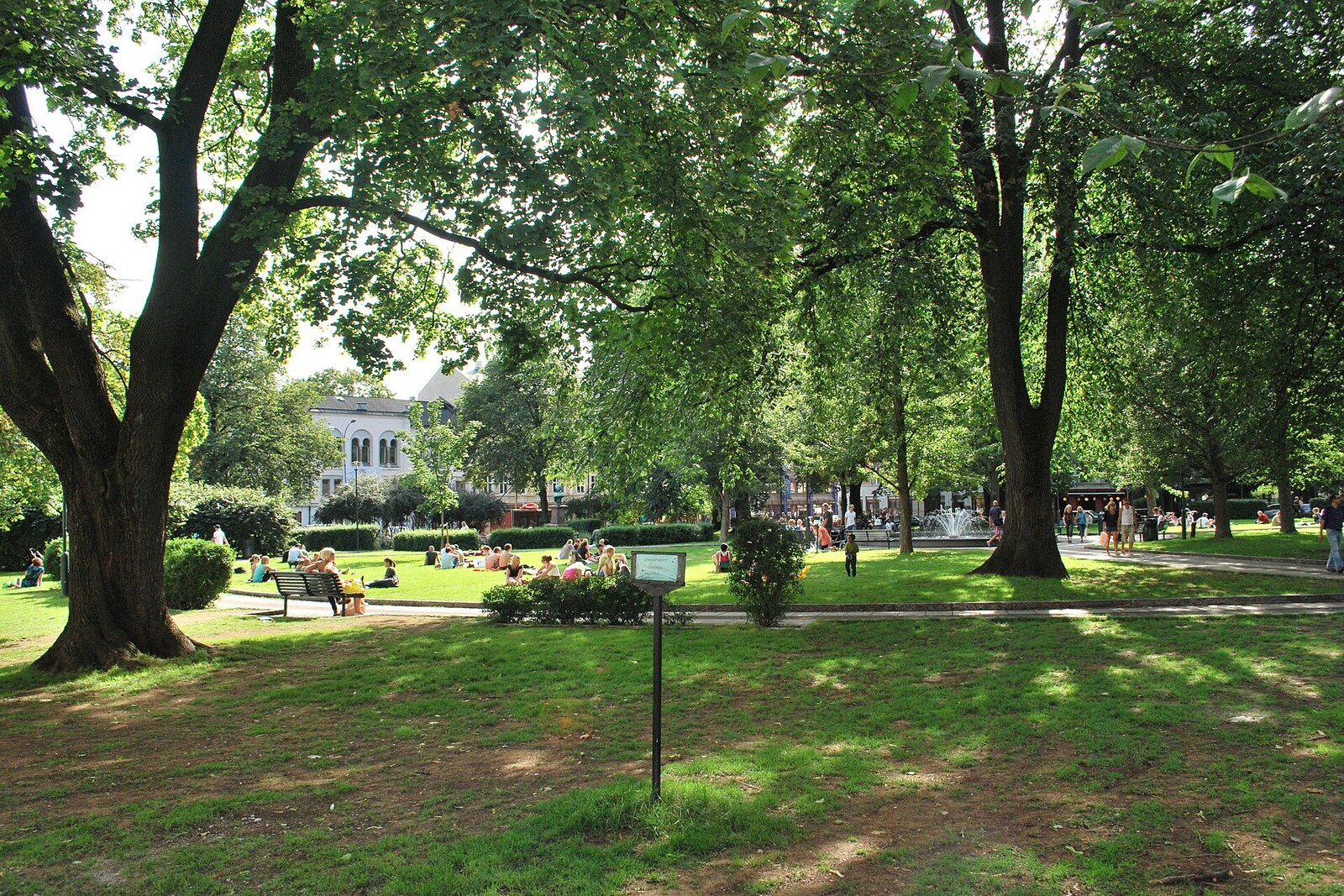
Look around first
What to notice
- Bronze bust of Eilert Sundt
- Fountain
- Diagonal paths
- Park benches
The story of the place
At the southern edge of the park stands a bronze bust of Eilert Sundt. The square bears the name of another man—General Olaf Rye. There is no image of him here. The name appeared in eighteen sixty-four, when the city set aside a recently purchased open plot for a square. That same year, Prussia and Austria attacked Denmark, and on the map of the new neighborhood appeared the names of three Norwegian officers in the Danish army: Olaf Ryes plass, Schleppegrells gate, and Helgesens gate.
All three had met as cadets in Kristiania. After the war of eighteen fourteen, Norway entered a union with Sweden. Rye refused to swear allegiance to the Swedish king and lost the opportunity to continue his officer's career in his homeland. Together with two comrades, he left to seek a place in a foreign army and eventually joined Danish service.
Three decades later, Denmark's war with supporters of Schleswig-Holstein's separation began. Rye's old regiment went over to the rebels. Men he had served and been friends with remained there, so at first Rye asked to be kept in the garrison. He then changed his mind and led a Danish battalion into battle. Military service was his profession, but he was now required to fire on his former comrades.
In the spring of eighteen forty-nine, Rye was already commanding the Fifth Brigade. After the unsuccessful battle at Kolding, he was assigned part of the blame for the defeat. He led his corps north across Jutland, preserved his men, and forced the enemy's superior forces to follow him as far as the Helgenæs peninsula. Meanwhile, Schleswig-Holstein troops laid siege to the fortress of Fredericia.
On June twentieth, Rye received orders to send most of the infantry to help the besieged city. He himself could remain behind. After thinking it over, the general decided to go with the soldiers. About five thousand men were secretly loaded onto ships, transported to Fredericia, and assigned to the detachment preparing a surprise sortie.
At dawn on July sixth, Rye's brigade advanced on the strong fortification of Treldeskansen. The general was killed during the attack; sources describe the exact circumstances of his death differently. Danish units captured the enemy positions and lifted the siege of Fredericia. Rye was first buried with the other fallen soldiers, then moved in the autumn to Garrison Cemetery in Copenhagen. The Danish army even acquired the expression “to go to Rye's brigade”—to die in battle.
Fifteen years later, the name of the fallen Norwegian was given to this square. The names of his comrades remained on the neighboring streets: Schleppegrell also fell in that war, while Helgesens survived it.
The bust of Eilert Sundt appeared later. In eighteen ninety, the city's gardeners turned the empty square into a park, and two years later they installed a work by the sculptor Mathias Skeibrok here. Sundt was a researcher and the founder of the Christiania Workers' Society—an educational association founded in that same eighteen sixty-four. After his death, members of the society, together with supporters of public education, raised money for the monument and presented it to the city.
A fountain was added at the intersection of the diagonal paths in nineteen twenty-seven. Benches now stand around it, summer terraces operate along the edge of the square, and market stalls are set up on the Markveien side during neighborhood celebrations. Olaf Rye remains in the address and the names of neighboring streets; the bronze face in the park itself belongs to Eilert Sundt.
Useful on site
The square is open around the clock; lighting is available until late in the evening.
Checked: June 17, 2026. Check the official source before visiting.All the main landmarks are accessible from outside; do not look for an exact match between the present-day view and Munch's early paintings.