 Guide On Map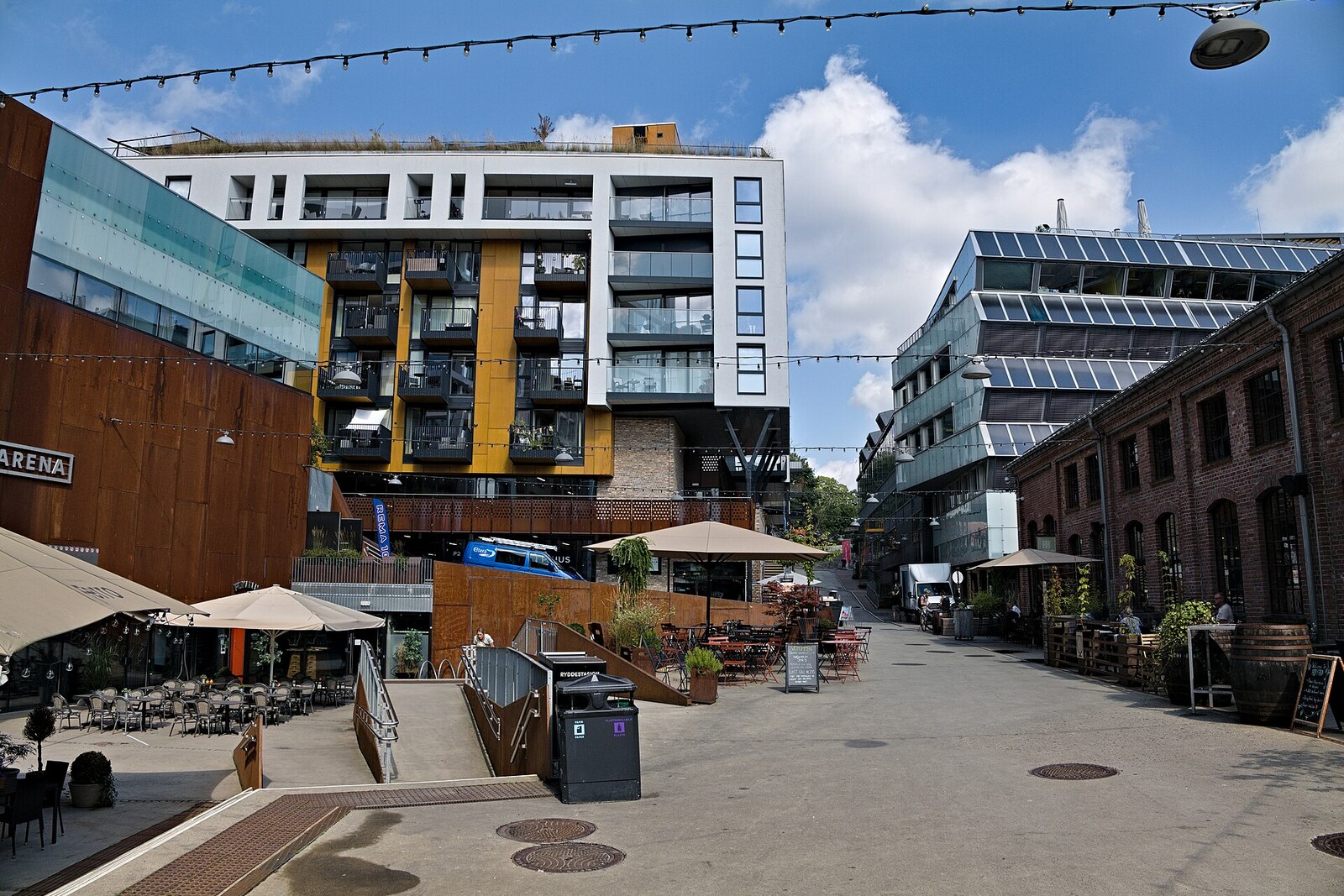
Look around first
What to notice
- The brick workshop building
- Two letters “A” above the entrance
- The date “1908” on the façade
The story of the place
Bridges in Norway often began in this long brick building. Steel elements were prepared here in advance, then sent to customers, who assembled them into bridges for railways and roads across the country. For this work, the workshop was made large, and later it was lengthened by another thirty meters. A covered market now operates behind its walls, while two letters A and the date nineteen oh eight remain on the façade.
In eighteen eighty-four, Ferdinand Ludvig Wiebe, the owner of the Vulkan factory that stood here, lost two businesses at once. He tried to expand the enterprise and opened a shipbuilding yard, but it went bankrupt and dragged the foundry down with it. Before that, Vulkan had made money from scales, fireproof safes, steam boilers, and cast-iron staircases for new buildings in Kristiania—the name Oslo had at the time.
After the collapse, the twenty-eight-year-old engineer Aksel Ingvald Spone Amundsen became manager and co-owner. The factory had been his workplace, and now he had to decide which products could bring orders back to it. Aksel Ingvald Spone Amundsen chose steel bridges. As early as eighteen eighty-six, Vulkan supplied them to the railway and the road authority. In eighteen ninety-seven, Aksel Ingvald Spone Amundsen bought the enterprise outright.
This was the first place in Norway to establish industrial production of steel bridge structures. Customers were sent prepared elements, which were assembled into a bridge. Hundreds of such structures appeared across the country. It was for this work that Aksel Ingvald Spone Amundsen built the large brick workshop in nineteen oh eight. In nineteen thirty-six, it was lengthened by another thirty meters. The Norwegian name Bruverkstedet means bridge workshop; it has nothing to do with cobblestone pavement.
Aksel Ingvald Spone Amundsen ran Vulkan until his death in nineteen thirty-nine, after which the enterprise remained with his family. In nineteen sixty-eight, foundry production was closed, and the remaining work was moved to Furuset. The neighboring foundry building was demolished later; the bridge workshop was preserved.
Since twenty twelve, Mathallen, a covered food market with specialty shops, cafés, communal tables, and cooking classes, has operated inside. Above the entrance of the old brick building, two letters “A”—the initials of Aksel Ingvald Spone Amundsen—and the date nineteen oh eight remain.
Useful on site
The Mathallen food market is open Tuesday–Saturday 10:00–20:00, Sunday 11:00–18:00; closed on Mondays. In July, the market is open daily 11:00–20:00, and changes are possible in August. Some restaurants in the Vulkan complex remain open longer.
Checked: June 17, 2026. Check the official source before visiting.You can listen to the story outside; plan a visit to the food hall separately according to current opening hours.