 Guide On Map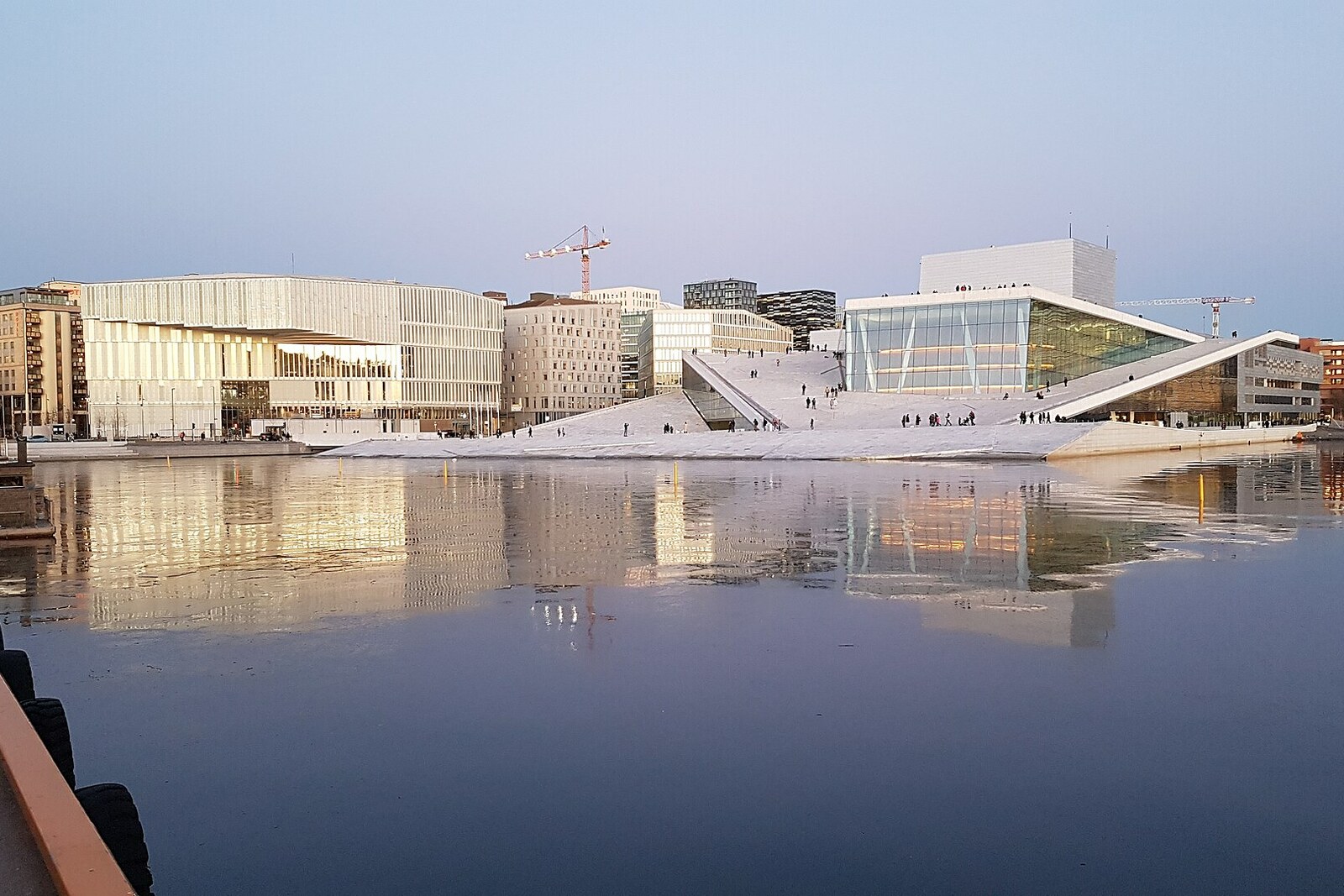
Look around first
What to notice
- The stone roof descending toward the square
- The statue of Kirsten Flagstad
- The plaque with the square's name
The story of the place
Kirsten Flagstad never entered this Oslo Opera House. The woman depicted in bronze in front of the building died forty-six years before it opened. But the square and the Opera's official address are named after her.
Flagstad was the first director of The Norwegian National Opera. When the Storting established a permanent national company in nineteen fifty-seven, she had to bring together singers, musicians, and dancers in a country where a dedicated opera building did not yet exist. By then, Flagstad had become famous for performing Wagner on the leading stages of Europe and America. The money she earned there now proved useful in Oslo.
The company was assigned Folketeatret—the former People's Theatre at Youngstorget. The venue was poorly suited to opera, and the allocated funds were not even enough for an orchestra of the required size. Flagstad recruited Norwegian singers and, without publicity, paid extra from her own funds so that the musicians would not have to be laid off. She was already being hospitalized often, yet she continued to lead the new company and make recordings, living on their proceeds.
Flagstad also insisted on equal status for ballet. The new company's first performance took place in nineteen fifty-eight, not in Oslo but while on tour in Hamar: the audience saw the second act of Coppélia. An operatic production was staged in the capital several months later. The company got underway, but Flagstad herself had to leave two years later—illness made it impossible for her to continue. She died in nineteen sixty-two, and the company she created remained in cramped Folketeatret for almost another half-century.
The wait ended when, in nineteen ninety-nine, members of parliament chose Bjørvika for the new building. Port activity here was declining, and the waterfront was occupied by transport structures and neglected plots. The Opera was meant to be the first to bring people to this part of the harbor. The following year, architects from Snøhetta won the competition with a design in which a stone roof descended directly to the city square and the water. People were allowed to walk up onto it without a ticket: the auditorium remained inside, while the roof became part of the waterfront.
On April twelfth, two thousand eight, Norway's first purpose-built opera house opened here. The company received three stages, rehearsal rooms, and workshops where costumes are sewn, sets are painted, and wigs and masks are made. About six hundred people in almost forty professions now work in the building. At the same time, the organization was renamed The Norwegian National Opera & Ballet—the equal status of the two arts that Flagstad had sought was finally secured in the name.
Two days before the opening, a plaque with her name was installed in the square. A bronze statue of the singer, which had stood at the Norwegian Academy of Music since nineteen eighty-two, was also moved here. Now the figure of the first director stands in front of a building that did not exist in her lifetime, and mail for the company she created arrives at Kirsten Flagstads plass, number one.
Useful on site
The exterior roof and public approaches function as an open urban space; the foyer is usually open Mon–Sat 11:00–16:00, Sun 12:00–16:00, and longer on performance days.
Checked: June 15, 2026. Check the official source before visiting.Do not walk up the sloping stone if it is wet or icy. A walk outside does not require attending a performance; the auditorium, tours, and productions are planned separately.