 Guide On Map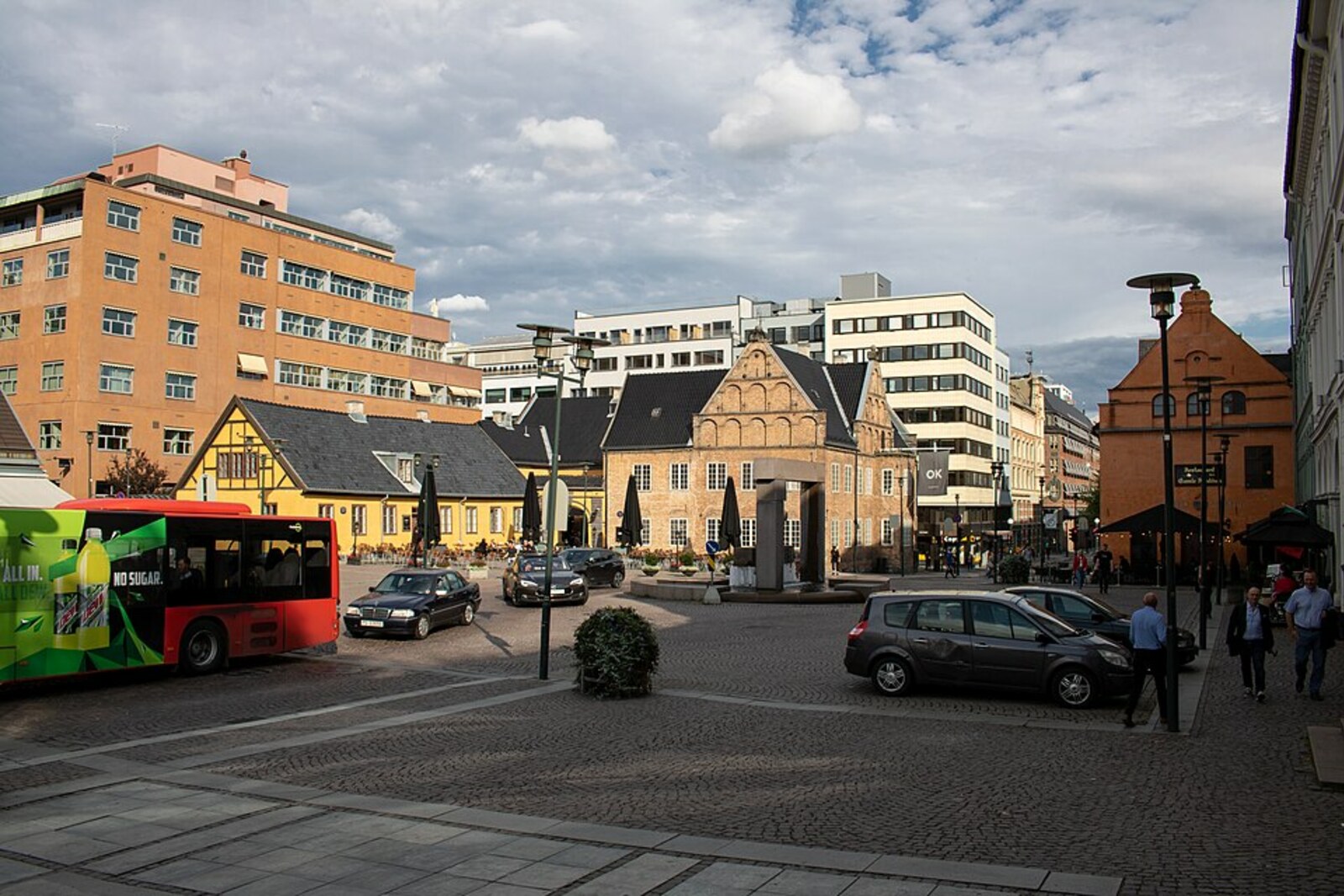
Look around first
What to notice
- Bronze glove with an outstretched finger
- Old Town Hall
- Straight streets
The story of the place
At the meeting point of the old quarter's straight streets is the square around which Christiania's civic life was gathered. Here people traded, heard court cases, and gathered the townspeople; municipal officials worked in the town hall on the corner, court was held there, and prisoners were kept in the cellar. The building was completed in sixteen forty-one, and nearby once stood the cathedral, the school, and the city's water column. The straight lines of the streets spreading out from the square still keep that old order in view.
On September twentieth, sixteen twenty-four, Oslo's mayor Søffren Mogenssøn sent a petition to the king. Mogenssøn spoke on behalf of the townspeople, who wanted to rebuild their houses on their former plots, east of Bjørvika. A month earlier, a fire had swept through the dense wooden development for three days. Almost all the homes, the church, and the waterfront warehouses containing tools, goods, and supplies had burned down. Families were left without shelter before winter. Some foundations and cellars survived, and returning to the old site meant not having to start entirely without property.
Christian IV, King of Denmark and Norway, wanted something different. After the fire of fifteen sixty-seven, it had already been proposed that the city be moved to Akershus Fortress, but then his father had yielded to the residents. This time, Christian decided not to yield. Medieval Oslo was vulnerable to shelling from the heights on the eastern shore, while near Akershus Fortress the new city could be enclosed by ramparts. Straight, broad streets were also meant to prevent fire from spreading from house to house.
On the day Mogenssøn dated the petition, the king arrived in Norway. A week later, Christian personally took part in laying out the streets on the western side of the bay. He rejected the townspeople's request, prohibited building on the old fire sites, and named the new city Christiania—after himself.
The relocation cost the townspeople more than rebuilding their old homes. Plots were allocated with regard to previous ownership and the owner's means, but land could be obtained permanently only after construction. The wealthy were ordered to build stone houses; those with less money were permitted timber-frame walls with brick infill, in the Danish manner. Many still built the familiar log houses and later asked forgiveness for the violation. A few years later, the townspeople told the king that they had invested almost all their property in the new development and now needed trading privileges to get back on their feet. The old quarters beyond Bjørvika were never rebuilt: their land was added to the fortress estate.
This square became the main hub of the royal street grid. Here people traded, held court, and gathered the townspeople. In sixteen forty-one, Christiania's first town hall was completed on the corner. It housed municipal officials and the court, prisoners were held in the cellar, and a pillory and a post for public punishments stood outside. Nearby were the cathedral, the school, and the city's water column. The decision to relocate became the everyday order of the new city here.
The bronze glove with an outstretched finger was installed in the center of the square in nineteen ninety-seven. It reduces the founding of Christiania to a single royal gesture. The documents preserve a less theatrical scene: the petition of the fire victims, two days of the king's work with surveyors, and an eighteen-point decree under which the residents built the city where they were told to.
The city itself had already regained the name Oslo, while the name Christiania Torv was approved only in nineteen fifty-eight. At the edge of the square, the town hall of sixteen forty-one still stands, straight streets spread out from it, and in the middle lies the glove of the king whose decision Søffren Mogenssøn could not change.
Useful on site
The square is always open; Oslo Kunstforening at Rådmannsgården is usually open Tue–Fri 12:00–17:00, Sat–Sun 12:00–16:00, closed Mon; Gamle Raadhus, as a restaurant, usually offers lunch Tue–Fri 11:30–15:00 and dinner Mon–Sat 16:00–22:00.
Checked: June 15, 2026. Check the official source before visiting.All the key details are visible from the square. Respect the work of the establishments in the historic buildings, and do not expect unrestricted access to the interiors.