 Guide On Map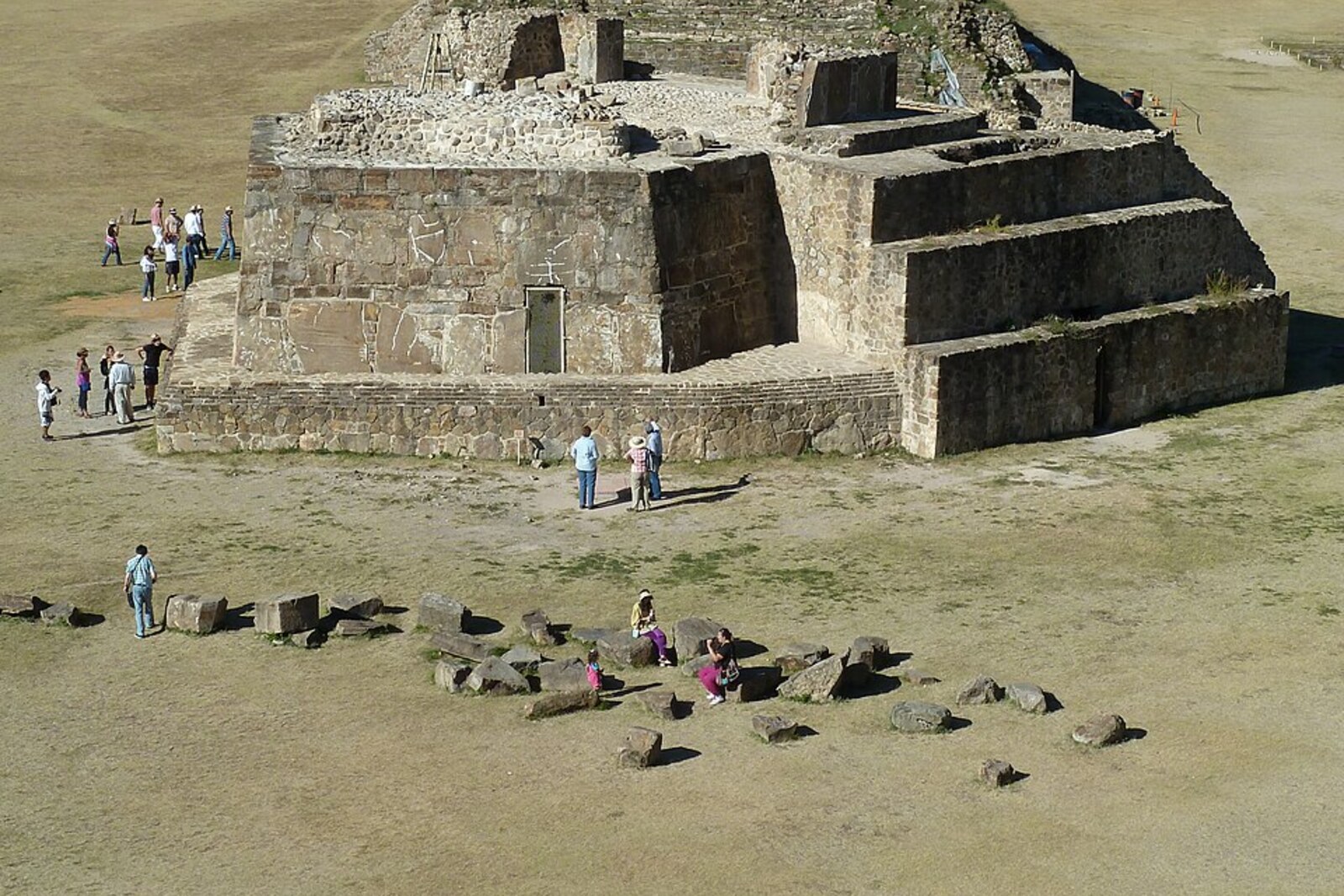
Look around first
What to notice
- Pentagonal base
- Stone staircase
- Carved slabs with hill signs
- The building's sharp angle
The story of the place
Archaeologists gave this structure the letter J because its ancient name has not survived. A stone staircase leads to the pentagonal base, which stands in the plaza at a sharp angle to the neighboring structures. This skewed placement gave it the nickname Observatory. Later measurements did not confirm a precise alignment with either Capella or another prominent star; a connection with the calendar is considered likely, although the way priests used it remains unknown.
In the nineteen thirties, the archaeologist Alfonso Caso cleared the walls of this pentagonal structure and tried to read the signs on its stone slabs. Many repeated the same pattern: a hill sign, a separate symbol above it, and below, an upside-down human head with a closed eye. Caso decided that these were the names of conquered regions and the slain rulers of those lands. This is how the slabs acquired their current name: the conquest slabs.
One of them sent archaeologists eighty kilometers north from here. In nineteen seventy-six, the Zapotec writing specialist Joyce Marcus read the sign on the slab as the name of Cañada de Cuicatlán—a hot gorge linking the Oaxaca Valley and Tehuacán Valley. If the reading was correct, the rulers of Monte Albán sent warriors there around three hundred BCE to seize the route and collect tribute from local farmers.
The archaeologists Charles Spencer and Elsa Redmond went to the gorge specifically to test this idea. They found the settlement of Llano Perdido, burned at roughly the presumed time of the campaign. Its inhabitants, sustained by crops from fertile alluvial lands, left their homes and moved to a neighboring ridge. Fortifications appeared at the only passage from the north. In the remains of later settlements, there were noticeably more fruits and seeds from the hot zone—probably because people increased production of what could not be grown in the cool Oaxaca Valley and was suitable for tribute. At the new site, archaeologists also found the base of a rack for displaying human skulls.
The result was a complete chain: the rulers of Monte Albán gained control of the passage, the farmers lost their former homes and changed their economy, and the victors ordered a message about the annexed lands fixed to the walls of a building in the center of their capital. Visitors to the plaza saw here not a battle scene, but a list of its results.
But the stones did not give archaeologists an indisputable translation. Other researchers believe that the hill signs may have denoted people's names or the incorporation of different regions into a single state, rather than a literal list of conquests. Excavations in Cañada de Cuicatlán confirm a violent break in the life of the gorge, but do not prove that all the slabs should be read as Caso proposed.
The building's sharp angle in relation to the other structures gave rise to its second name, Observatory. In nineteen seventy-two, archaeoastronomers calculated that a line from the staircase might indicate the rising of Capella on the day when the sun passed directly over Monte Albán. The structure was measured again later: its angle points exactly neither to Capella nor to another prominent star. Researchers nevertheless consider a connection with the calendar likely and more cautiously call the structure a calendar temple; exactly how priests used it is unknown.
The letter J is an archaeologists' working label; the ancient name has been lost. What remains on the site are the pentagonal base, an orientation skewed in relation to the plaza, and the slabs that led archaeologists to begin searching in the ground for a distant burned settlement.
Useful on site
The archaeological zone is usually open daily 8:00-17:00, last entry 16:00.
Opening hours by day
First compare the direction of the walls with the neighboring structures, then approach the carved stones.