 Guide On Map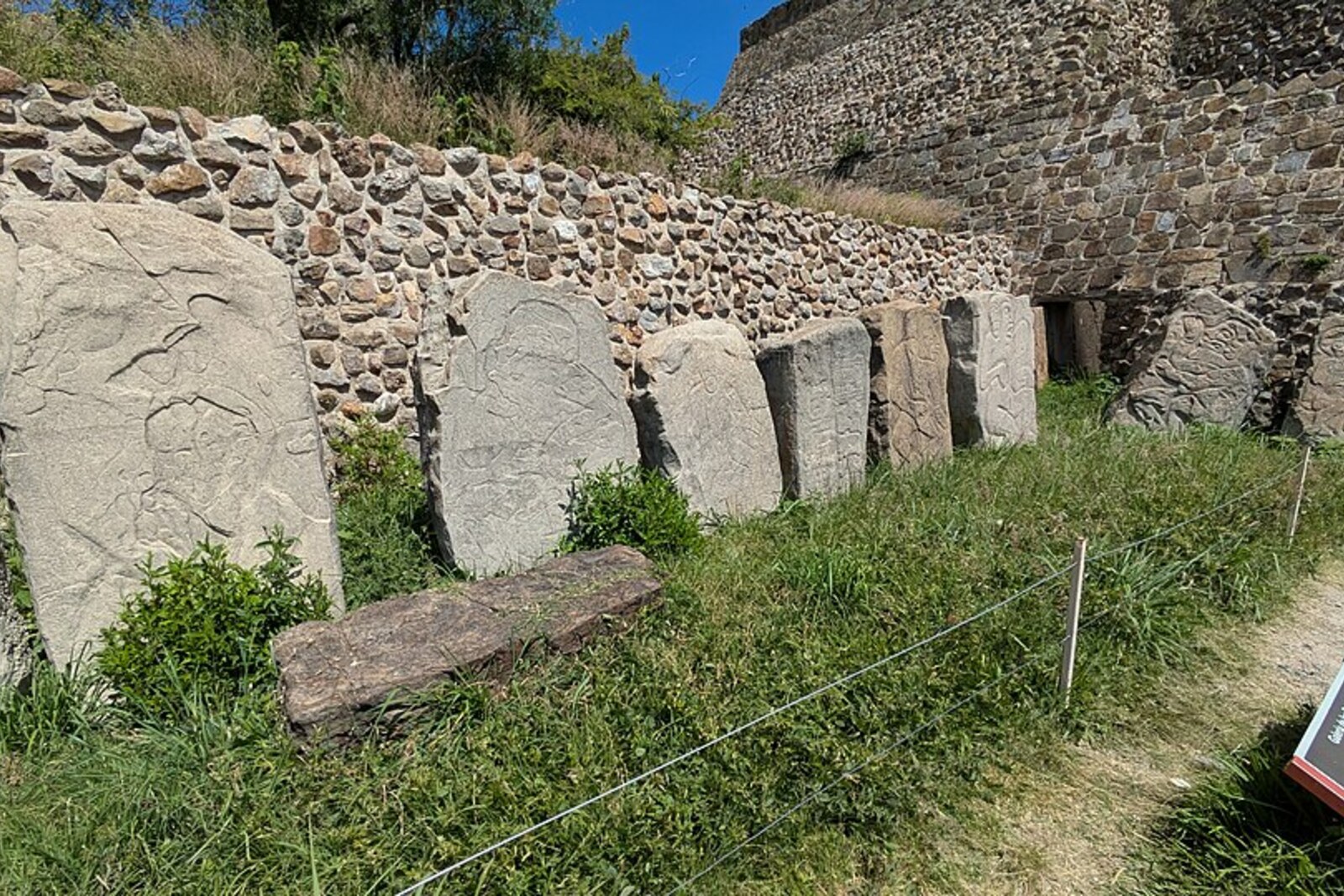
Look around first
What to notice
- Vertical carved figures
- Horizontal carved figures
- Calendar signs
- Fragment of ancient masonry
The story of the place
Stone panels with human figures are set in rows into the wall of Building L facing the Main Plaza: some are stretched out at full height, others lie across the wall, and calendar signs are visible beside some of them. When Monte Albán was becoming the valley's main city, more than three hundred such panels were made; they showed people of a particular rank to those who came to the plaza. Later, the wall was dismantled and the stones went into the masonry of new structures, so the original sequence broke apart long ago. A section of ancient masonry remains at the base, while the most fragile reliefs have been replaced with copies: the museum safeguards the originals, where the features are more clearly visible.
The name “Danzantes” arose from a mistake. In the early nineteenth century, researchers saw naked people on the stones, with bent arms and widely spread legs, and decided that they were dancing. The name stuck, although the figures themselves still have no single undisputed explanation.
They were carved around five hundred BCE, when Monte Albán was only beginning to become the valley's main city. The first rulers needed to show which people stood behind the new order and who held the right to speak on behalf of the communities gathered here. Stonecutters made more than three hundred panels and set them in rows into the wall of Building L facing the Main Plaza. Vertical figures alternated with horizontal ones, and beside some of them the craftsmen carved calendar names and signs of rank. Even a person unable to read Zapotec glyphs saw before them a long procession of bodies marked by name.
In the twentieth century, archaeologists read this procession as a list of the defeated. Nakedness meant the humiliation of a captive; closed eyes and open mouths recalled the faces of the dead; some men are shown with damaged genitals and streams of blood. According to this version, the rulers of Monte Albán ordered depictions of captured chieftains from neighboring settlements. After execution, the opponents remained before the townspeople in stone, while their calendar names turned victory over a nameless crowd into a list of specific defeats.
But on some panels the eyes are open, people kneel, walk, or perform actions poorly compatible with an image of a corpse. Modern researchers therefore allow another reading: the figures may have included members of a warrior-priestly alliance performing ritual bloodletting, dead ancestors, and heads of communities taking part in the founding of the city. For now, it is impossible to distinguish captives, founders, and ancestors with certainty: early Zapotec writing has been deciphered only partially. One thing can be said with confidence: the carvers depicted people of a particular rank and gave some of them personal calendar names. They did not call them dancers.
Later Zapotec builders dismantled most of the ancient wall. The panels went into the masonry of new structures, sometimes far from Building L, and ended up hidden beneath plaster. The original sequence broke apart in antiquity; that is why archaeologists find identical figures in different parts of Monte Albán and cannot restore the entire account in its intended order.
In nineteen eighty-five, restorers saw that rain, temperature changes, and cracks were wearing away the shallow relief. They removed the most vulnerable panels and transferred them to the Monte Albán Site Museum, while copies made of fiberglass and synthetic resin were installed on the wall. A fragment of the ancient masonry remains at the base of Building L; many of the more clearly distinguishable faces are now in the museum. What remains here is the name given because the movements of the bodies were misunderstood.
Useful on site
The archaeological zone is usually open daily 8:00-17:00, last entry 16:00.
Opening hours by day
Look at an oblique angle and do not touch the panels: in places, the weathered lines are barely holding on.