 Guide On Map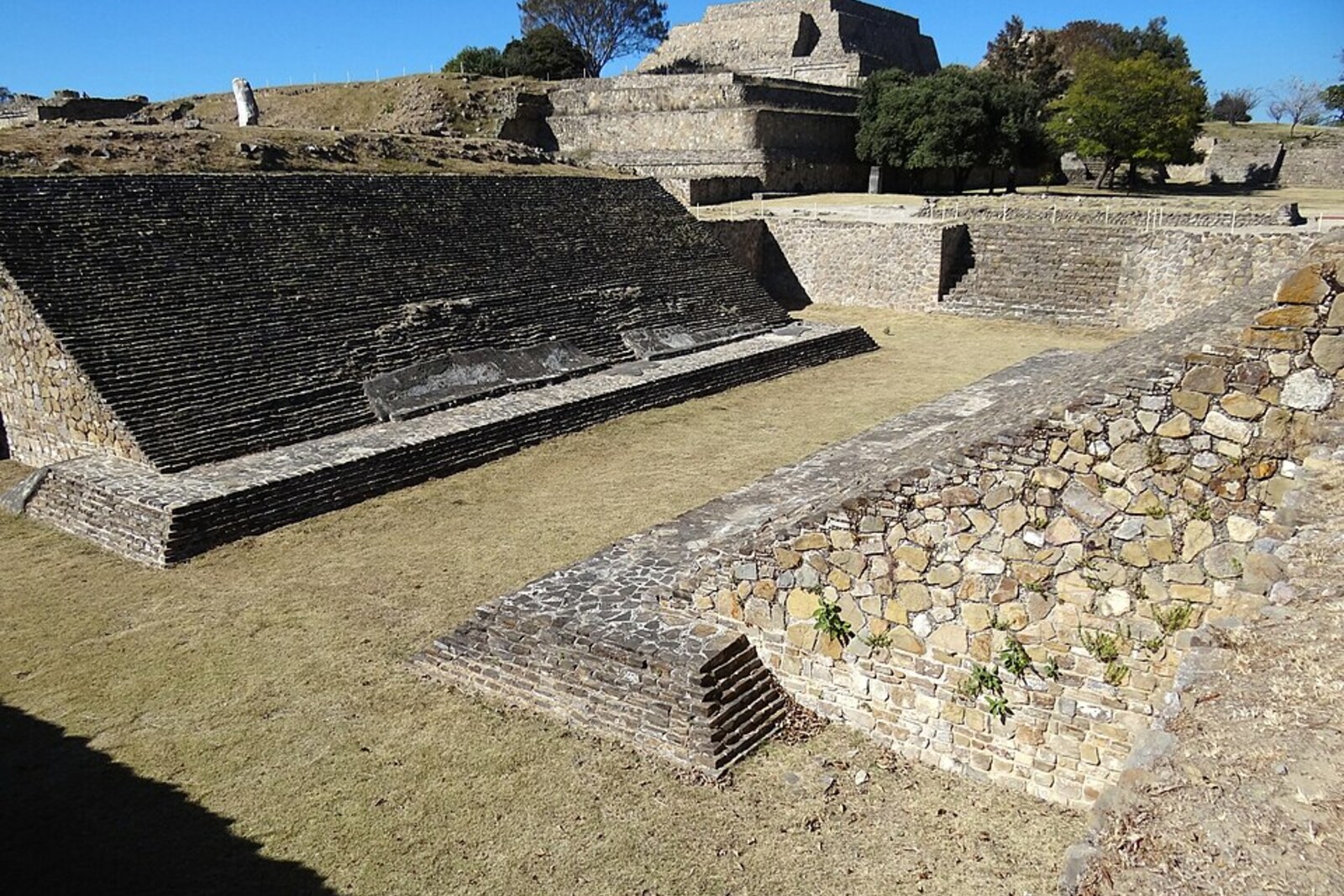
Look around first
What to notice
- Sunken playing lane
- Sloping side walls
- Round stone in the center
- Rectangular niches in the corners
The story of the place
The lane between the two slopes lies below the neighboring buildings, as if the court had been deliberately sunk into the ground. The side walls were once covered with smooth lime plaster: a solid rubber ball bounced from them back toward the middle. There were no vertical rings here, and archaeologists can no longer reconstruct the rules of the local game. A round stone remains in the center, while the rectangular niches in the corners have not yet received a convincing explanation.
Zapotec players descended here—participants in a ritual contest whose outcome could settle a dispute over land, tribute, or trade. The stakes were quite mundane. Communities subject to Monte Albán gave corn, beans, and squash, while traders came to the Main Plaza. A loss could establish an obligation to pay, while a victory could establish a claim to a plot of land or the right to control exchange.
The court was built around one hundred years before the beginning of the Common Era, when the rulers of Monte Albán were unifying the valley around their capital. The match was held beside the plaza where tribute was collected and deals were made: the decision was reached in the very place where it would have to be carried out. The names of the sides, the score, and the specific judgments did not reach archaeologists.
The players were people of high status. In a clay image found at Monte Albán, a participant rests wearing greenstone ornaments, a protective belt at the waist, and pads on the forearms. The belt softened the impact of a solid rubber ball. It was struck with the hips and forearms, with players trying to return it to the opponent and keep it in play.
The layout of the court follows this movement. The playing lane was sunk below the surrounding buildings. Its sloping side walls were covered with a thick layer of smooth lime plaster: a ball that struck them returned down to the players. There were no vertical stone rings here, and no one can now reconstruct the exact rules of the Zapotec version of the game. The round stone in the center is considered a marker; the purpose of the rectangular niches in the corners remains unknown.
Images from Oaxaca link the game with decapitation, but they do not prove the common story that the winner or loser was necessarily killed on this court. A different outcome is more reliably known for the matches held here: the dispute went to the winning side, and with it came a new tribute payer, owner of the land, or controller of trade.
No records of these decisions remain. What remain are the staircase down, two slopes that were once smooth, and the stone circle between them—the place where the fate of a cornfield or a trade route was entrusted to the movement of a rubber ball.
Useful on site
The archaeological zone is usually open daily 8:00-17:00, with last entry at 16:00.
Opening hours by day
View the court from the edge, and do not descend into closed areas or areas not intended for access.