 Guide On Map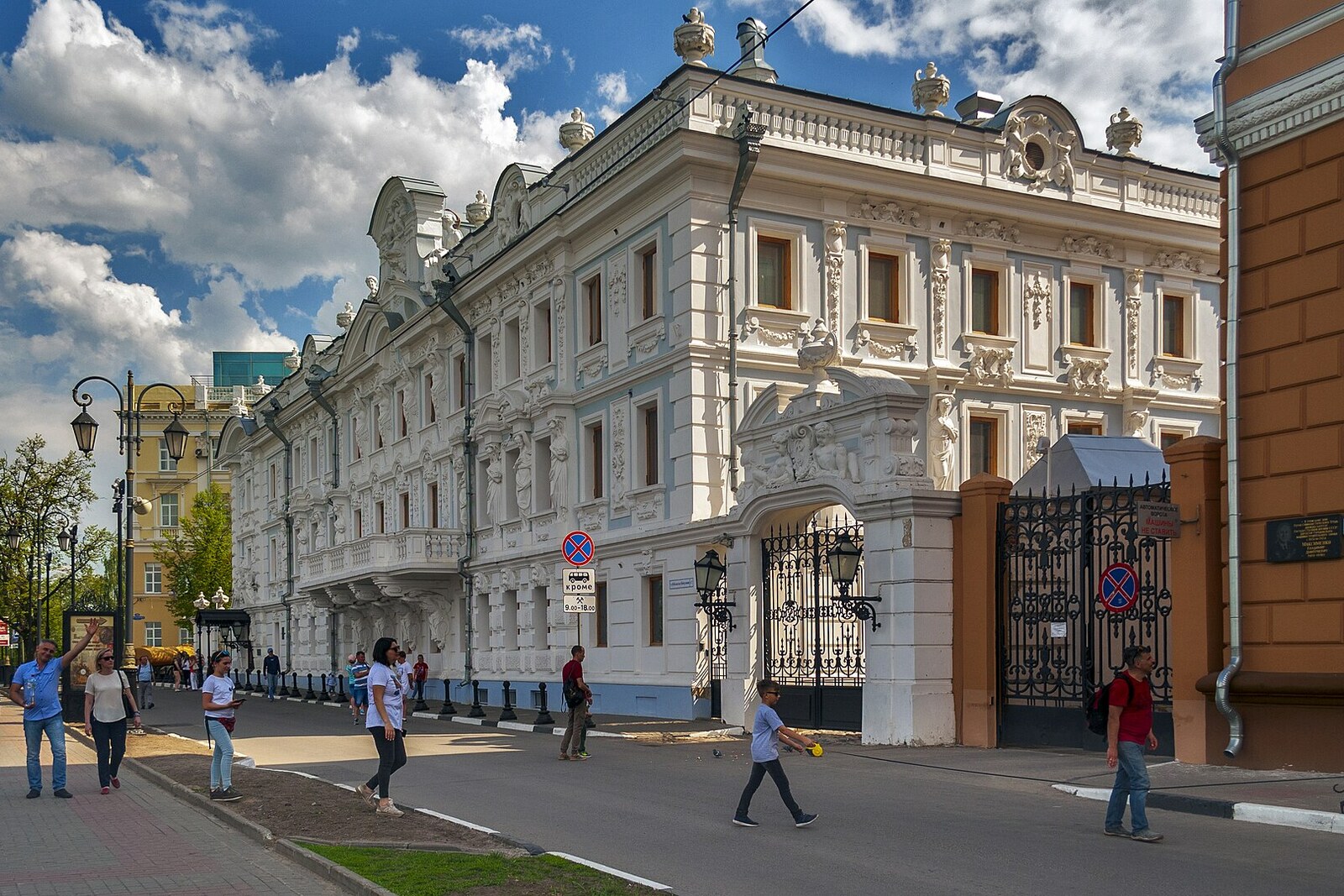
Look around first
What to notice
- Decorative plasterwork on the facade
- Marble staircase
- Double-height ballroom
- Carved vestibule with a mirror
The story of the place
Behind the decorative plasterwork of the facade on the Volga embankment are the walls of the old estate: when its owner decided to build a grand three-story house, the earlier building was not dismantled but incorporated into the new structure. The owner was Sergey Mikhailovich Rukavishnikov, heir to a family that had become wealthy through steelmaking and trade; the house was given a sequence of drawing rooms, a marble staircase, and a double-height ballroom. One authentic mirror from the former furnishings has survived, kept in the carved vestibule by the entrance.
In February nineteen eighteen, the city executive committee resolved to move the museum into the Rukavishnikov house, which was subject to requisition. The owner’s sons were tasked with setting up the museum. Ivan Sergeyevich Rukavishnikov, a poet and prose writer, advocated for a public art collection and a school attached to it. His younger brother Mitrofan, a sculptor, intended to place paintings and sculptures in the ceremonial rooms of his own house. The brothers were personally responsible for the safekeeping of all the property entrusted to them.
The surname on the facade belonged to their father, Sergey Mikhailovich Rukavishnikov, heir to a fortune the family had earned through steel production and trade. The plot came to him with a small house: his father had bought the old estate here at auction in eighteen sixty-eight. Sergey decided to build a mansion on the embankment unlike any the city had yet seen. The architects did not demolish the earlier house but enclosed its structures within a new three-story palace. By eighteen seventy-seven, it had acquired a marble staircase, an enfilade of drawing rooms, and a double-height ballroom.
Forty years later, these rooms had to be adapted for the public. At the first meeting of the museum commission, Ivan Rukavishnikov accused the previous leaders of leaving valuable collections unexamined in crates and of failing to open the art school even after two decades. The brothers insisted that art should be displayed in their house. For the move, they provided their own men, a horse, tarpaulins, and matting. More than one thousand two hundred art objects were transferred to them by inventory and against a receipt.
At first, the museum occupied the ceremonial staircase, three rooms on the first floor, a living room, the former reading room, and the ballroom. The Rukavishnikovs’ own paintings, sculptures, books, and studio furnishings were still nearby; the brothers had to obtain separate protection documents for them. On July twenty-first, nineteen eighteen, the People's Art Museum opened here, with Mitrofan as its director.
The cost of this cooperation proved heavy. Living in the house became increasingly difficult. To protect the museum collections, Ivan was officially allowed to retain his personal revolvers. In the summer of nineteen nineteen, both brothers left Nizhny Novgorod and never returned.
The art museum they had envisioned did not remain in these halls for long. In nineteen twenty-four, the historical collection was moved here, and the paintings were sent to the neighboring Sirotkin Estate. The Rukavishnikov Palace is now the main building of the Nizhny Novgorod Museum-Reserve. The furniture in the ceremonial rooms has mostly been selected from museum collections and recreates a merchant interior; the estate’s only authentic mirror remains in the carved vestibule by the entrance. The rooms the brothers gave over to paintings never became living quarters again.
Useful on site
Every day from 10:00 to 20:00; ticket office and entry until 19:15. The last Thursday of the month is a sanitation day. The facade is accessible from the embankment without a ticket.
Checked: June 24, 2026. Check the official source before visiting.From outside, the scale of the house and its position above the Volga are easy to appreciate. The staircase, mirrors, and ballroom are inside; viewing them requires a separate museum visit.