 Guide On Map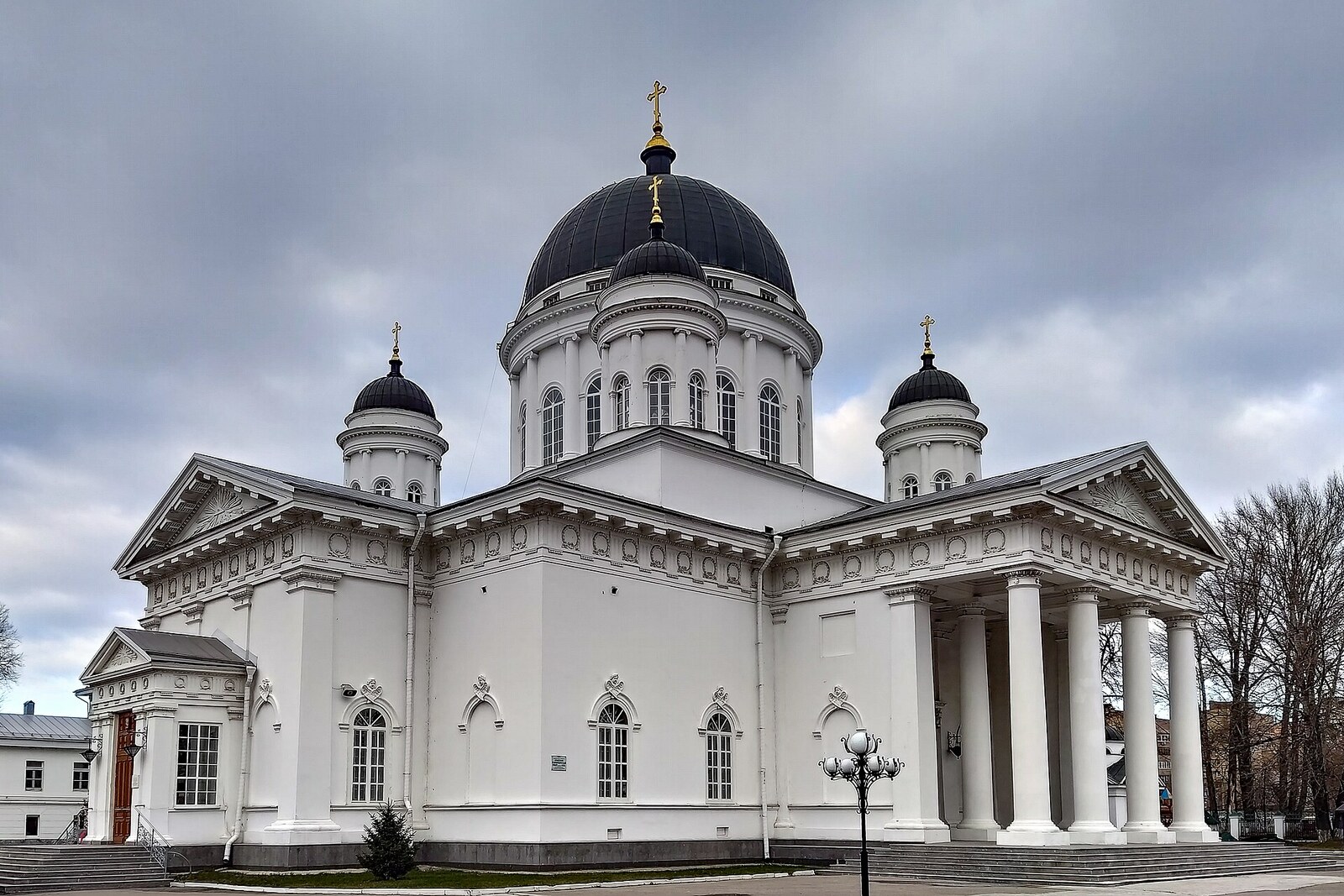
Look around first
What to notice
- The cathedral's stone structure
- The main iconostasis
- Icons at the entrance
The story of the place
The stone structure of Spassky Old Fair Cathedral recalls more than services: after the Revolution, a food warehouse was set up within its walls. The building was returned to the Church in nineteen ninety-one, and the interior decoration had to be created anew. The name Spassky came from the Saviour Transfiguration Cathedral in the Kremlin, from which church utensils and icons were once brought here; the word “Old Fair” appeared later, when the Alexander Nevsky Cathedral was consecrated nearby.
During services, many merchants did not approach the main iconostasis—the wall of icons separating the altar. They remained at the entrance, where old Russian icons hung, and lit candles there. Some brought their own icons, wrapped in cloth, and prayed before them.
These people came to Nizhny Novgorod to trade. After the fire of eighteen sixteen, the fair was moved here from Makaryev Monastery. Over several weeks, merchants made deals on which their turnover for the following year depended, and then left for their own cities. There was no permanent parish here. Priests, church utensils, and icons arrived from the Saviour Transfiguration Cathedral in the Kremlin. From it, the Fair church acquired its familiar name, Spassky, although the main altar had a different dedication.
The stone cathedral was consecrated in eighteen twenty-two. Its iconostasis was decorated by Fridolino Torricelli, an artist of Italian descent who worked in the European academic manner. He painted the figures of saints with parts of their bodies exposed. For visiting merchants, this was so unfamiliar that some refused to pray before his images or light candles before them.
The merchants asked for the iconostasis to be replaced and offered icons in the “Greek style”—the name then used for the familiar, austere Orthodox manner. In eighteen thirty-two, they were allowed to raise money for the alteration. Then lengthy approvals began: one project proved too expensive, while others were reworked. Torricelli died without seeing how the dispute over his work would end.
The new iconostasis was installed only in eighteen forty-seven, to a design by the architect Roman Kuzmin. It was carved from linden wood and gilded. Yet the paintings were again done in the Italian manner, although the merchants had raised money for icons in the Greek style. The original iconostasis disappeared, but the wish of those who secured its removal was only partly fulfilled.
Kuzmin's work did not survive either: after the Revolution, the iconostasis was destroyed, and the cathedral was turned over for use as a food warehouse. The building was returned to the Church in nineteen ninety-one; the present interior decoration was recreated from scratch, and work on the iconostasis was completed in November two thousand five. Services are now held here daily.
The cathedral began to be called Old Fair after the new Alexander Nevsky Cathedral at the Fair was consecrated in eighteen eighty-one. Today, the old cathedral contains neither the images before which the merchants refused to pray nor the iconostasis they sought for a quarter of a century.
Useful on site
An active church; services are held daily. Church shops are listed as open from 7:00 to 19:00, but tourist visits depend on services.
Checked: June 24, 2026. Check the official source before visiting.This is an active church: you can listen to the full account outside, but pause the audio before entering and observe the community's rules.