 Guide On Map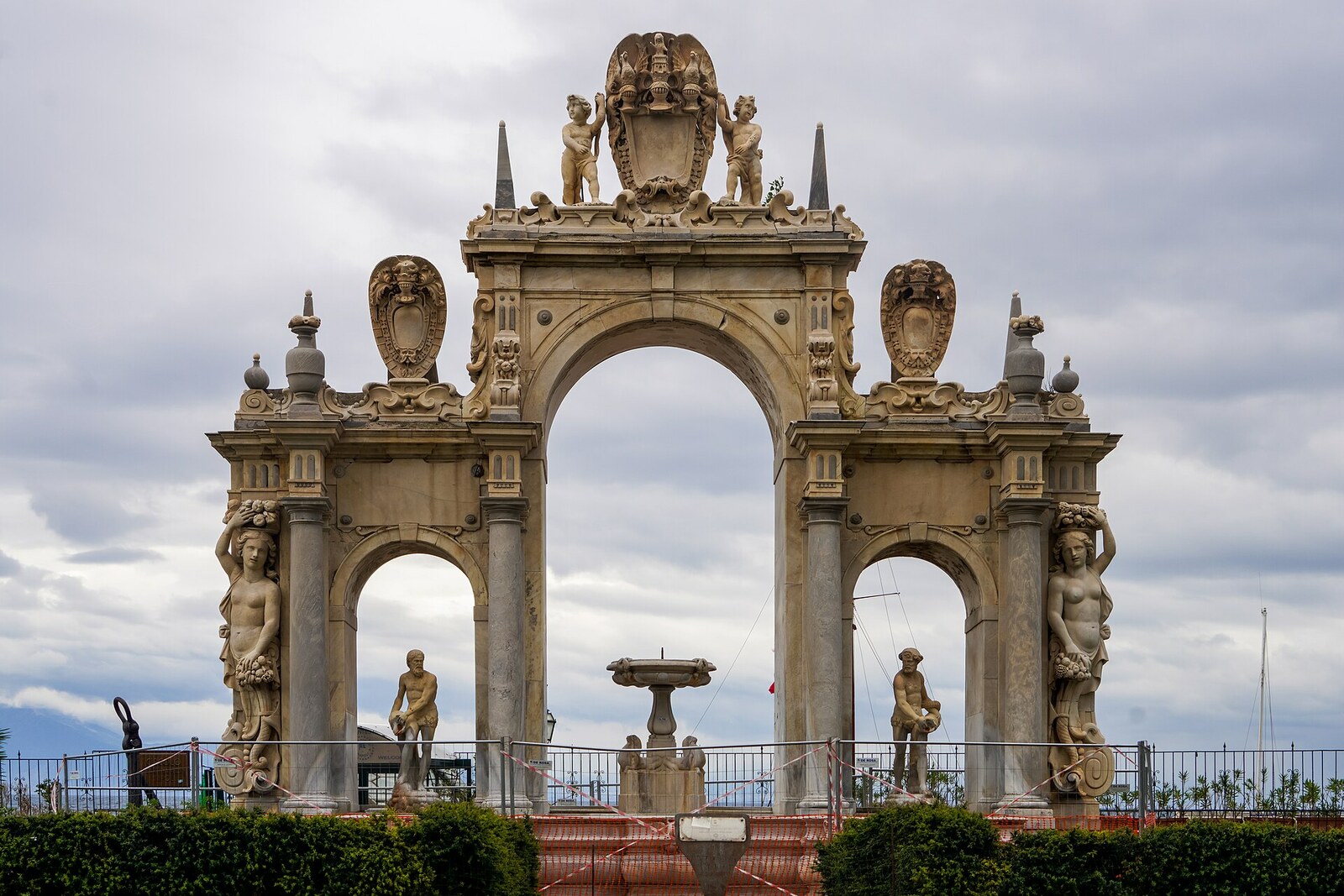
Look around first
What to notice
- Three stone arches
- River deities in the side openings
- Central basin
- Worn coats of arms
The story of the place
At the sea's edge, three stone arches are gathered together: river deities with sea creatures stand close in the side openings, while a basin for the jet stands between them. Coats of arms are still visible above the arches, though time has almost worn away their designs. The waterfront was laid out where part of the fishing harbor once stood, filled in when the shore was expanded; the fountain was set here only at the beginning of the twentieth century.
In sixteen seventy, Pedro Antonio de Aragón, the Spanish king's viceroy in Naples, wanted to immortalize his services to the city. For this, he made use of an enormous ancient torso of a seated Jupiter, found in excavations at Cumae. Craftsmen attached stucco arms to the torso, concealed its missing lower part with marble slabs, and set it upright. A long list of the viceroy's deeds appeared on the pedestal.
Nearby stood a fountain by Michelangelo Naccherino and Pietro Bernini. At the time, it was by the Royal Palace, in what is now Piazza del Plebiscito, and its three arches framed the descent to the arsenal and the sea. Townspeople dubbed the composite statue the Giant of the Palace; its name passed to the fountain and to the road descending from here.
Anonymous verses against city officials and courtiers soon began to be attached to the pedestal. They were written mainly by ordinary Neapolitans, though well-known writers were sometimes among the authors. Their names and occupations usually remained unknown: a guard was posted nearby, passersby were forbidden to read the sheets, and a reward was offered for the authors. Anonymity protected people, but turned the stone Jupiter into a talking statue.
In eighteen oh seven, King Joseph Bonaparte of Naples, trying to put an end to these mockeries, ordered the Giant removed. According to legend, before it was taken down, a will appeared on it: the statue left its head to the State Council, its arms to the ministers, its belly to the courtiers, its legs to the generals, and assigned an unnamed part of its body to the king. The ancient torso was freed of its later additions; it is now in the National Archaeological Museum of Naples. The fountain lost its neighbor but kept its nickname.
The fountain itself remained by the palace for another eight years. In eighteen fifteen, during the reconstruction of the road, it was dismantled and moved to the eastern mole, in front of the sanitary department building. The building was called Immacolatella because of the statue of the Virgin Mary on its roof, and the fountain acquired a second name: the Immacolatella Fountain.
In eighteen sixty-nine, it was dismantled again and reassembled in the new Villa del Popolo park by the port. Port structures gradually surrounded the park, and by nineteen oh three the fountain was once more lying in pieces. Finally, in nineteen oh six, a cooperative of stonemasons assembled it in this spot—on the new waterfront, laid out over a filled-in part of the old fishing harbor.
The three arches were once again set by the sea, as they had been at the first site. River deities with sea creatures remained in the side openings, a basin for the jet in the central one, and coats of arms worn away by time above the arches. The Giant is not among them: the name points to the statue left by Piazza del Plebiscito, while the fountain reached its present shore only three centuries after it was created.
Useful on site
Open urban space.
Checked: date not specified. Check the official source before visiting.All the main details are visible from outside; view the sculpture from the pedestrian side and do not step into the roadway for an overall shot.