 Guide On Map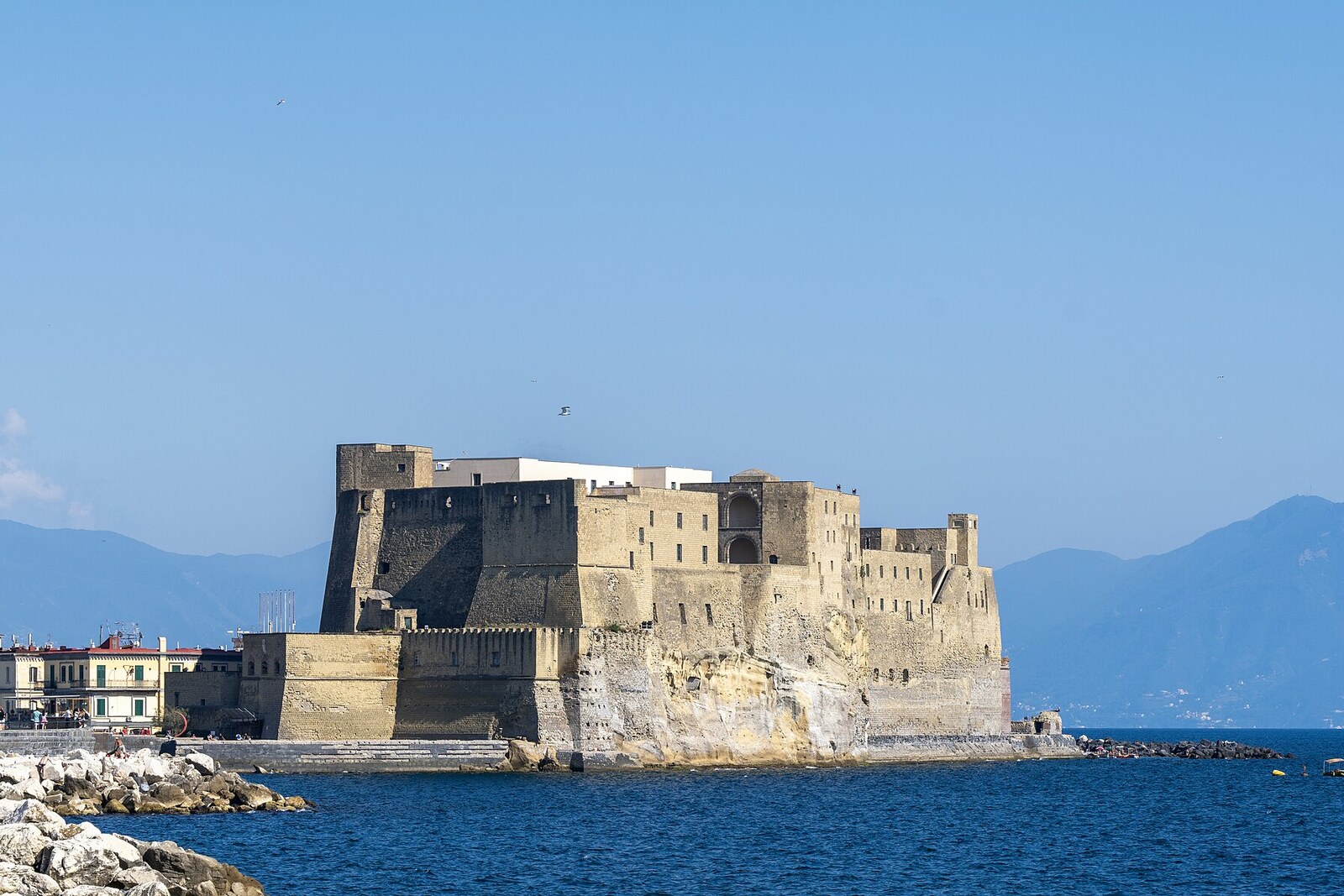
Look around first
What to notice
- The tuff rock of Megaride
- Fortress walls
- The bridge to the shore
- A hall with ancient columns
The story of the place
Megaride is an ancient tuff island, now connected to the shore by a bridge. Neapolitan chronology begins the city’s history here: in the ninth century BCE, Greeks settled on the island, and Parthenope Settlement later arose on neighboring Pizzofalcone. There are no Greek houses before you. The fortress appeared much later, and one of its first prisoners bore the name of Rome’s founder.
Romulus Augustulus was the young emperor of the Western Roman Empire, placed on the throne by his own father. His father, the military commander Orestes, ruled in his name. Soldiers of the Roman army demanded land in Italy for resettlement, but Orestes refused. Their commander, Odoacer, then rebelled, killed Orestes, and overthrew his son.
Earlier emperors were often dealt with at once. Romulus was saved because he was plainly not directing the conflict. An ancient author writes that Odoacer spared him because of his youth and beauty. Romulus’s exact age is unknown, but his contemporaries used the nickname Augustulus—“little Augustus”—mockingly.
Odoacer granted the deposed emperor an annual allowance of six thousand gold solidi—the income of a prosperous Roman senator—and sent him here, to Castrum Lucullanum, together with his relatives. That was the name of the fortified estate of the Roman commander Lucius Licinius Lucullus. As early as the first century BCE, Lucullus established part of his seaside villa on Megaride, and in the fifth century Emperor Valentinian III ordered it turned into a fortress. The island was suited to an honorable exile: remote enough to hold a dangerous prisoner, yet rich enough for him to live with a retinue rather than in a cell.
Odoacer sent the imperial insignia to Constantinople and began ruling Italy as king. That is why the year four hundred seventy-six is conventionally considered the end of the Western Roman Empire. Romulus himself remained a private citizen in a house that had once belonged to a victorious commander. What happened to him next is not reliably known: the sources lose track of the former emperor precisely here.
The present walls were not the walls of his residence. Normans, Angevins, Aragonese, and Spaniards repeatedly rebuilt the fortress. Individual details of the Roman villa survive, incorporated into later structures: inside is the Hall of Columns, with ancient columns. No room can honestly be called Romulus’s quarters. The exact trace of his exile is Megaride’s rock itself and the old name Castrum Lucullanum.
In the Middle Ages, this same fortress gained another protector. The people of Naples considered the poet Virgil a magician as well. According to legend, he hid an egg in a secret chamber, enclosed in a jar and an iron cage. As long as the egg remained whole, the fortress and all of Naples were meant to stand.
In the year thirteen seventy, a natural arch beneath part of the castle collapsed, and the towers and load-bearing structures suffered severe damage. A rumor spread through the city: the egg had broken, so the next disaster would destroy Naples itself. Queen Giovanna I, who needed to stop the panic and restore the fortress, announced that she had put a new, even stronger egg in its place and ordered the ruined sections rebuilt immediately.
No one found the egg. Yet the name Castel dell'Ovo remains on maps and signs: it refers to a castle associated with an egg. It repeats the medieval legend and the royal assurance that the invisible protector was whole again.
Useful on site
Castel dell'Ovo is closed to the public until further notice; Borgo Marinari and exterior views remain accessible as public urban space.
Checked: date not specified. Check the official source before visiting.This stop is designed for exterior viewing: if access inside the fortress is closed, listen to the story from the accessible part of Borgo Marinari.