 Guide On Map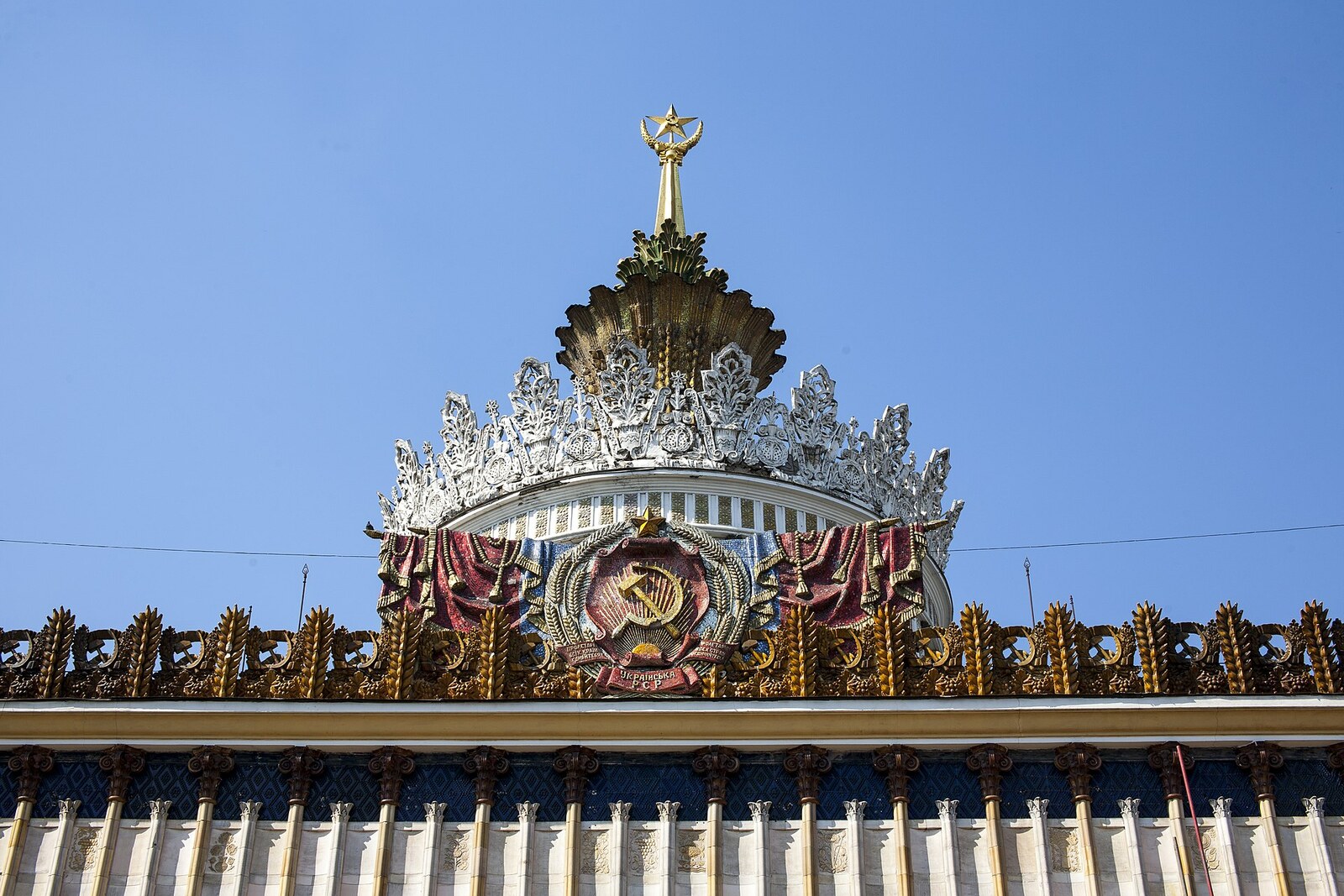
Look around first
What to notice
- Golden ceramic ears of grain
- Ceramic facade blocks
- Tower with a spire
- Star above the entrance
The story of the place
The Slovo Museum now operates inside this tall pavilion, where the journey from old alphabets and the first printed books continues through school notebooks and personal diaries. The brick structure is covered with ceramic cladding; a spire and a star rise above the entrance, while ears of golden ceramic grain run across the facade. When the exhibition was reorganized by sectors, the building became the Agriculture Pavilion: crops and methods of cultivating the land were displayed here. After the retail kiosks and a long closure, its stained-glass windows, roof lantern, and lost ceramic elements were restored.
The golden ears of grain on the facade appeared after an unpleasant conversation that took place here four months before the exhibition opened.
In late March nineteen thirty-nine, Nikita Khrushchev, First Secretary of the Communist Party of the Ukrainian SSR, came to inspect the republic's pavilion. The architect Alexei Tatsiy had designed the wooden building as a Ukrainian cottage enlarged in scale. It was almost finished, but Khrushchev was not satisfied with the result. The republic was supposed to appear industrial and collective-farm-based, not remain behind the facade of a rural house.
For Tatsiy, this meant that the work he had already completed might be demolished. The exhibition's specialists proposed a solution: erect new walls around the perimeter and change the pavilion's appearance. Tatsiy and the architect Nikolai Ivanchenko, who joined him, had to complete the redesign by August first. Golden ears of grain appeared on the facades, while the entrance was surrounded by sheaves and figures of leading workers from industry and agriculture. In four months, the architects effectively hid the earlier structure inside a new building. The exhibition opened on schedule.
That pavilion did not survive to the present day. During the war, the roofs leaked, the gutters became clogged, and the wooden structures began to rot. In nineteen forty-seven, the building was dismantled. Khrushchev proposed building a permanent pavilion here, and Tatsiy was selected again in a closed competition. The architect had an opportunity to repeat his response to the long-ago objection, this time in durable materials and on a much larger scale.
Together with Valentina Chuprina and Grigory Shlakanev, Tatsiy designed the present building. The brick walls were clad in ceramic blocks, golden ears of grain once again ran across the facade, and a tower with a spire rose above the entrance. The pavilion became the largest of the republic pavilions: from the ground to the star, it measures forty-two meters. Khrushchev got the grand image of the republic he had demanded, while the solution Tatsiy had once used to save the wooden pavilion from demolition was carried over to the stone facade.
The name Agriculture Pavilion appeared in nineteen sixty-four. The exhibition organizers replaced the arrangement by republic with sector-based displays, and these halls began presenting crops and methods of cultivating the land. In the nineties, the exhibition was removed, retail kiosks occupied the rooms, and in two thousand thirteen the structurally unsound building was closed.
Restorers reconstructed the interiors, stained-glass windows, roof lantern, and spire, and remade some of the lost ceramics. Above the Main Entrance alone, they had to install two hundred forty-seven blocks and cast twenty-seven new elements. In the spring of two thousand nineteen, the Slovo Museum opened in the cleared halls. It now shows how the Glagolitic and Cyrillic scripts, printed books, school handwriting, and personal diaries changed over time.
Golden ceramic ears of grain still repeat across the entrance. They were made for the building of nineteen fifty-four, but the architect's response itself arose here in March nineteen thirty-nine—when four months remained before the opening and the completed pavilion might be demolished.
Useful on site
Museum: Tue–Sun 11:00–22:00, admission until 21:15; Mon closed. On 26–27 June 2026, the museum is closed for technical reasons.
Checked: date not specified. Check the official source before visiting.The facade can be read without entering. The Slovo Museum exhibition requires separate time and is not needed to continue the outdoor route.