 Guide On Map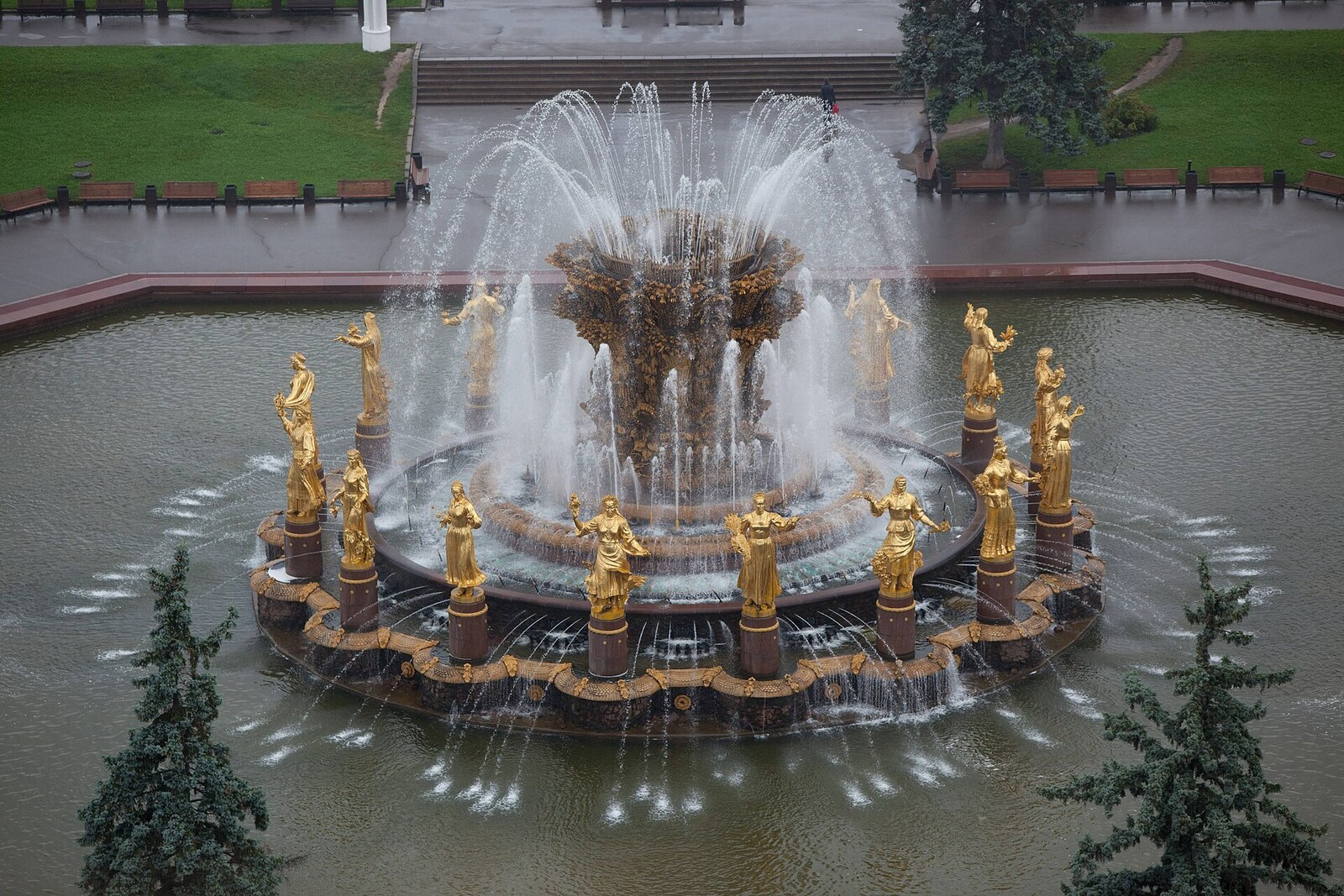
Look around first
What to notice
- Sixteen gilded figures
- Central sheaf
- Cotton in the hands of the Turkmen figure
- Small spruce beside the Karelo-Finnish figure
The story of the place
The sixteen gilded women around the sheaf represent not individual peoples in the ethnographic sense, but the sixteen union republics that existed by the time the fountain opened in nineteen fifty-four. The figures were placed here, behind the Central Pavilion, among the republic pavilions of the All-Union Agricultural Exhibition—the name VDNKh had at the time. Each republic was given a national costume and a plant associated with its agriculture. Wheat, sunflowers, and industrial hemp were combined in the center.
At first, the fountain was indeed called the “Golden Sheaf.” Architect Konstantin Topuridze designed the exhibition’s main fountain, while sculptor Zinaida Bazhenova was assigned five figures, including the Turkmen SSR. In Bazhenova’s early drawings, the women danced, knelt, raised their arms, and carried flowers, a drinking bowl, or a musical instrument. But the commission called for ceremonial allegories. In the final bronze version, the young women stood upright and motionless around the sheaf.
To give each allegory a human body, the sculptors looked for models. For the Turkmen figure, they searched for female students at Moscow’s institutions of higher education. They chose Gozel Annamamedova, a student at the Moscow Conservatory who was training to become a professional pianist. Bazhenova used Annamamedova’s appearance and transformed the young musician into the Turkmen SSR: she dressed the bronze figure in a national costume with a turban and placed cotton in her hands. The other young women were likewise sculpted from live models, although the names of most of them are now unknown.
It was the women who changed the fountain’s name. The sheaf represented agriculture, while the ring of republics around it came to signify their presence together. Just before the opening, the “Golden Sheaf” became the “Friendship of Nations Fountain.”
After posing, Gozel returned to the piano. She graduated from the conservatory, taught for many years at Ashgabat Music College, and trained about one hundred students. According to her son, the story of the Moscow sculpture gradually faded from the family’s memory. The pianist’s name did not remain on the fountain: here she is identified only by her costume, turban, and cotton.
Two years after the opening, the Karelo-Finnish SSR was transformed into an autonomous republic within Russia. Its gilded young woman, with flowers and a small spruce at her feet, was not removed. That is why sixteen figures still stand around the sheaf—exactly the number of republics that existed at the moment when a conservatory student was being sought across Moscow to give the Turkmen SSR a human face.
Useful on site
As of the verification date: daily 07:00–00:00; operates seasonally.
Checked: date not specified. Check the official source before visiting.Walk all the way around the basin: it is impossible to make out the attributes of every figure from a single vantage point. Even without water, the sculptural map remains fully legible.