 Guide On Map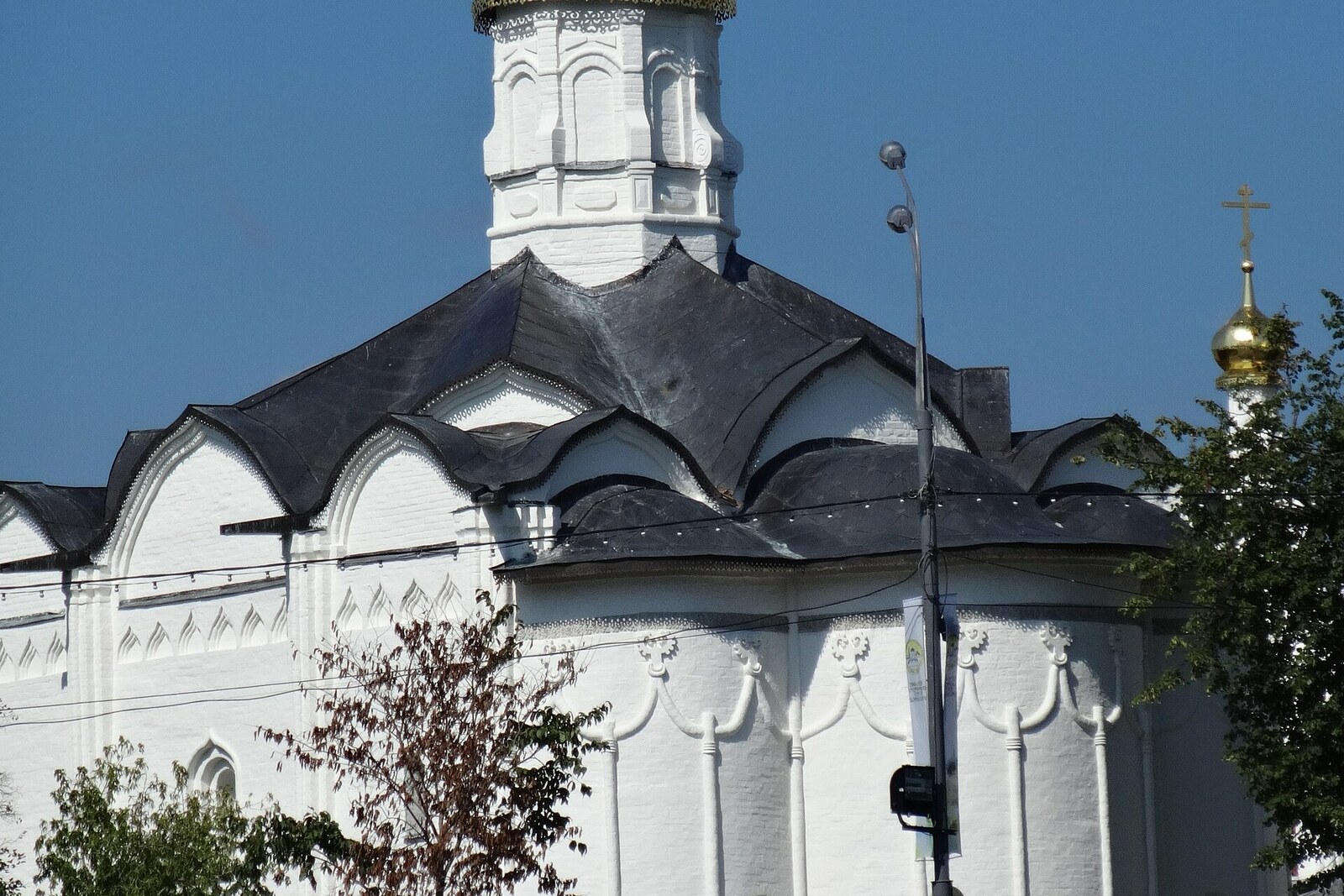
Look around first
What to notice
- Church of St. Paraskeva
- Church of the Entry of the Most Holy Theotokos into the Temple
- Monastery wall above Podol
The story of the place
The Podol lowland stretches below the Lavra hill: the Church of St. Paraskeva and the Church of the Entry of the Most Holy Theotokos into the Temple stand side by side, while the monastery wall runs higher up. This settlement was home to laypeople who worked for the monastery, and poor people and travelers were received at the churches. In the seventeenth century, this site was occupied by a small women's monastery, which left behind two stone churches. They now again belong to Trinity Lavra of St. Sergius, and their courtyard is called Pyatnitskoye Podvorye.
In sixteen forty-seven, the wife of Mikhail Bogdanov, a servant of Trinity Lavra of St. Sergius, took her seriously ill husband to Vyazniki. Bogdanov was a layman in the service of Trinity Lavra of St. Sergius, and his wife hoped for help from the local Kazan Icon of the Mother of God. They returned home with a copy—a replica of the venerated icon—and placed it here, in the Church of the Entry of the Most Holy Theotokos into the Temple.
A monastery record links Bogdanov's recovery to a moleben before this icon. This is church testimony to a miracle, not a medical case history. What mattered to the parishioners was the result: other residents also began to venerate the icon brought for the sake of one ill servant.
Podol was the name for the lowland below the hill on which the large monastery stands. Its lay employees lived here, and poor people and travelers were received here. By the middle of the seventeenth century, a small women's monastery with two stone churches—the Church of the Entry of the Most Holy Theotokos into the Temple and the neighboring Church of St. Paraskeva—stood outside the walls of Trinity Lavra of St. Sergius. At first, the Kazan Icon of the Mother of God stood in the Church of the Entry of the Most Holy Theotokos into the Temple, where the settlement's residents came.
Around sixteen fifty, the icon was moved to the Church of St. Paraskeva. Luka, the church sexton responsible for order in the church, removed it from the iconostasis to the altar. The parishioners lost access to the icon for which they came here to pray, and they were unhappy about it.
According to a monastery legend, during the Nativity Fast Luka heard a voice ordering him to return the icon from the altar and place it between the icons of the Trinity and Paraskeva. The sexton did not believe it and did nothing. After the second command, he left the church and met a carpenter carrying a board. Luka asked him to make a new place for the icon. The carpenter nailed up the board with three nails, and the icon was once again before the parishioners.
Access to the icon was restored only briefly. In sixteen fifty-four, a severe epidemic began in Moscow. Patriarch Nikon ordered that the venerated Pyatnitsky icon be brought there for molebens. It appears that it was not returned from Moscow.
Today the two churches are again under the jurisdiction of Trinity Lavra of St. Sergius and make up its Pyatnitskoye Podvorye—a separate church courtyard where services are held. The copy of the Kazan Icon of the Mother of God, over which the sexton Luka struggled with his own doubt and restored the parishioners' place at the iconostasis, is no longer here.
Useful on site
The official website of the podvorye simultaneously publishes two conflicting schedules: 07:45–19:00 on Mondays–Saturdays and 06:45–19:00 on Sundays in the main section; 09:00–17:00 on weekdays and 06:30–17:00 on Sundays in the contacts. Check the current month's service schedule and call.
Checked: date not specified. Check the official source before visiting.This is a separate church territory: take services into account, and view closed buildings only from outside.