 Guide On Map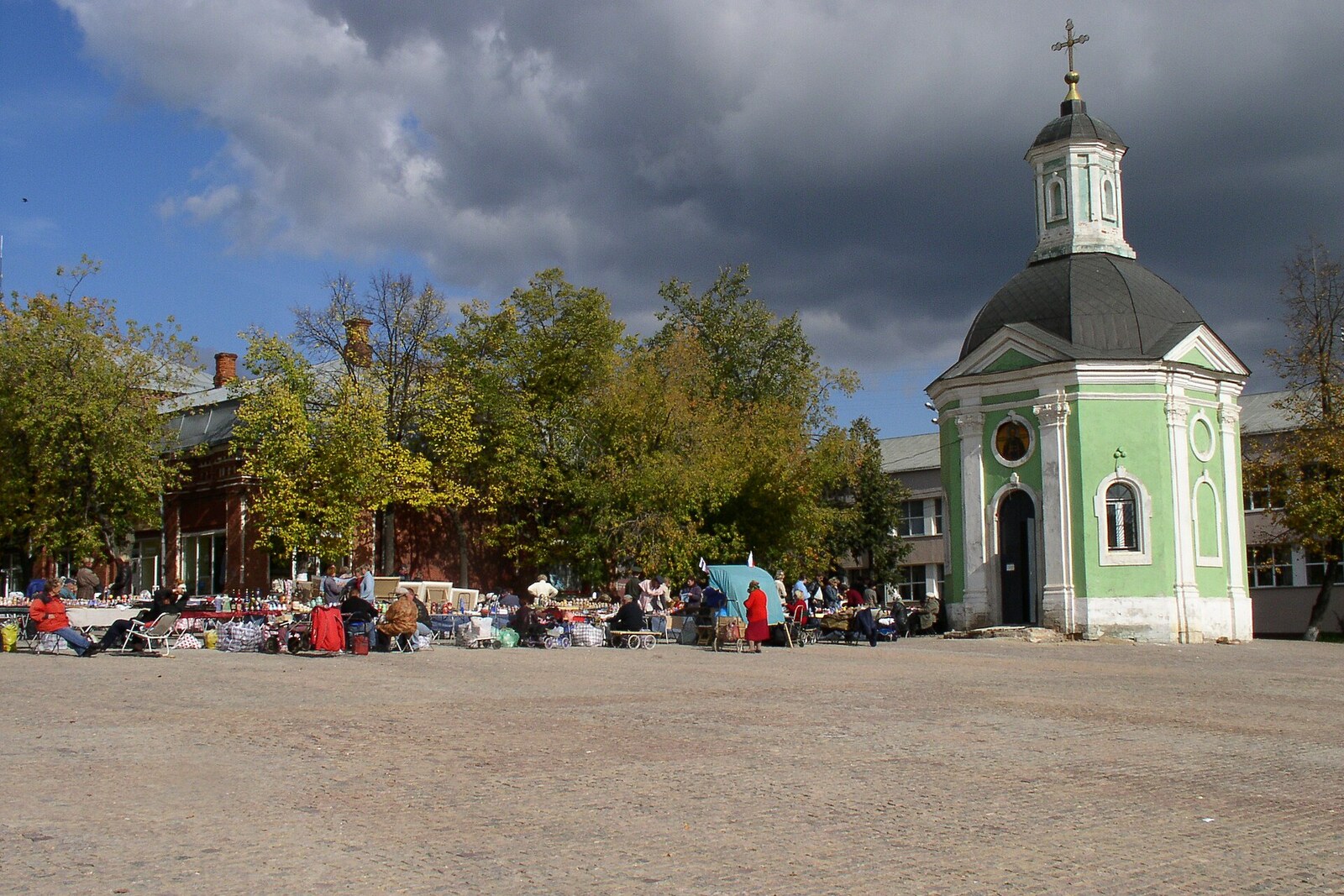
Look around first
What to notice
- The red-brick facade of the Trading Rows
- Doors on the square side
- Doors on the avenue side
The story of the place
The red-brick Trading Rows appeared after local merchants and townspeople feared they might lose everything here. At the time, townspeople were urban residents who made their living through crafts and small-scale trade. They rented tightly packed wooden stalls from the Trinity Lavra of St. Sergius and lived off selling goods to pilgrims.
There were enough customers: by the end of the nineteenth century, up to half a million pilgrims came to the monastery every year. The old road from Moscow ran along the square's eastern edge, with the Holy Gates opposite. Almost everyone entering the monastery crossed the market first. That was why the merchants held on to Krasnogorskaya Square despite the cramped conditions and the risk of fire.
On the night of December twenty-second to twenty-third, nineteen hundred, structures caught fire nearby. One of the merchants lost almost his entire fortune. In January, the merchants and townspeople submitted a petition to Vladimir, Metropolitan of Moscow and abbot of the Lavra. They explained that a fire caused by something insignificant could immediately spread from one crowded stall to another and leave them destitute. They asked for stone premises to be built at the monastery's expense, or for the tenants to be allowed to build them themselves. In the first case, the merchants agreed to pay for both the land and the stalls; in the second, only for the land.
The choice between these proposals touched on an old dispute. Krasnogorskaya Square was the main marketplace of Sergievsky Posad, as the city was then called, but the Lavra controlled it. The city administration tried to lease plots to merchants itself and challenged the monastery's rights in court. The lawsuits ended against the city.
The Spiritual Council, which managed the monastery's property, decided that a stone row built with the tenants' money could strengthen the city's claims. So the Lavra paid for the construction itself. The merchants received safe premises but remained tenants; the monastery retained the rental income and the right to control the building.
The Rows were built in nineteen oh two to nineteen oh three to a design by Alexander Latkov. The stalls were deliberately arranged on two sides: some faced the square, while others faced the highway, now Red Army Avenue. The building was placed exactly along the edge of the monastery's plot, so it also became a stone boundary between the square and the city.
The square's name is older than these walls: it was called Krasnogorskaya after Krasnaya Gora, the old name of the elevated area in front of the Lavra. And the Rows themselves once again house a monastery shop and a pilgrimage center. From the request of merchants who feared a single fire, an entire red building remains—with doors facing both the road and the market, but built by the owner of the land.
Useful on site
The square is open as a public urban space. The pilgrimage center in the Trading Rows building lists seasonal hours: 08:00–18:00 from April through November and 08:30–17:00 from November through April.
Checked: date not specified. Check the official source before visiting.View the square from outside: this stop does not require entering any buildings.