 Guide On Map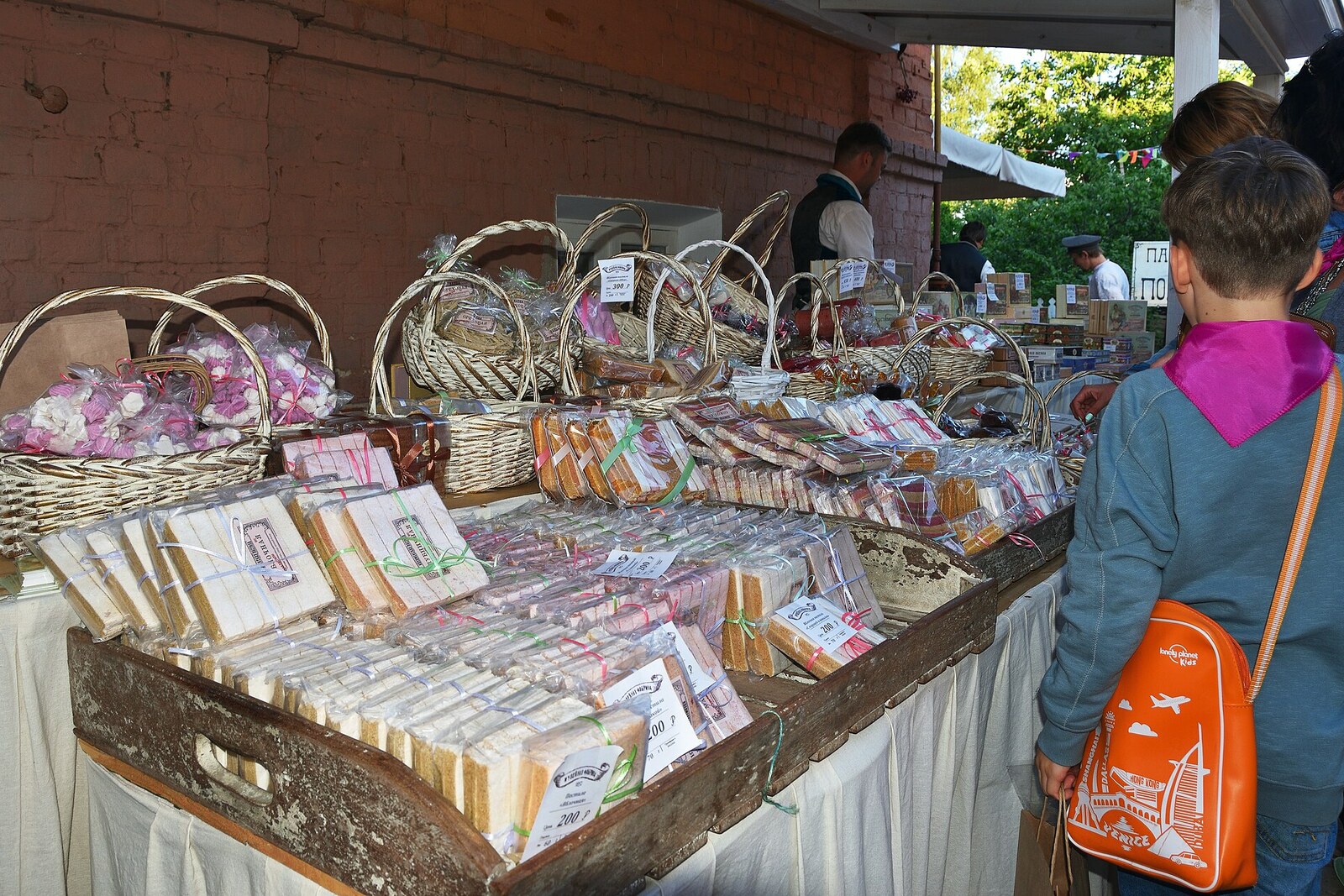
Look around first
What to notice
- The facade of Chuprikov House
- The Russian oven
- The descent to the basement
The story of the place
Behind this house's facade, pastila is made in workshops, while the upper rooms are occupied by a theatrical museum. During the clearing work, a basement level that was initially unknown was discovered; this space made it possible to place the production facility and the museum on different levels. Archival plans suggested how to restore the rooms and the oven to their former appearance, while new equipment for the workshops was made from old drawings. Tour participants make pastila themselves and end the visit with tea.
In eighteen fifty-two, the merchant Karp Fomich Chuprikov opened a pastila establishment on Polyanskaya Street. His son, Pyotr Karpovich Chuprikov, inherited the family business and set up three workshops here: for pastila, confectionery, and preserves. After the revolution, production ceased. The equipment disappeared, the building was left unused, and it gradually fell into disrepair.
In two thousand nine, staff of the newly established Museum of Kolomna Pastila found archival information about the Chuprikov factory and its plans. The museum worker Natalia Nikitina and the entrepreneur Elena Dmitrieva were then making pastila in a rented workshop. They needed their own production facility, and they decided to move it here—to the place where the same product had been made before the revolution. The city agreed to lease them the building.
Behind its walls, they found a shell with no floors. During the clearing work, a passage to the basement was discovered: Nikitina and Dmitrieva had considered the house to be one story and had not budgeted for restoring another level. Yet it was downstairs that the workshops could be placed, leaving the upper rooms for the museum. Giving up the basement would have meant giving up the entire concept of the Museum Pastila Factory.
The basement lay half a meter below the road. Rainwater flowed inside, and Dmitrieva had to replace the asphalt around the house, install curbs, and lay drainage and sewer lines. The creators received a grant and an interest-free loan, while they covered the remaining costs from their own savings. Over two years, they invested more than nineteen million rubles in the work. The facades, the rooms of Chuprikov House, and the Russian oven for drying pastila were restored from archival materials. The production machinery was made anew from old drawings: no ready-made factory remained inside.
On September third, two thousand eleven, Nikitina and Dmitrieva opened production here together with a theatrical museum. This combination helped pay for the costly manual labor. The pastila was noticeably more expensive than mass-produced sweets, and people bought it mainly as a Kolomna souvenir. The tour explained what the buyer was paying for: the apples are washed and cored, the purée is boiled down and whipped, and the mixture is spread out and dried in the oven.
Today, actors portray a Chuprikov proprietor, a gardener, and a housekeeper; visitors take part in making pastila and end the program with tea. And the descent to the cellars leads to that very unplanned level, thanks to which the production facility and the museum could be accommodated under one roof.
Useful on site
Daily from 10:00 to 20:00; a full visit to the production facilities and museum rooms is conducted as part of a pre-booked program.
Checked: date not specified. Check the official source before visiting.The working rooms and demonstration of the process are available only as part of the museum format, which must be arranged separately.