 Guide On Map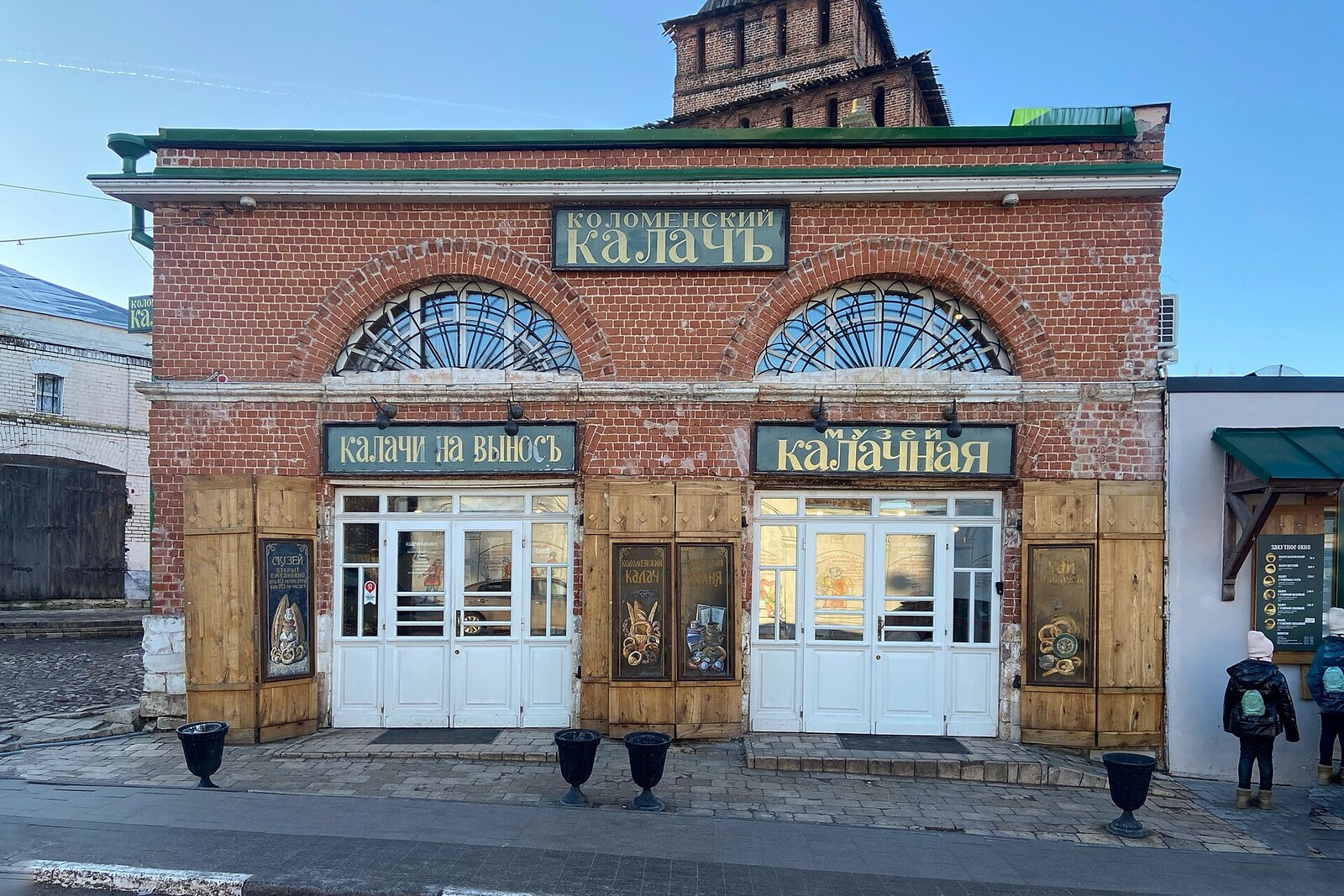
Look around first
What to notice
- Two-deck oven
- Cold table
- Kalachi with a handle and a cut lip
The story of the place
The building near Pyatnitskie Gates once served as a wholesale shop and was part of the city's trading complex. Bakers now work here beside a two-deck oven restored from old drawings, preparing dough on a cold table. A kalach has an extended handle and a cut thick part called the lip; it is folded over before being placed in the oven. When the navigable stretch of the Moskva River ended in Kolomna, merchants transferred goods from ships to warehouses and wagon trains, while bakers received imported wheat for bread.
In the early two thousands, the Kolomna kalach existed in old manuals and in the name of a local urban trade. No bakers remained who could pass the craft on from hand to hand. Natalia Nikitina, a social entrepreneur and head of Kolomna Posad, decided to make kalach once again into a product baked and sold here.
Nikitina's team worked with historians and food technologists for about a year. Manuals from the nineteenth and early twentieth centuries were found at the Russian State Library, but a printed recipe could not replace a baker. Experiments were needed to restore the proportions of two types of flour, the hop starter, the alternation of heat and cold, the long kneading, and the shaping. For the Kolomna kalach, they used three parts krupchatka—flour made from durum wheat—and two parts more finely milled flour. The dough is rubbed on a cold table, with care taken to preserve large pores inside it; then the handle is pulled out, the thick part—the lip—is cut, and it is folded over before being placed in the oven.
For production, Nikitina chose a former wholesale shop by Pyatnitskie Gates, once part of the local trading complex. This setting explains the origin of the Kolomna kalach. In old Kolomna, the navigable stretch of the Moskva River, known as the big water, came to an end. Merchants transferred goods here to warehouses and overland wagon trains, while kalach bakers received imported wheat and could make their own flour blends. White wheat bread cost more than rye bread; a master made a living by selling kalachi and was financially responsible for every unsuccessful batch.
A two-deck oven, recreated from old drawings, was installed in the restored shop. That is why the bakers' work is the main museum exhibit here. During the program, they prepare the dough, shape the kalachi, and put them into the oven; the finished baked goods are then sold in the shop. A theatrical host of the kalach shop demonstrates the craft, while real production continues behind the performance.
The museum opened in two thousand thirteen. Soon customers began lining up outside the former wholesale shop, and photographs appeared online with the caption: “A line for bread has been organized in Kolomna.” For Nikitina, this line became proof that the restored technology was once again bringing income to those who possessed it. In September two thousand twenty-two, the millionth kalach was baked in this oven.
Useful on site
Daily from 10:00 to 20:00; museum programs are held by advance appointment.
Checked: date not specified. Check the official source before visiting.The production demonstration and tasting require a separate museum program; without it, the stop remains an outdoor chapter of the route.