 Guide On Map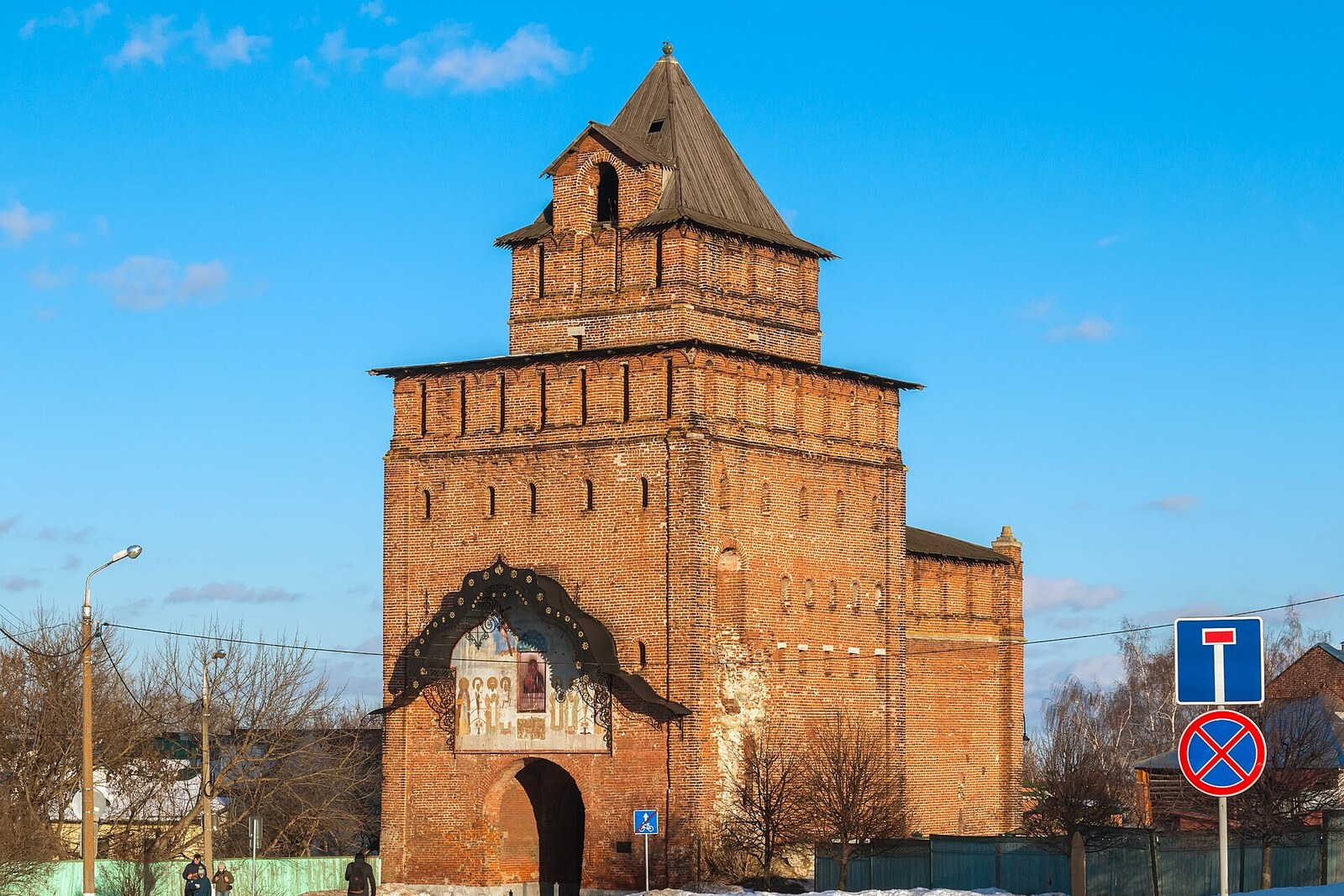
Look around first
What to notice
- Passage arch
- Areas of small dark brick
- Stone chapel
The story of the place
This tower preserves the only ceremonial passageway of the Kolomna fortress. Through the tall arch, the road led from the Kremlin to the Posad with its large marketplace, where sellers, buyers, and duty collectors gathered, while a special court heard commercial disputes. A wooden Church of Saint Paraskeva Pyatnitsa, the patroness of traders, once stood nearby; the gates got their name from it. The church has long been gone, but a stone chapel remains on the outer side of the tower, and smaller, darker bricks from later repairs are visible in the exposed masonry.
In the summer of eighteen eighty-two, the architect Nikolai Sultanov came to Kolomna to inspect its ancient structures. By then, entire stretches of the wall and most of the towers had already disappeared from the Kremlin. For decades, townspeople had been taking the masonry apart for their own construction projects; one contemporary bluntly called the fortress a quarry. A repair project lay dormant because no money could be found for it.
Sultanov was looking for structures that could still be saved. He found only one Kremlin tower in normal condition: Pyatnitskie Gates. In eighteen eighty-three, the architect reported this to the St. Petersburg Society of Architects. Had the specialists once again confined themselves to an inspection, Kolomna might have lost its last passage tower as well: the other main gates had already been dismantled or lost earlier.
Three years later, the Moscow Archaeological Society sent Andrei Pavlinov, an architect-restorer who made his living by designing and studying Old Russian structures. He began his work with Pyatnitskie Gates. Pavlinov reinforced the passage and rebuilt the damaged sections with small bricks. These repairs have survived: where the masonry is exposed, they are darker and smaller than the old Kremlin bricks. After this restoration, Pyatnitskie Gates remained the fortress's only surviving ceremonial entrance.
They got their name from people who came here not to fight. Behind the gates lay the Posad, and nearby stood a huge city marketplace. In the middle of the sixteenth century, there were thirty-one trading rows here and nearly seven hundred shops and trading places. Opposite the passage stood the customs yard, where collectors took duty from both sellers and buyers. There were also a storehouse, large scales, and the tiun's chamber—a court that heard commercial disputes. The gates led directly to the place where goods were inspected, duties were paid, and people stood up for their money.
Saint Paraskeva Pyatnitsa was an early Christian martyr whom Russian traders revered as their patroness. A wooden Church of Saint Paraskeva Pyatnitsa stood by the gates, and the gateway came to be known as Pyatnitskie Gates after this church. When the church disappeared, eighteenth-century documents briefly called the gates Savior Gates, but the new name did not last. In the nineteenth century, a stone chapel was added to the tower, preserving the memory of Paraskeva.
The old wooden church has not survived. Its connection with the gates is now marked by the chapel on the outer side of the tower and by the name itself above the road that connected the fortress with the commercial Posad.
Useful on site
Exterior viewing and passage are available at any time; the gates are part of the city street network.
Checked: date not specified. Check the official source before visiting.Walk through the arch and pause briefly on both sides, without blocking the passage for others.