 Guide On Map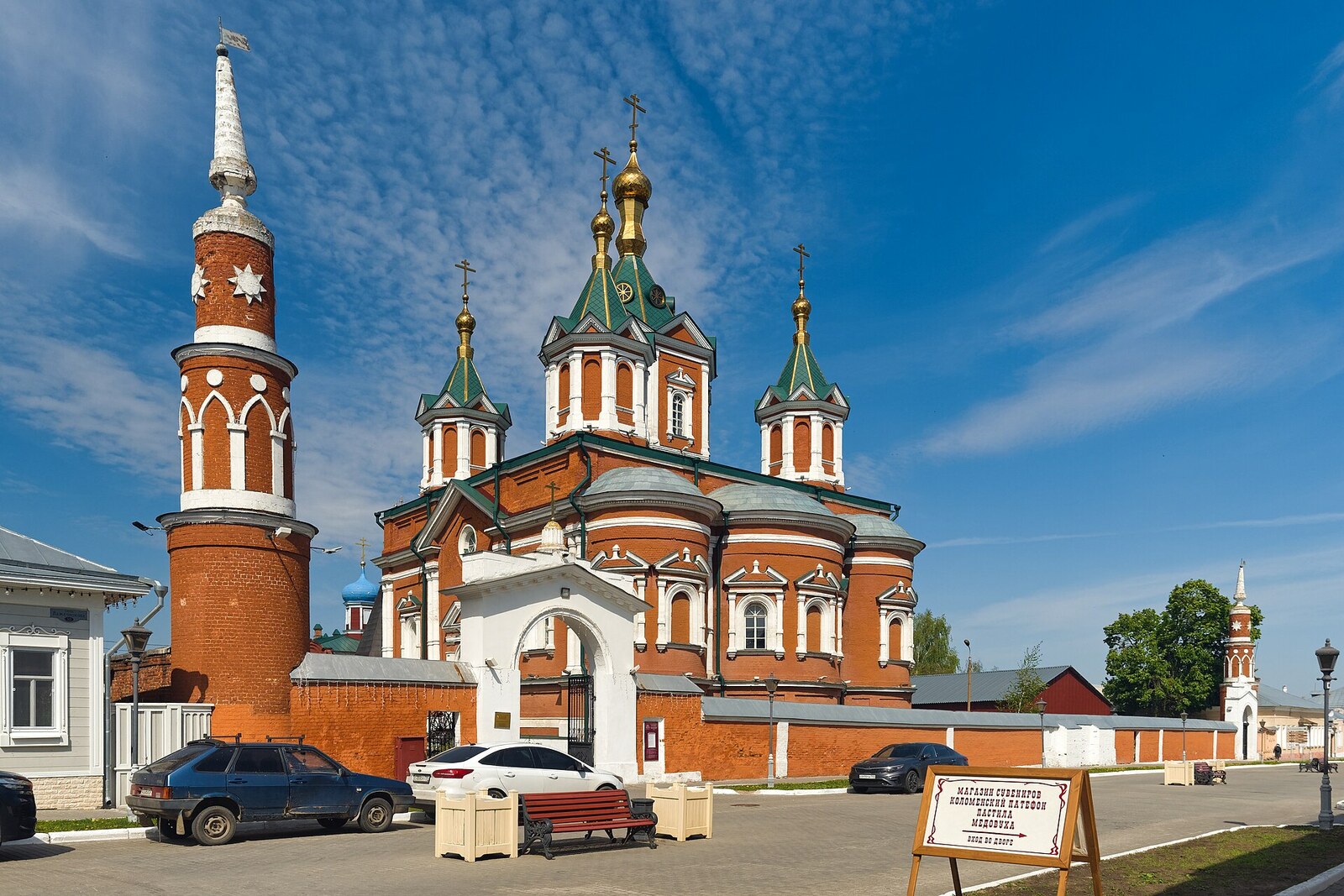
Look around first
What to notice
- The tent-roofed Church of the Assumption
- The five-tented Cathedral of the Exaltation of the Cross
- The grave to the right of the entrance gates
The story of the place
In eighteen forty-eight, a dilapidated residential building collapsed at Brusensky Assumption Monastery. The nuns narrowly escaped death. The new abbess, Olympiada, had been sent here to put the monastery in order: its wooden cells were falling apart, and there was not enough money to repair the old church. Now she had to find housing for the sisters, but there was no money for construction.
An episode survives in Olympiada’s biography: the Kolomna merchant Filipp Tupitsyn saw the abbess weeping, asked what had happened, and promised to help build stone cells. After him, other wealthy townspeople began contributing money. Olympiada built several residential buildings, arranged a shared refectory for the sisters, and then undertook the most expensive project of all—the large Cathedral of the Exaltation of the Cross.
The new church was needed because of the old Church of the Assumption. The small white tent-roofed church dates from fifteen fifty-two. In the summer of that year, Ivan IV (Ivan the Terrible) assembled an army in Kolomna before the campaign against Kazan; after the victory, the church was erected in the Kremlin in memory of the campaign. The monastery received the first part of its name from the church’s dedication to the feast of the Dormition of the Theotokos. Most researchers connect the word “Brusensky” with squared timber: the first cells, fence, and other buildings were wooden, or, as people said then, made of timber. The documents have preserved no exact explanation of the name. After its devastation during the Time of Troubles, the former men’s monastery was restored as a convent.
By the middle of the nineteenth century, the ancient Church of the Assumption had become dilapidated and could no longer hold all the sisters. But Olympiada’s decision to build an enormous five-tented cathedral beside it seemed risky even to her church superiors. Bishop Evgeny, who had come to visit two female relatives who were nuns, reminded the abbess of the Gospel parable of the man who laid the foundation of a tower without calculating the cost and could not finish it. For the abbess, this was a direct warning: an unfinished construction project could leave the community with neither money nor a new church.
Olympiada continued collecting donations. One of the largest contributions came from the Moscow benefactor Yakov Ermakov, whose daughter lived here as a nun under the name Feofaniya: he paid for the cathedral’s interior decoration. Three years later, Bishop Evgeny came to Kolomna again, saw the nearly completed building, admitted that he had been wrong, and gave a Gospel Book for the altar. The cathedral was consecrated in eighteen fifty-eight.
The nuns received stone residential buildings, a shared refectory, and a spacious church. By the beginning of the eighteen seventies, a large agricultural operation was already operating here, and an established community of nuns lived here. Monastic life was resumed after a long break in nineteen ninety-seven; today nuns live here again and services are held.
Olympiada died in eighteen seventy-three. The sisters secured permission in advance to bury her inside the monastery—to the right of the entrance gates, opposite the Cathedral of the Exaltation of the Cross that she had built. The nuns called this grave “our gatekeeper.”
Useful on site
An active convent; access to the grounds and churches is subject to the service schedule. No separate regular visitor schedule has been published.
Checked: date not specified. Check the official source before visiting.This is an active convent: look around the grounds quietly, and if a service is in progress, limit your visit to the exterior.