 Guide On Map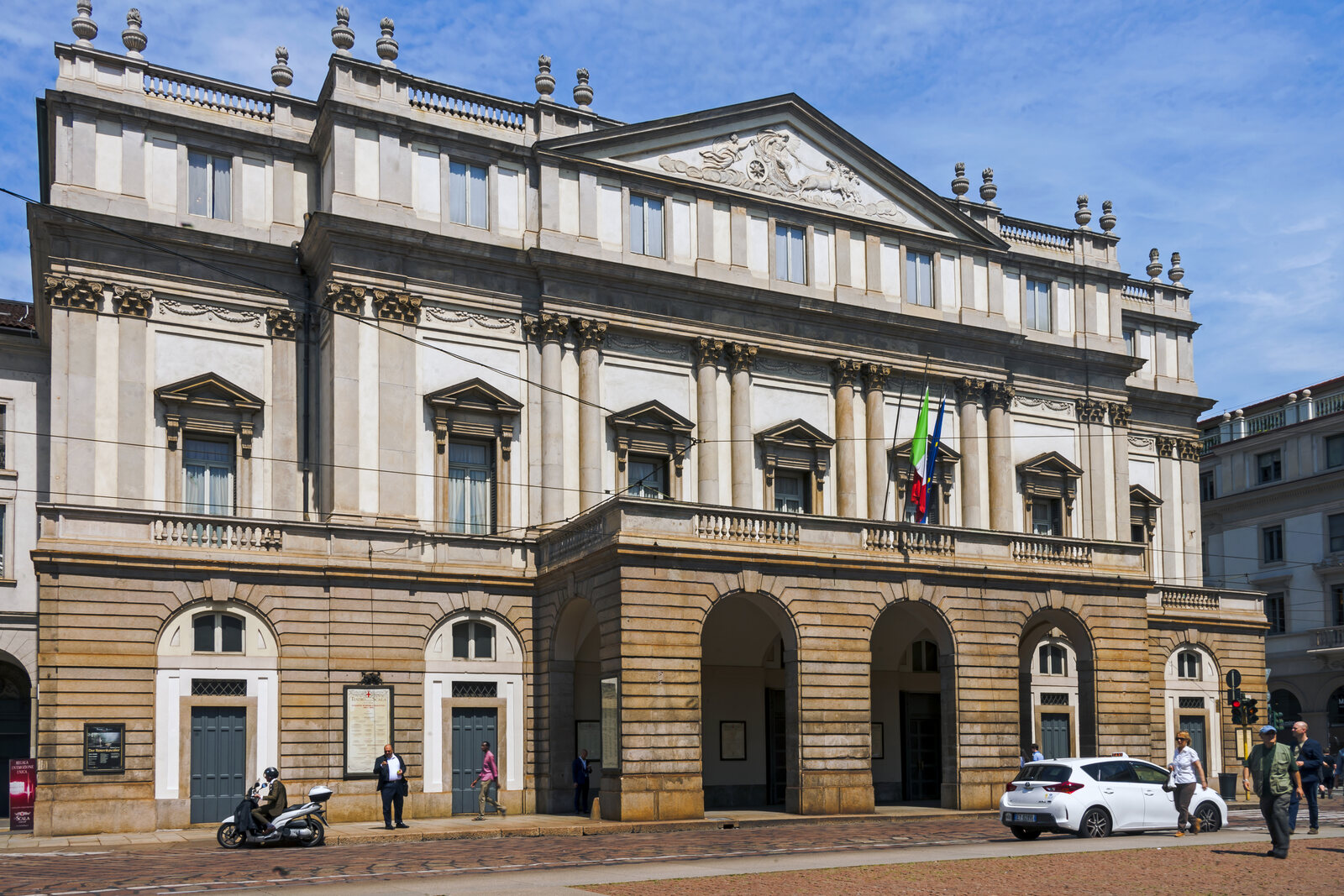
Look around first
What to notice
- Theater facade
- Covered entrance
- Theater boxes
- Nabucodonosor poster
The story of the place
The covered entrance at La Scala's facade leads into the theater, where the impresario assembled the entire season: commissioning new operas, hiring singers, and answering for full boxes. Here, manuscripts turned into productions on the stage, and the fate of each evening immediately became both an artistic and a financial matter. A few rooms away from the auditorium is the La Scala Theatre Museum, which has preserved a poster from one of those seasons.
On September fifth, eighteen forty, the La Scala audience rejected Giuseppe Verdi's comic opera Un giorno di regno. It was withdrawn after its only performance. For the young composer, this was a blow to the profession by which he intended to support himself. Verdi had already left his only permanent post—a city music teacher's job in Busseto—and moved to Milan for theater commissions.
By that evening, he had lost two young children, and less than three months before the premiere, his wife Margherita Verdi had died. Behind him was one opera, received by the public without enthusiasm; ahead was a contract for several more scores. Verdi demanded that the contract be terminated and announced that he would compose no more.
Bartolomeo Merelli, La Scala's impresario, refused to let him go. At the time, the impresario assembled the season himself: he commissioned operas, hired singers, sought full boxes, and answered for a failure at the box office. It was Merelli who, after staging Verdi's first opera, commissioned three more works from him; now his choice also appeared to have been a mistake. He needed to bring the composer back to work and obtain a new production in place of the failed one.
Merelli had a finished libretto for the opera Nabucco, written by Temistocle Solera. Another composer, Otto Nicolai, had already rejected it. Merelli gave the manuscript to Verdi and insisted that he at least read it. Many years later, Verdi said that at home he tossed the bundle onto the table, its pages fell open at the words of the chorus of captive Jews, “Fly, thought, on golden wings,” and that line made him continue reading. The account was recorded almost forty years after the event, and Verdi's version contains errors in the chronology of the family deaths, so the accidentally opened page cannot be taken as a scene reconstructed with certainty. The sequence itself is reliable: Merelli did not terminate the contract, gave Verdi the rejected text, and Verdi wrote the music.
On March ninth, eighteen forty-two, Nabucco was first performed on this stage. In the autumn, the opera gave fifty-seven performances. By eighteen forty-four, it had been staged in nearly sixty theaters. Merelli gained another success and commissioned Verdi's next opera; the composer, who had intended to leave the profession, was now receiving offers from other cities. Later, he called Nabucco the true beginning of his creative career.
The La Scala Theatre Museum preserves the original poster from that season. It bears the full title—Nabucodonosor; the shortened Nabucco became established two years later. The poster remains a few rooms away from the stage where the public first ended Verdi's career after one evening, and then paid fifty-seven times in a row for his return.
Useful on site
The facade can be viewed freely, but the museum is visited separately; visibility of the auditorium may depend on theater operations.