 Guide On Map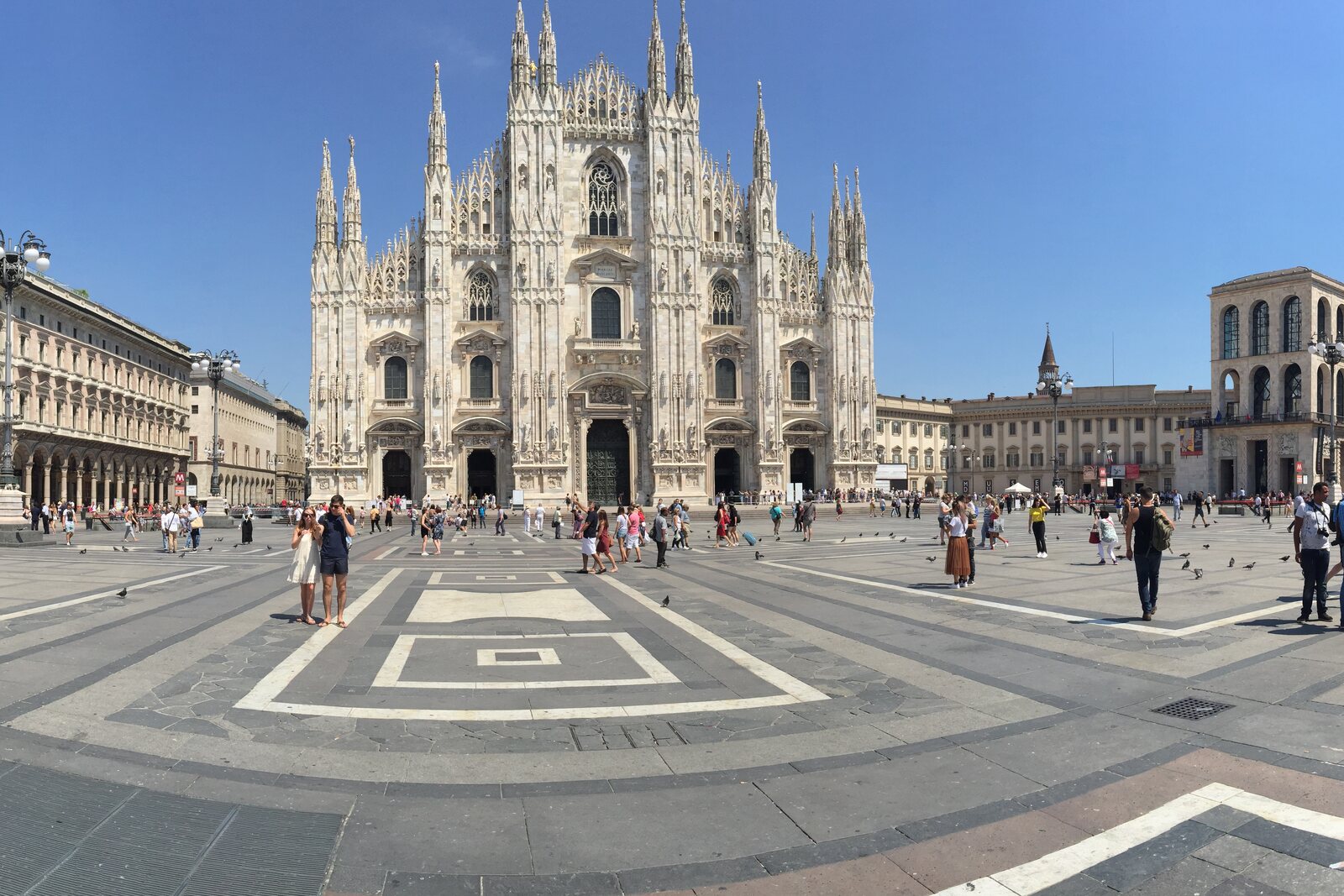
Look around first
What to notice
- Equestrian monument to Victor Emmanuel II
- Exit onto Via Torino
- Side porticoes
- Facade of Milan Cathedral
The story of the place
On May seventh, eighteen ninety-eight, General Fiorenzo Bava Beccaris rode into Piazza del Duomo on horseback. He commanded the Milan Army Corps and was to bring the city center back under control. On Via Torino, barricades were already standing about one hundred meters from here. Others blocked the streets leading onto the square.
Piazza del Duomo literally means Cathedral Square. Milanese people named it after the cathedral, but the present open space in front of it appeared comparatively late. In the eighteen sixties and seventies, the city council demolished the covered commercial structure Coperto dei Figini and the cramped Rebecchino quarter, built the side porticoes, and opened a passage to the new gallery. In place of shops, taverns, and residential buildings, there emerged a broad rectangle where the main streets of the center converged. It was a convenient urban stage for celebrations. For the general, it was a ready-made parade ground and a hub from which Milan could be occupied piece by piece.
The unrest was sparked by rising bread prices. For families living on daily wages, the increase meant less food, not fewer expenses on comforts. Clashes began on May sixth. The following day, tens of thousands of workers stopped work, and crowds moved from the outskirts toward the center.
Bava Beccaris had been responsible for this city since eighteen ninety-five; his further military career depended on whether he could hold Milan for the monarchy. He later set out his plan almost day by day. First, the troops were to hold Piazza del Duomo and push the rebels back toward the city gates. Then they were to occupy the gates and boulevards, followed by the suburbs and railway lines. On the evening of May seventh, the general received the powers of a royal commissioner: this meant that he could govern the province as a military zone. Infantry, cavalry, and army wagons filled the square; units moved out along the streets from here.
Piazza del Duomo itself was the operation's headquarters, while shooting took place in different parts of Milan. Bava Beccaris ordered troops to open fire; they also used artillery. According to the official count, about eighty people were killed and several hundred were wounded. Opponents of the government named far higher figures. Thousands of people were arrested, and opposition newspapers were closed. By May tenth, the general had carried out his plan.
At the center of the square, the bronze Victor Emmanuel II—the first king of united Italy—had already stood for two years. Umberto I, who reigned in eighteen ninety-eight, was his son. A month after the shootings, Umberto awarded Bava Beccaris a high military order, and soon afterward the general became a senator.
Gaetano Bresci saw this award. He was an Italian weaver and anarchist working at a silk factory in the American city of Paterson. He had a well-paid position as a foreman, a wife, a young daughter, and another child the family was expecting. Bresci left them and returned to Italy. At his trial, he explained that he had decided on murder after the events in Milan and the awarding of their organizers. On July twenty-ninth, nineteen hundred, he shot King Umberto in Monza. Bresci was sentenced to life imprisonment; the following year, he was found dead in his cell. Suicide was named as the official cause. Bava Beccaris kept his seat in the Senate and died in nineteen twenty-four.
There is no longer a military camp on the square. What remain are the equestrian monument to the father of the king who rewarded the general, and the outlet of Via Torino at the southwestern corner—the very street whose barricades Bava Beccaris saw one hundred meters from here.
Useful on site
It is more convenient to listen to the story away from the main flow of people, while keeping the monument and the cathedral facade in view.