 Guide On Map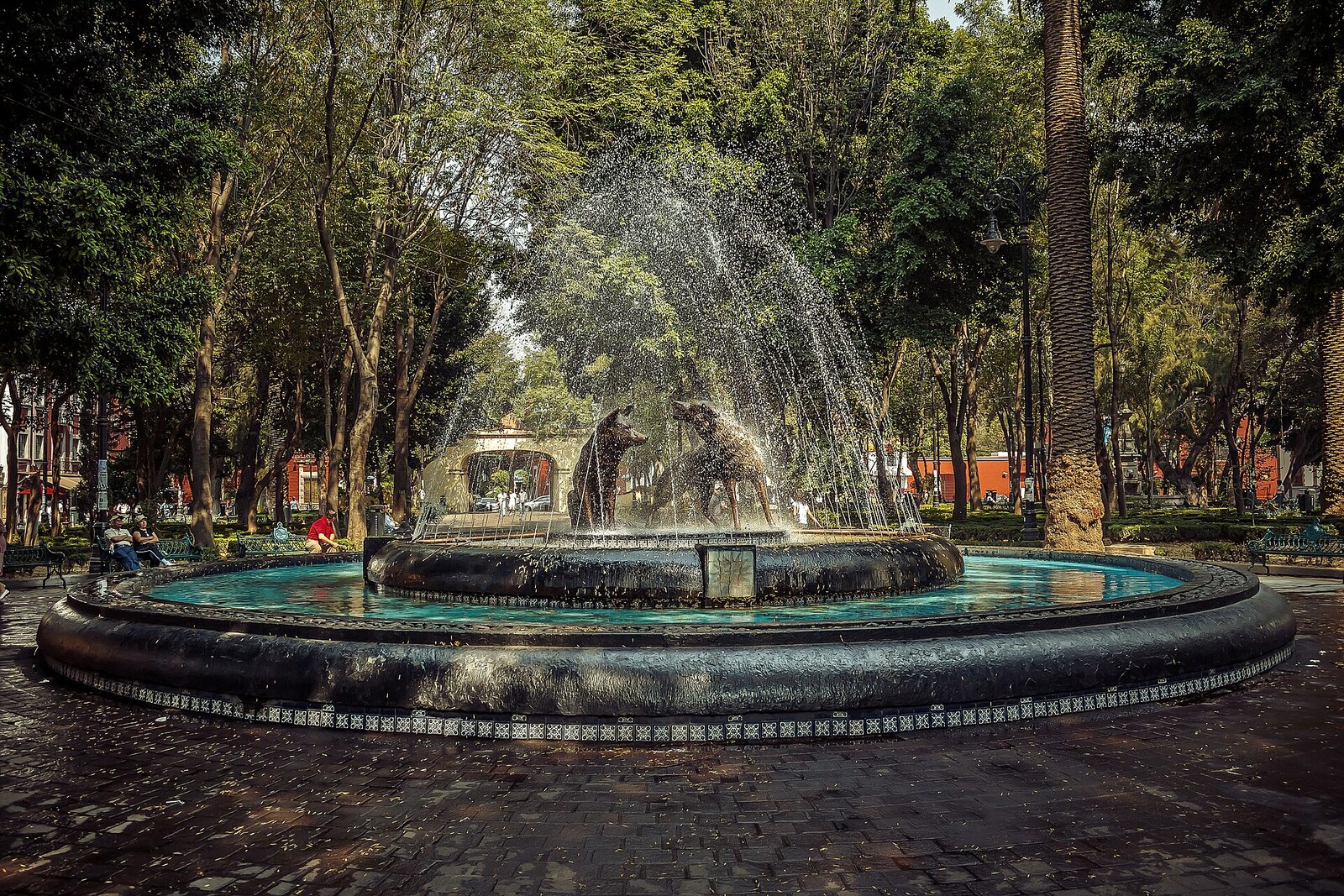
Look around first
What to notice
- Double stone arch
- Fountain with bronze coyotes
- Geometric flowerbeds
- Benches
The story of the place
The layout of this urban garden is based on the pattern of flowerbeds and paths established in nineteen thirty-four. When the pattern was still different, children rode bicycles here; during civic holidays, a running track was marked out; basketball players played on the court, and traders came on Fridays. At the beginning of the nineteen eighties, a fountain with two bronze coyotes by Gabriel Ponzanelli appeared in the center. These figures refer to the old name of Coyoacán, which in Nahuatl is associated with a place where coyotes are found.
On September twenty-seventh, nineteen twenty-one, Jardín Centenario was opened here. An old church property was chosen for it: formerly, a double stone arch at the western entrance led into the huge courtyard of the Monastery of San Juan Bautista. It occupied both the present-day garden and the neighboring square, and for a time it served as a cemetery.
The garden was developed under the program of President Álvaro Obregón. He led the country after a decade of revolutionary war and wanted to secure recognition for his young government within Mexico. The anniversary of independence offered a fitting occasion. Eleven years earlier, they had marked one hundred years since the uprising began; now Obregón chose another date—the end of the war. On September twenty-seventh, eighteen twenty-one, a united army of former royalist soldiers and insurgents entered Mexico City. Exactly one hundred years later, Coyoacán’s former cemetery courtyard opened under the name Centenario—“Centennial.”
The organizers planted trees, laid out flowerbeds and paths, installed irrigation, and put in benches and lamps. They even renamed the northern Calle San Felipe as Calle Centenario. Residents gained a place for altogether different pursuits: children rode bicycles here, during civic holidays adults marked out a running track and held competitions, basketball players got a court, and on Fridays traders set up a market. The neat geometry of today was still a long way off. The layout of the flowerbeds, which is largely still preserved today, was created in nineteen thirty-four.
At the beginning of the nineteen eighties, the center of this layout was occupied by a fountain with a sculpture by Gabriel Ponzanelli. He placed a bronze female coyote on its hind legs and set a male alongside in an alert pose. The animals were chosen because of the ancient name of Coyoacán itself. In Nahuatl, it is parsed as “coyo-hua-can”; one old interpretation translates it as “where they have coyotes.” The fountain turned the name into two recognizable figures and became a meeting place.
At the western edge, the church arch remains; in the center of the former cemetery courtyard stand the bronze coyotes, and between them people still meet, trade, and relax.
Useful on site
Open public space
Checked: date not specified. Check the official source before visiting.The fountain is often crowded, so move to the edge of the garden if you want to hear the story in peace. Do not climb onto the basin or the sculptures for a photograph.