 Guide On Map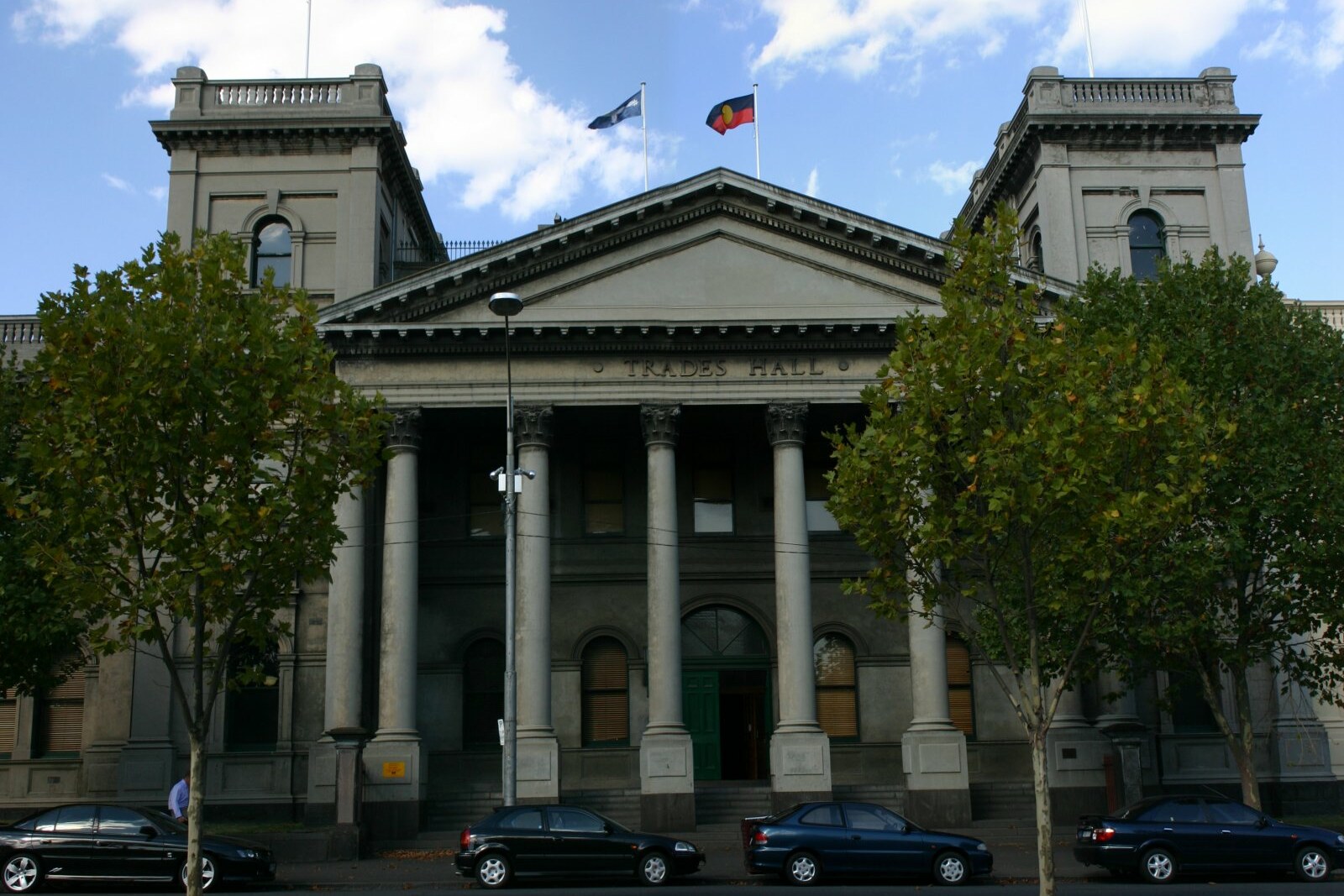
Look around first
What to notice
- Three gilded eights
- Granite column
- Bronze globe
- Stone facade of Trades Hall
The story of the place
The stone Trades Hall did not rise all at once: for decades, offices, meeting halls, and rooms for new unions were added to it. Trade unions still meet here, while at other times the spaces are occupied by plays, exhibitions, and comedy festival performances. In front of the facade stands a granite column with a bronze globe; above it shine three gilded eights. They divide the day into labor, leisure, and rest, and the monument itself was once moved here from Parliament House.
In May eighteen fifty-nine, about eight hundred people sat at long tables on this site to drink tea. Music and speeches followed. Those gathered were opening the wooden Trades Hall and literary institute—a shared home for trade unions, built and paid for by the workers themselves. Before it, union committees had to meet in hotels and rent whatever rooms were available.
The victory won three years earlier provided the money and people for this home. Melbourne's skilled builders then worked ten hours from Monday through Friday, and another eight hours on Saturday. Their wages were calculated by the day. On large building sites, a stonemason could earn fifteen shillings; some contractors agreed to shorten the shift only if the pay fell to thirteen. The workers demanded that their daily wage be retained: otherwise, the two free hours would have to be bought at the expense of their families.
On April twenty-first, eighteen fifty-six, James Stephens, a Welsh stonemason and chairman of the committee campaigning for the eight-hour day, stopped work on the construction site of the University of Melbourne. He called on the others to put down their tools and led them across the city. Stonemasons from other sites joined the march along the way; they finished at Parliament House.
Stephens and his companions could have lost their day's pay and their jobs, but they chose a favorable moment. After the gold rush, Melbourne was building frantically, and it was difficult to replace many experienced tradesmen at once. The contractors began to give way. Stonemasons and several other building trades received an eight-hour day without a corresponding reduction in wages.
Three weeks later, the workers held a victory march. Its motto divided the day into three equal parts: eight hours of labor, eight hours of leisure, and eight hours of rest. But the builders understood that a one-time agreement was not enough. Different trades needed a place where their representatives could negotiate with one another, store documents, and educate workers and their children. They created the Trades Hall committee, raised funds, received land from the colonial government, and built the first hall here.
The wooden building with its iron roof has disappeared. The present stone complex was built in stages from eighteen seventy-four to nineteen twenty-five, adding offices, meeting halls, and rooms for new unions. Trade unions still use it today; at the same time, it hosts plays, exhibitions, and performances of the Melbourne International Comedy Festival.
The annual march honoring the eight-hour day continued for decades, and its participants decided to leave a permanent marker. In nineteen oh three, fourteen surviving participants in the early movement attended the unveiling of the granite monument. Three gilded eights above the column repeat their division of the day, while its parts—labor, leisure, and rest—are named on the bronze globe.
At first, the monument stood by Parliament House, where the stonemasons had marched. In nineteen twenty-four, it was moved here, opposite the Trades Hall they had created. The first wooden hall is gone; the three eights stand before the same site that the workers received for their meetings in eighteen fifty-eight.
Useful on site
The monument is accessible from outside; access to Trades Hall depends on events, tours, and hall rentals.
Checked: date not specified. Check the official source before visiting.The monument can be viewed from the street. Trades Hall remains a working institution, so do not go inside without clear access or a separate program.