 Guide On Map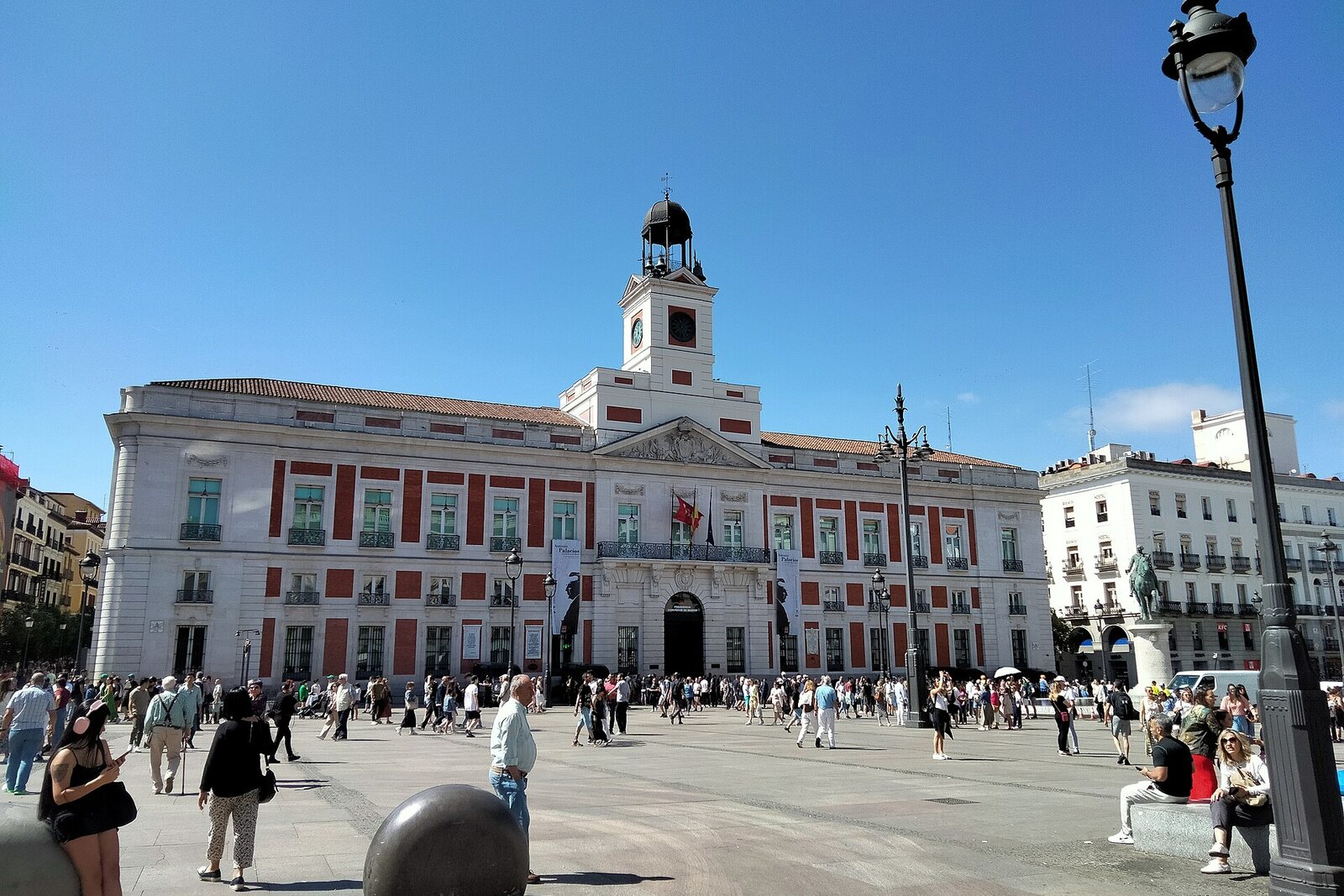
Look around first
What to notice
- White marble plaque on house No. 8
- Real Casa de Correos
- The foundations of Buen Suceso Hospital behind glass in Sol station
The story of the place
Madrid residents arrange to meet here for the same practical reason that townspeople and soldiers converged here two hundred years ago: the main streets of the old center meet at this point.
Puerta del Sol means “Gate of the Sun.” A small eastern postern in the medieval wall stood here, decorated with an image of the sun. In the seventeenth century, the wall and gate were dismantled, but the roads remained. By the beginning of the nineteenth century, their intersection held a cramped, elongated square, nothing like today’s semicircle. Calle Mayor, Calle de Alcalá, Calle de Carretas, and Carrera de San Jerónimo opened onto it. Those converging streets determined what happened here on May second, eighteen oh eight.
French troops entered Spain under an agreement with the Spanish court: Napoleon Bonaparte promised to lead his army through the country for war with Portugal. His forces then occupied the fortresses and Madrid. King Charles IV abdicated in favor of his son Ferdinand VII, but both went to the French city of Bayonne—each hoping to win Napoleon’s support. In the capital, Joachim Murat, commander of the French army, was in charge. He wanted to remove the remaining members of the royal family.
On the morning of May second, people gathered before the Royal Palace, trying to prevent the departure of the king’s younger brother, Francisco de Paula. The French Guard opened fire. Spanish soldiers were ordered to remain in their barracks. News of the dead spread through the streets, and at Puerta del Sol the residents first responded en masse with weapons.
Vendors, artisans, and urban laborers came here. They earned their living in shops and workshops, did not serve in the army, and handled rifles poorly. Most had knives, axes, and sticks; firearms could only be obtained during the clashes themselves. The choice was especially dangerous for these people: soon, any knife or tool that soldiers deemed a weapon could become grounds for a death sentence.
Murat sent cavalry from the Imperial Guard to the crossroads. Among the riders were Mamelukes—a mounted detachment created by Napoleon after the Egyptian campaign that retained eastern-style uniforms and curved sabers. Two squadrons of mounted chasseurs and a detachment of Mamelukes entered from the directions of Calle de Alcalá and Carrera de San Jerónimo. To break through farther toward Calle Mayor, the cavalrymen had to attack three times.
Men pulled riders from their saddles. Women crawled beneath the horses and stabbed the animals with knives to topple the cavalrymen. People fired from windows and threw stones. At the corner of Calle de Carretas, beside Real Casa de Correos, ten-year-old José del Cerro and eleven-year-old José Gacio Cristóbal met a Guards dragoon with stones. Del Cerro was wounded in the thigh and arm and died from the effects of those injuries several months later. Gacio Cristóbal was shot on Calle de Carretas.
Artillery, rifle fire, and repeated cavalry attacks cleared the square. Some of those who survived went to Monteleón Artillery Park, where fighting was still underway. That evening, Murat created a military commission: those caught with weapons were sentenced to death. Executions by firing squad began that same night and continued the following day. The Dos de Mayo Uprising was suppressed, but news of it spread throughout the country; a war began that lasted six years.
Buen Suceso Church and Hospital stood at the edge of the square at that time. After the battle, the wounded took shelter there, while French soldiers shot prisoners in the courtyard. The building was demolished in eighteen fifty-four. During the construction of Sol station in two thousand six, its foundations were found beneath the square; the stonework can now be seen behind glass inside Sol station.
Another marker remained above ground. A white marble plaque, installed in nineteen oh eight, hangs on the façade of house number eight. Its inscription is dedicated to the “heroes of the people” who joined the first battle here against Napoleon’s troops. At the palace, the crowd was fired upon; at the crossroads of the vanished Gate of the Sun, the townspeople first forced the cavalry to break through the crowd three times.
Useful on site
Open square; checked 2026-06-30. No ticket is required, but access to the Zero Kilometer plaque and the façade may be closed during mass events or a police perimeter.
Checked: June 30, 2026. Check the official source before visiting.Listen from the edge of the square, where both the façade of Real Casa de Correos and the movement of people are visible. On days of mass events, do not try to make your way to the central point.