 Guide On Map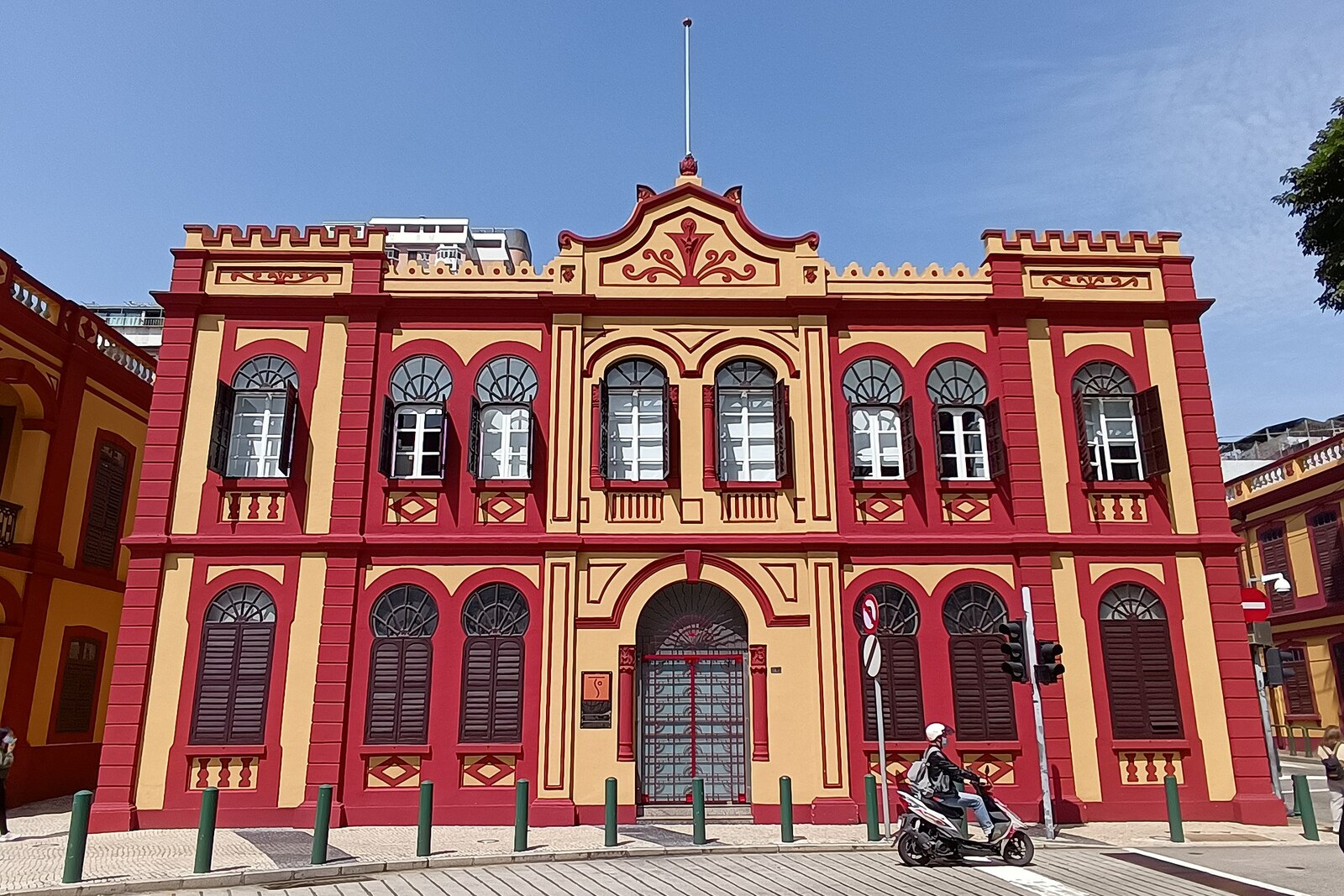
Look around first
What to notice
- Ochre-red façade
- Wooden shutters
- Two wells
- Curved metal staircase
The story of the place
The ochre-red façade with wooden shutters conceals a public gallery arranged in two connected buildings: the front one faces the street, while the second extends into the courtyard. Exhibitions alternate in the front part, while screenings, discussions, and lectures take place farther in. Between the buildings, the steps and an inner courtyard lit from above by a glass skylight have survived.
At the center of this ochre-red house, two old wells have survived. They now stand beneath a glass skylight amid the exhibition rooms, but in the nineteen twenties they were used by a well-to-do Macao family. The front mansion and the later building in the courtyard then formed a private property.
In the mid-nineties, the Oriente Foundation decided to open the Macao Contemporary Art Centre here: a gallery on the lower floor and a radio studio upstairs. The commission went to Maria José de Freitas, a restoration architect. She was paid to alter a protected building, and she was responsible for two things at once: a modern working space and the preservation of a house that could not be turned into an empty stage set with a historic façade.
De Freitas retained the exterior walls, wooden shutters, ochre and red paintwork, the original floor levels, and both wells. She dismantled the interior rooms and rebuilt them around exposed concrete and white walls. The front house was linked to the rear building, the glass skylight above the wells was enlarged, and a metal staircase with a gentle curve was installed at the back. In June nineteen ninety-seven, the client received a gallery downstairs and a radio studio upstairs. The Macao Contemporary Art Centre began holding exhibitions here, but left the house a few years later.
The Cultural Affairs Bureau leased the vacated premises and opened Tap Seac Gallery on December fifth, two thousand three. Japanese graphic designer Shigeo Fukuda came for the ceremony. The following day, an exhibition of his posters opened in the new rooms—the gallery's first exhibition. The house was immediately used for the role assigned to it: to show foreign art in Macao, and then to provide space for local artists, competition projects, and annual showcases.
Today, changing exhibitions occupy the front part of the building. Screenings, discussions, and lectures are held in the rear; between them remain the steps and an inner courtyard lit from above. The radio studio is no longer here, the Macao Contemporary Art Centre has moved away, and De Freitas left the two household wells exactly at the center of the public gallery.
Useful on site
Usually daily 10:00–19:00; closed for installation, dismantling of exhibitions, and maintenance.
Opening hours by day
Access inside depends on the current exhibition. If the doors are closed, examine the façade and the building's layout from the street; lectures, openings, and special events should be checked and planned separately.