 Guide On Map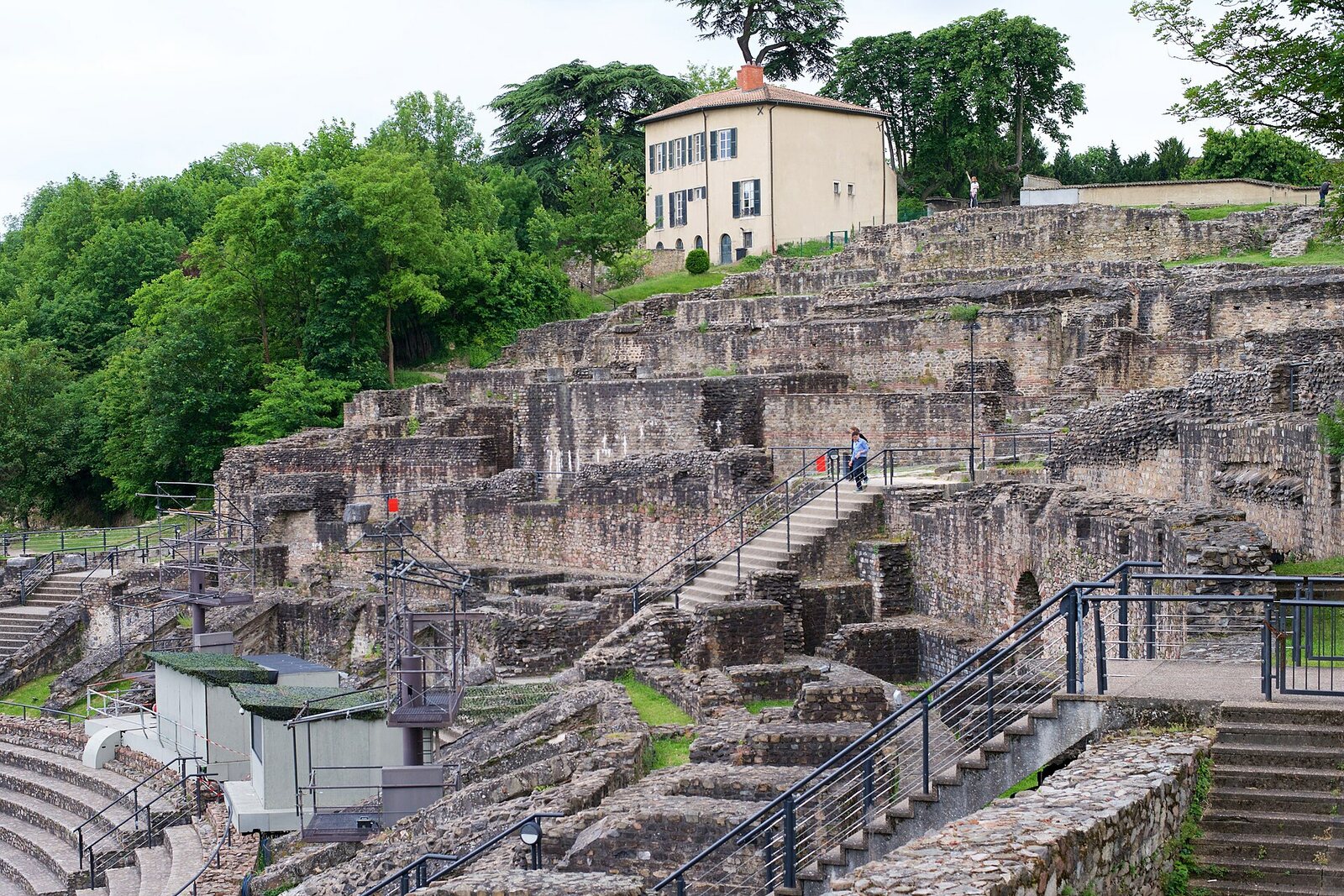
Look around first
What to notice
- Semicircular rows of the Ancient Theatre of Fourvière
- The orchestra
- The foundation of the stage wall
- Marble slabs of the Odeon of Lyon
The story of the place
The semicircular rows of the Ancient Theatre of Fourvière rest on the slope of Fourvière, and the orchestra area has been preserved below them. Roman builders constructed this theatre in the late first century BCE, when the city occupied the upper part of the hill; at first it held about five thousand spectators, then about ten thousand. Comedies and dance performances were staged here. Beside it stands the Odeon of Lyon, for music, recitations, and meetings; colored marble slabs brought from different parts of the Mediterranean still lie by its lower rows.
In the spring of nineteen thirty-three, twenty-seven unemployed residents of Lyon received picks and shovels from the city hall. Mayor Édouard Herriot hired them to clear ancient walls on the slope of Fourvière. For archaeologists, it was a way to settle a dispute that had lasted for years; for the diggers, it was paid work.
They hoped to find underground the amphitheater of Lugdunum—the name of Roman Lyon. An amphitheater was an oval arena surrounded by seating: fights and executions were held there. Researchers were looking for the building associated with the death of the first Christians of Lyon in one hundred seventy-seven. Curved walls protruding from the ground seemed like a fitting trace.
But as the excavations progressed, the rows formed a semicircle, and below them appeared the orchestra—the area in front of the audience—and the foundations of a stage. Such details belonged to a theatre. By nineteen thirty-five, they had to admit it: there was no amphitheater here. Its remains were discovered later on the slope of Croix-Rousse, on the other bank of the Saône.
Herriot did not stop the work after that. The city bought the neighboring plots and established a permanent municipal excavation workshop. The crew gradually grew: by nineteen forty, as many as one hundred twenty masons and diggers worked here. They cleared the earth from a vast theatre and the smaller semicircle beside it—the Odeon of Lyon.
The first theatre is called the Great Theatre to distinguish it from its neighbor. It was built in the late first century BCE, when the Roman city occupied the upper part of Fourvière. The builders supported the seating rows on the slope: at first, it held about five thousand people; after its expansion, up to ten thousand. Mostly comedies were performed on the stage, along with dances.
The Odeon of Lyon appeared later and held about three thousand spectators. This is what the Romans called a small theatre for music, recitations, and meetings. Its thick outer wall probably supported a roof, and slabs of colored marble brought from different parts of the Mediterranean still remain by the lower rows. In the Great Theatre, a wall more than twenty meters high once rose behind the stage. There was no open view of the city during performances; now only the wall’s foundation remains.
On June twenty-ninth, nineteen forty-six, Édouard Herriot came here again—to open the restored theatre. After his speech, a student troupe from the Sorbonne performed Aeschylus’s The Persians. These performances gave rise to the summer festival now called Nuits de Fourvière.
The rows through which the archaeologists understood their mistake once again serve spectators. At their foot, the semicircular orchestra still lies, and every summer a modern stage is set up behind the low line of the ancient foundation.
Useful on site
Open urban space; choose a viewing point that does not obstruct pedestrian traffic.
Checked: date not specified. Check the official source before visiting.Both structures can be viewed in the open air; watch your footing on the uneven stone and do not go beyond the barriers. The Lugdunum Museum, with the Claudian Tablet, requires separate time.