 Guide On Map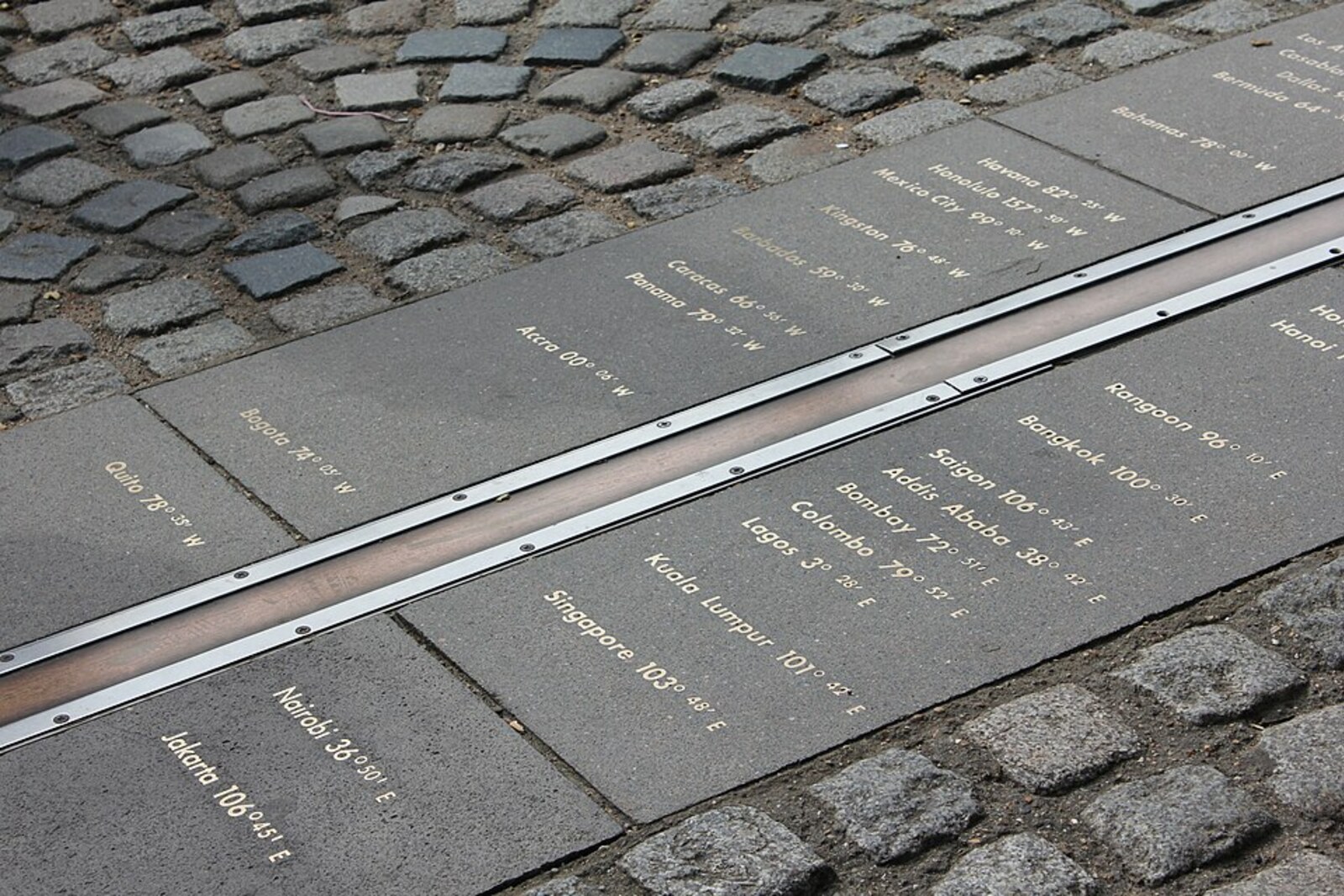
Look around first
What to notice
- Flamsteed House
- Airy Transit Circle
- Metal meridian strip
- Several meridian lines in the courtyard
The story of the place
In the spring of seventeen sixteen, pages from a star catalog were burning on Greenwich Hill. John Flamsteed—the first Astronomer Royal and the observatory's master—lit the fire. He broke up three hundred copies of the book, removed the sheets he considered usable, and publicly burned the rest in Greenwich Park. Flamsteed himself called the fire “a sacrifice to truth.”
Forty years earlier, King Charles II had tasked him with correcting the tables of the Moon's motion and of star positions. Sailors knew how to determine latitude, but they made errors of hundreds of miles with longitude—their position east or west. One method required measuring the Moon's position among the stars and comparing the result with a table calculated for a particular hour at the observatory. An error in a star's coordinates became an error on a sea chart.
The architect and astronomer Christopher Wren chose this hill for very earthly reasons. The sturdy foundations of the old Greenwich Castle remained here, the land already belonged to the Crown, and the open height was close enough to London's scholars and craftsmen. That is how the word “Royal” came about: the king established the post, appointed the astronomer, and housed him in a building constructed for the work.
Above the living quarters, Wren built the Octagon Room with tall windows. Yet none of its walls ran exactly north to south. To make measurements along the meridian, Flamsteed had to work in small extensions. There his telescopes followed a celestial body during the brief moment when it crossed the imaginary line through north, the zenith, and south. The moment of crossing was marked by pendulum clocks.
The state paid Flamsteed one hundred pounds a year. A church parish in Burstow and pupils who lived at the observatory provided additional income. Instruments and assistants consumed far more. He paid for the main mural arc for measuring the altitude of stars with money he received after his father's death. Flamsteed later calculated that he had invested more than two thousand pounds in the work. His concern was understandable: if unfinished observations were printed with errors under his name, the work of his entire life would suffer.
By the beginning of the eighteenth century, the catalog was still not ready. Isaac Newton, president of the Royal Society, and the astronomer Edmond Halley needed Flamsteed's observations for their own calculations. Newton obtained from Queen Anne the establishment of a commission that had the right to oversee the observatory and decide when to publish its materials. Flamsteed handed over sealed copies of the records. In seventeen twelve, Halley issued four hundred copies of the catalog with his own editing and with data the author considered raw and corrupted.
Four years later, Flamsteed recovered most of the print run and made that very bonfire. He then compiled and corrected the observations again, but did not manage to complete the publication. After his death in seventeen nineteen, Margaret Flamsteed took over the work. She was the astronomer's wife and had helped him with calculations and the management of the observatory. Together with her husband's former assistants, she published the complete catalog in seventeen twenty-five, and four years later a star atlas—the largest and most accurate of its time.
Halley received Flamsteed's post, but the observatory came to him without telescopes or clocks. Margaret removed them as property her husband had bought at his own expense. Government lawyers tried to recover the instruments, but Halley had to ask for money for new ones. He was granted five hundred pounds; the new meridian instrument was installed a little east of Flamsteed's line. Later Astronomers Royal changed the telescopes again, and with them the working Greenwich meridian shifted. That is why several lines are marked in the courtyard, rather than one eternal boundary between the hemispheres.
The historic zero runs through the last of these large meridian instruments. In eighteen fifty, the seventh Astronomer Royal, George Biddell Airy, designed the Airy Transit Circle—a telescope able to move only in the north–south plane. An observatory staff member noted the moment when a star crossed the eyepiece crosshairs and measured its altitude at the same time. Over a century, about six hundred thousand observations were made with this instrument. The telescope itself still stands in its original mounting; the metal strip in the courtyard continues the line through its eyepiece.
Longitude has no natural zero. In eighteen eighty-four, the International Meridian Conference in Washington, D.C., chose it by vote. Nearly two-thirds of the world's shipping already used charts measured from Greenwich, so changing from them required the fewest corrections. Twenty-two votes were cast for the meridian through the center of Airy's instrument, one against, and two other representatives abstained. Its crosshairs became zero for world longitude, and Greenwich Mean Time became the basis of the worldwide reckoning of days proposed by the conference.
Modern satellite navigation places the Prime Meridian about one hundred two and a half meters farther east. It needs a plane through the Earth's center of mass, whereas Airy's telescope was aligned to the local vertical defined by Earth's gravity on this hill. That is why a phone on the metal strip will show a small west longitude. The zero of eighteen eighty-four remained here—in the crosshairs of the old telescope.
Useful on site
June–August: 10:00–19:45 (last entry 19:00); September: 10:00–18:00; October–April: 10:00–17:00. In other months, hours may vary; check the website.
Checked: June 22, 2026. Check the official source before visiting.You can look at the time ball and clock from outside, without rushing straight to a photograph on the line. If access to the official meridian courtyard or to the instrument displays matters to you, check the conditions for a separate visit to the observatory.