 Guide On Map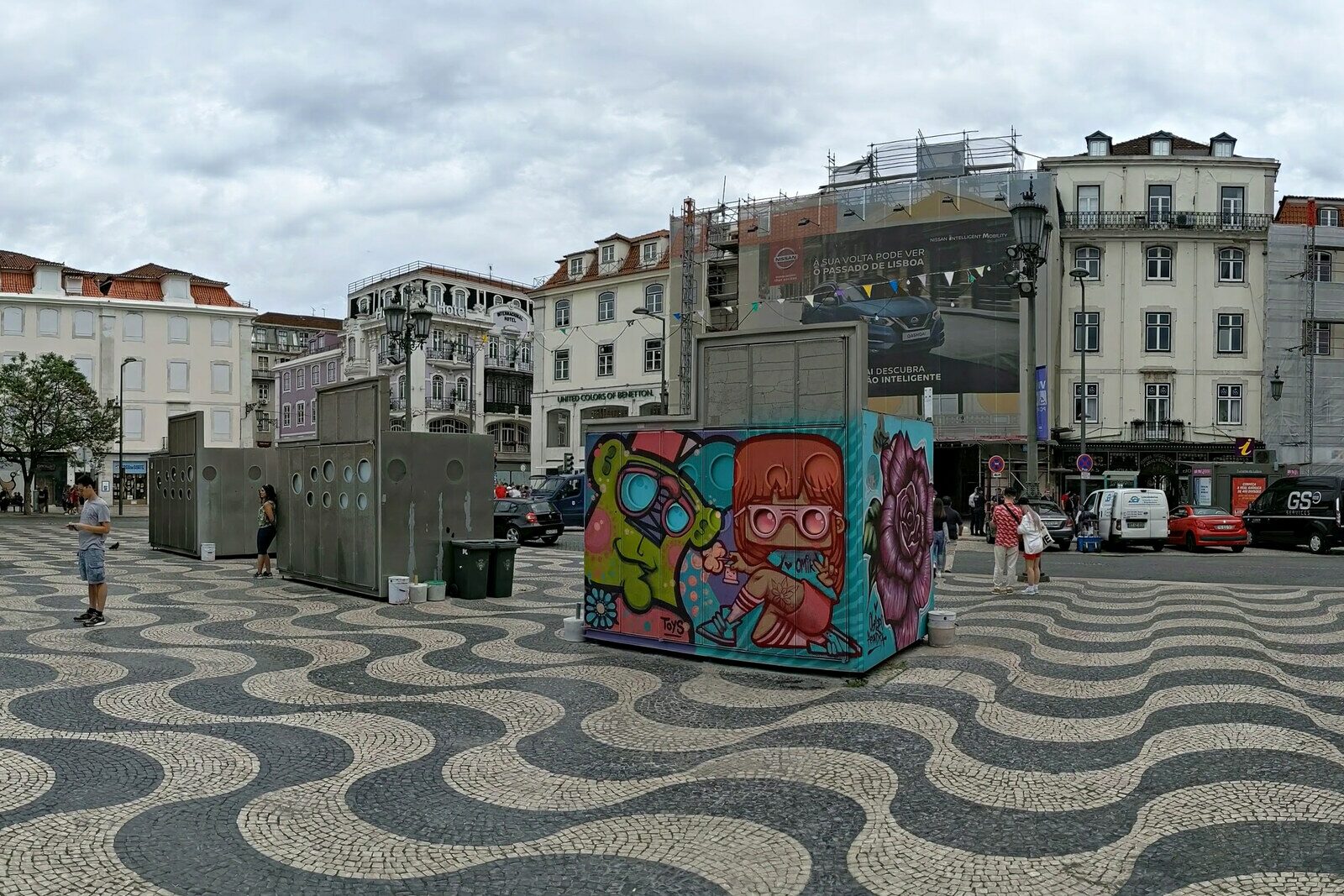
Look around first
What to notice
- Tall column
- Bronze figure with a rolled-up document
- Wavy pavement
- Theater facade
The story of the place
The wavy pavement spreads across a wide open space among houses rebuilt after the earthquake. When the center was reconstructed, it was not occupied by blocks: the old word “rossio” meant common open land used by townspeople. Here they learned the news, shopped, gathered for celebrations and public executions; when the city needed a large crowd, it was already here.
In the right hand of the bronze Pedro IV of Portugal (Pedro I of Brazil) at the top of the column lies a rolled-up document. It is the Constitutional Charter of 1826, which he granted to Portugal in eighteen twenty-six. Twelve years later, the dispute over this document ended here in gunfire.
Pedro IV of Portugal (Pedro I of Brazil) was one and the same person. He proclaimed Brazil's independence and became its first emperor, and after his father's death he also inherited the Portuguese crown. He did not come to Lisbon then: from Rio de Janeiro, he issued the Charter, which limited the monarch through parliament, and handed the Portuguese throne to his seven-year-old daughter, Maria II. When her uncle seized the throne, Pedro IV of Portugal (Pedro I of Brazil) renounced the Brazilian crown, returned to Europe, and led the war for his daughter's rights. Maria II became queen, and her father died soon after the victory.
In eighteen thirty-six, the government called Rossio Dom Pedro Square. The old name survived anyway. The Portuguese word “rossio” meant a common open place used by townspeople. After the earthquake, the houses around it were rebuilt, but the open space was left. People came here for shopping and news; celebrations, executions, and political gatherings were held here. Anyone who needed a city crowd knew where to find it.
By then, the liberals were already arguing among themselves. Supporters of the Constitution of eighteen twenty-two demanded direct elections and a single-chamber parliament. Pedro's Charter provided for indirect elections and an upper chamber, where seats were obtained by inheritance or royal appointment. In September eighteen thirty-six, Lisbon's National Guard forced Maria II to restore the old constitution temporarily. The National Guard was an unpaid citizens' militia; the battalion of craftsmen from the Naval Arsenal was especially determined. These people earned their living in workshops and fell into formation with their own political demand.
Their commander, naval officer and Naval Arsenal inspector Ricardo José Rodrigues França, sought to preserve the gains of September. On March ninth, eighteen thirty-eight, his battalion occupied the Naval Arsenal. França made an agreement with a government representative: the guardsmen would leave the building, and they would not be prosecuted. They marched to Rossio and dispersed. That same evening, the head of government and general Sá da Bandeira removed França from his post and disbanded the rebellious battalions.
Four days later, the guardsmen took up arms again. They demanded that França be reinstated and feared that the queen would restore her father's Charter. Government soldiers drove them from their positions, but Sá da Bandeira still hoped to settle the matter without another battle. He personally stepped between the armed men, persuaded them to go down to Rossio, and walked with them.
Sources disagree on whether the guardsmen promised to surrender their rifles or insisted on the right to take them home. On the square itself, their commanders entered one of the houses with Sá da Bandeira to agree on the procedure for disarmament. A shot rang out outside. Contemporaries never established who fired first. A company of the Municipal Guard, approaching from Rua da Palma, fired a volley across the square. The bullets struck both guardsmen and people who had come to Rossio on business or out of curiosity. The guardsmen returned fire with rifles and fired twice from the cannons they had brought. At nightfall, the survivors abandoned their weapons and scattered through the neighboring streets.
The death toll remained disputed; about a hundred people are usually named. The armed wing of the radical liberals was crushed, and the battalions were disbanded, although their commanders were not put on trial. On April fourth, Maria II swore allegiance to a new constitution: it combined provisions of the old text with some rules from her father's Charter.
The theater at the square's northern edge was named after Maria II and opened in eighteen forty-six. A column to her father was erected in eighteen seventy. The rifles of the Naval Arsenal battalion have long been gone from Rossio; in the bronze Pedro's hand remains the Charter whose return these people feared.
Useful on site
Open city square. Busiest in the middle of the day and in the evening.
Checked: June 16, 2026. Check the official source before visiting.It is more convenient to listen from the side, away from the main diagonal flows; the church and cafés are not necessary for the route and may remain external landmarks.