 Guide On Map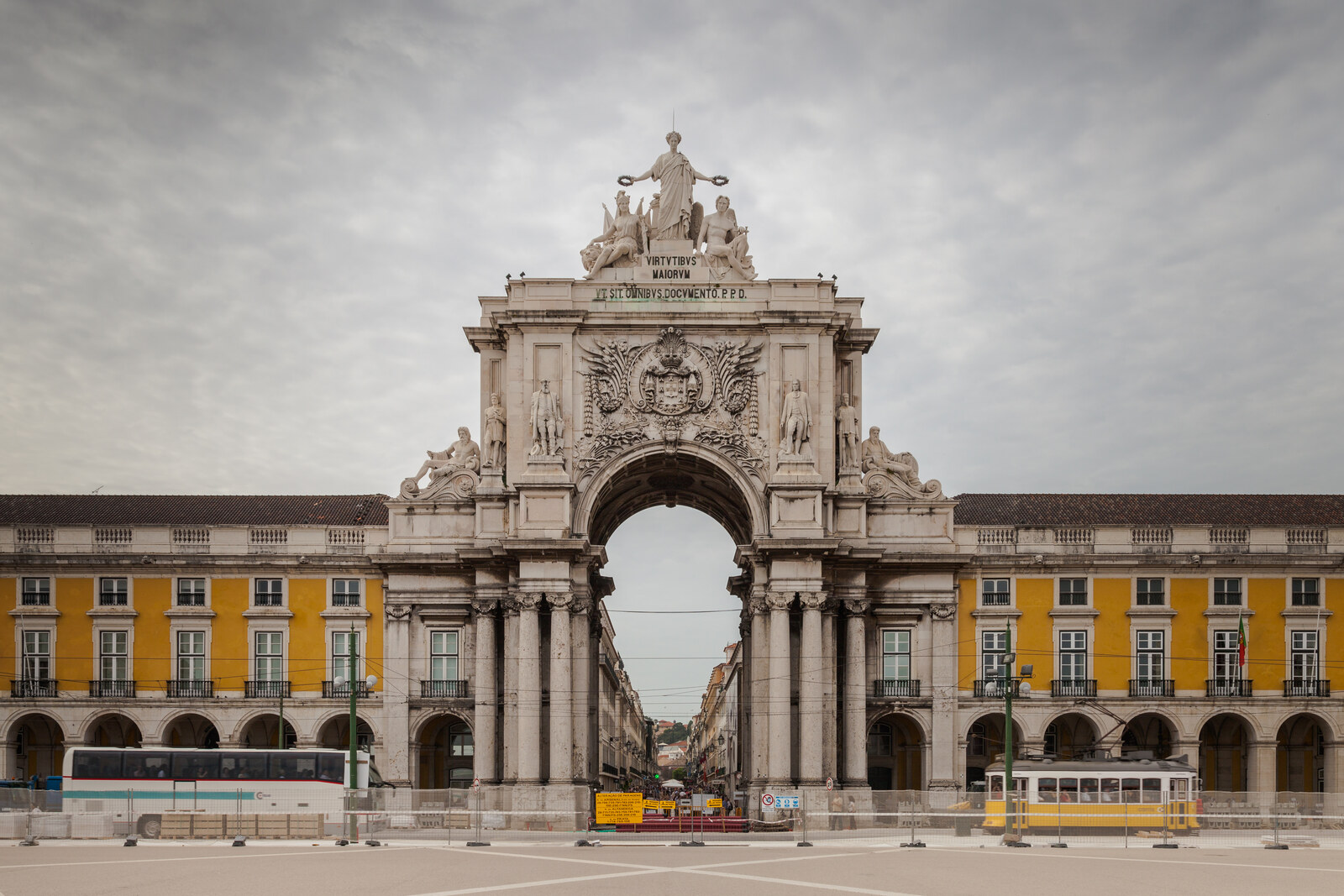
Look around first
What to notice
- Four stone figures
- The scroll in the right-hand figure’s hand
- Stone fragments beneath the right-hand figure’s foot
- The Latin inscription
The story of the place
On the northern side of the riverside square, a stone passageway forms the entrance to a city block: arrivals on the Tagus crossed the square and continued through these gates. Above the passage is an entire sculptural wall with four national figures, chosen for a brief account of the country. The right-hand figure holds a scroll, with stone fragments beneath the foot; above the figure, Fame, Genius, and Valour crown it. The Latin inscription speaks of the virtues of the ancestors and says that the monument was paid for by the public.
In seventeen seventy-seven, King José I died. The Marquis of Pombal, his chief minister and leader of the post-earthquake reconstruction, lost his post. The new queen, Maria I, wanted to break with the practices of her father’s reign, while Pombal’s opponents sought a trial for a man who had once been able to decide their fates. She halted a substantial part of his building program. The arch already begun here and the adjoining block were dismantled.
Gravely ill, the Marquis of Pombal asked permission to leave for the town that bore his title and settled there in his own house. In seventeen eighty-one, a court found the former minister guilty of abuses. Maria spared the eighty-two-year-old convicted man corporal punishment, but forbade him to approach the royal court. A year later, he died. Nothing remained of his arch at the entrance to Rua Augusta.
Several decades later, supporters of the constitutional monarchy, who had defeated the absolutists in the civil war, decided to complete the northern side of the square. In eighteen forty-three, the government held a competition for a new arch. This time, the patrons wanted to place a brief history of the country above the passage. The site was literally fitting: anyone arriving from the river crossed Commerce Square and entered the city through these gates.
The stone lineup included Viriatus, leader of the Lusitanians who resisted Rome; Vasco da Gama, who opened the sea route from Portugal to India; Nuno Álvares Pereira, the commander whose victories helped defend independence from Castile; and the Marquis of Pombal, who led the reconstruction of Lisbon. He was chosen as the most recent national figure in time and linked to the new city that had risen beyond the arch.
This lineup caused controversy even before the work was finished. In eighteen seventy-two, the Academy of Sciences advised removing Viriatus and Vasco da Gama: the former was considered a figure of a different scale from the statesman Marquis of Pombal, while the latter, in the academicians’ view, ought not to occupy a secondary place. One critic wrote mockingly that the ancient Viriatus had ended up almost side by side with an eighteenth-century minister.
The government did not change the list. Vítor Bastos, a sculptor and acting professor at the Academy of Fine Arts, completed the commission; he would receive a permanent professorship only in eighteen eighty-one. On the facade facing the square, his four figures stand in precisely the disputed order: Viriatus and Vasco da Gama on the left, the Marquis of Pombal and Nuno Álvares Pereira on the right. The Marquis of Pombal holds a rolled-up plan of Lisbon and sets his foot on fragments of the ruined city.
Above them, the French sculptor Célestin Anatole Calmels placed Fame, who crowns Genius and Valour. The Latin inscription dedicates the arch to “the virtues of the ancestors, so that they may serve as an example to all,” and adds that the monument was erected at public expense. The Marquis of Pombal’s first arch here was dismantled; on the second, he was carved at full height and placed among the very ancestors mentioned by the inscription.
Useful on site
Access to the top of the arch follows the monument operator’s schedule and varies by season. Check the official schedule on the day of your visit; if the ascent is closed or the line is irritating, the route works perfectly well from outside.
Checked: June 16, 2026. Check the official source before visiting.The main account can be read from the square and from the beginning of Rua Augusta; treat the ascent to the top as a separate visit and check access in advance.