 Guide On Map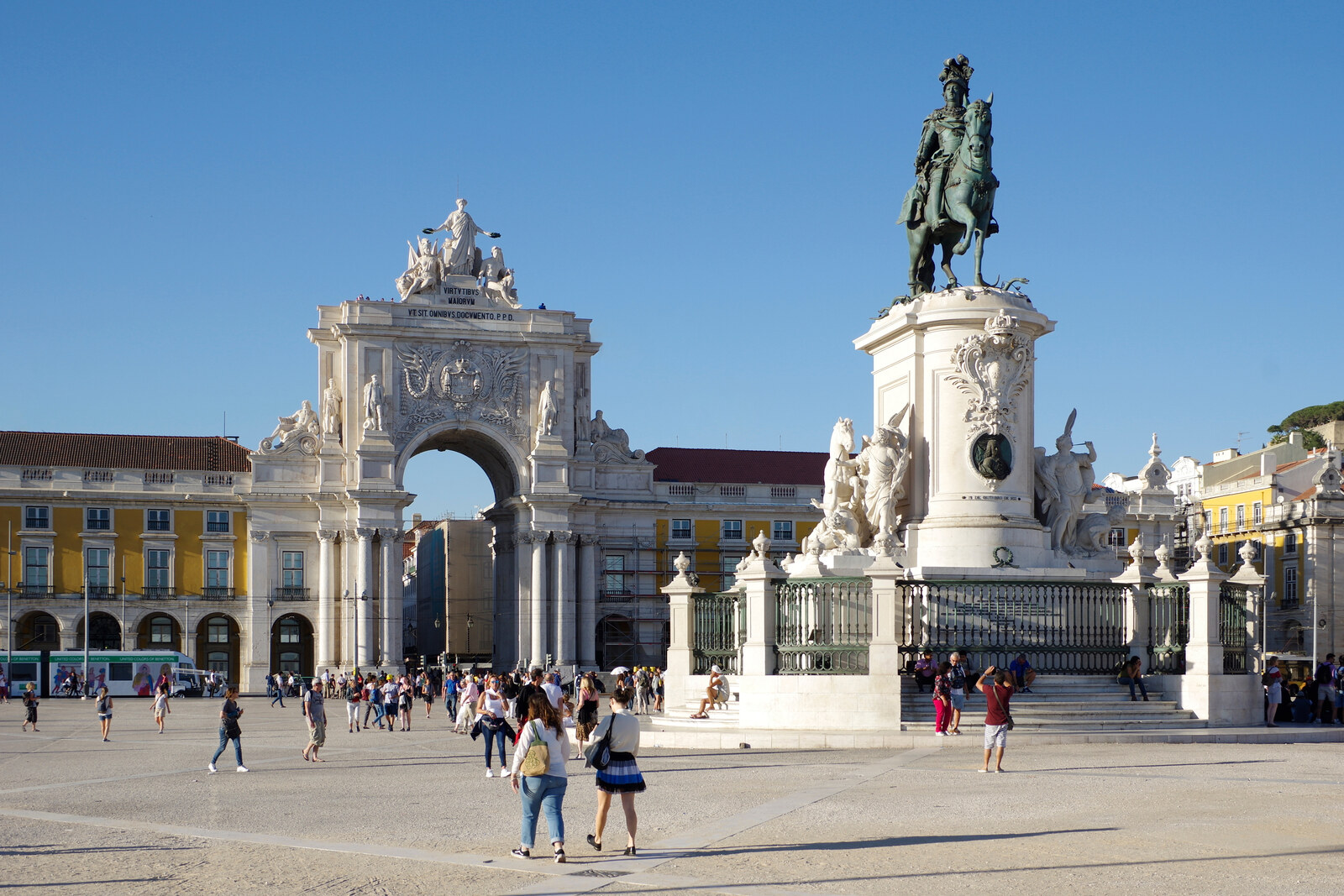
Look around first
What to notice
- Equestrian statue
- Bronze profile on the pedestal
- Matching blocks with arcades
- The open side by the river
The story of the place
Commerce Square functioned as the place where commercial Lisbon met the state: goods brought by sea were processed here, deals were made, cases were tried, and government was conducted. Three sides of the square are formed by matching blocks with arcades, while the fourth remains open to the Tagus because the river was part of its daily work. Behind these facades, mercantile business and royal administration literally occupied the same address.
On the side of the pedestal facing the Tagus is a bronze profile of the Marquis of Pombal. It was removed when the minister fell into disgrace and returned more than half a century later. This small medallion explains both the square’s present name and why a king stands in its middle, even though the royal palace is no longer here.
On November first, seventeen fifty-five, an earthquake, a wave, and fires destroyed Ribeira Palace—the principal residence of José I—on what was then Terreiro do Paço. The customs house, mint, Naval Arsenal, and the institutions through which trade with overseas possessions was processed perished with the palace. The merchants made their living from importing and reselling these cargoes; after the disaster, they lost their warehouses, offices, and the place where deals were made. The king moved the court to a wooden residence in Ajuda. During his reign, the stone palace by the river was never rebuilt.
The royal minister Sebastião José de Carvalho e Melo, the future Marquis of Pombal, took charge of rebuilding Lisbon. His position and his ability to carry out reforms depended on José’s trust. The minister chose the most radical of the proposed plans: to clear the destroyed low-lying area and build it anew. On the site of the palace courtyard, he left a broad square open to the river, and entrusted the construction of the surrounding blocks to the capital’s merchants.
A royal decree of June seventeen fifty-nine was the first to use the name Commerce Square. The new buildings housed the customs house, the commercial exchange, and the Junta do Comércio, the state council for trade affairs. The upper floors were occupied by courts and royal offices. The merchants paid for the construction of the facades behind which they were to process cargoes and deals again. Thus, the professional group that had lost its livelihood here received its own name at the site of the former palace.
On June sixth, seventeen seventy-five, Pombal held the unveiling here of the equestrian statue of José I. The square was still unfinished. The minister conducted the ceremony before the townspeople, while the king himself watched it from a window of the new customs house without appearing in public. On one of the pedestal’s reliefs, allegorical Commerce opens a chest of money before ruined Lisbon. On the other side, beneath the royal coat of arms, was Pombal’s profile—the signature of the minister who turned the palace courtyard into a commercial and administrative center.
Two years later, José died. The new queen, Maria I, dismissed Pombal by royal decree. The medallion was removed from the pedestal and replaced with the coat of arms of Lisbon; the former minister left for his estate and died there. The original profile was returned to the pedestal in eighteen thirty-three.
The palace never reappeared here. In its place stand matching blocks built with the participation of merchants; at the center is the bronze José I, and beneath the royal coat of arms Pombal is again visible—the man whom the king’s heirs once ordered removed from here.
Useful on site
The square is open as a public space. The institutions inside the arcades keep their own hours.
Checked: June 16, 2026. Check the official source before visiting.Do not stand for long in the path of the crowds crossing the square; it is easier to examine the monument’s details by walking all the way around the pedestal.