 Guide On Map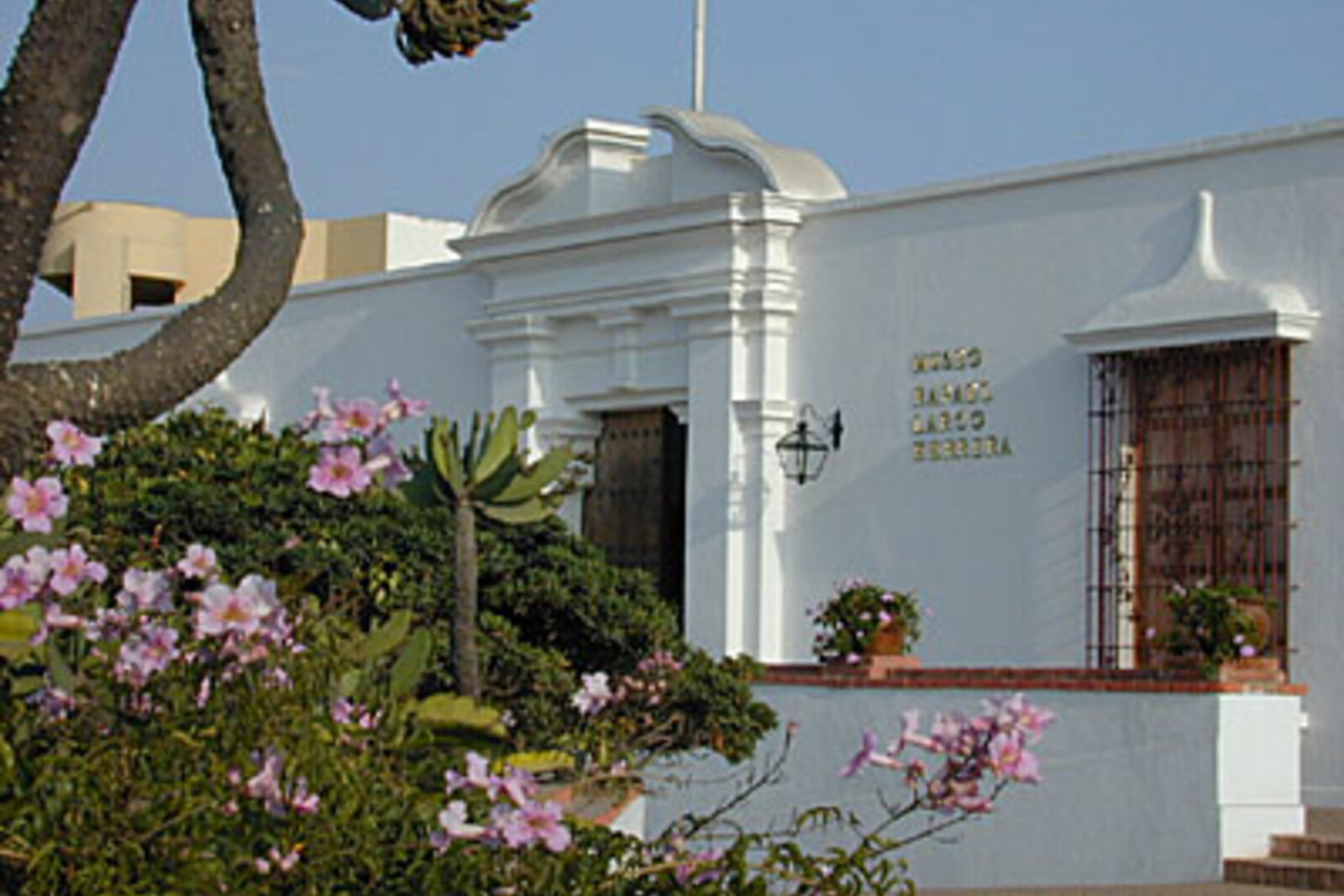
Look around first
What to notice
- Moche portrait vessel
- Carved wooden brackets
- Grilles of the old casona
- Open storage racks
The story of the place
Museo Larco occupies an old manor house dating from the early eighteenth century. When it was refitted, grilles, doors, columns, beams, and carved wooden brackets were brought here from Trujillo, on the same northern coast where many of the antiquities here originate. Thirty thousand ceramic objects stand on the open storage racks, and visitors are allowed right up close to them.
In nineteen twenty-three, Rafael Larco Herrera, owner of Chiclín Hacienda and a collector of Peruvian antiquities, gave his son a ceramic vessel. On it, an artist of the Moche people had modeled the head of a priest or noble warrior: a headdress with bird heads, large ear ornaments, and a calm face.
This vessel was what remained of another collection. Larco Herrera saw how poorly ancient Peru was represented at the Prado Museum in Madrid and gave the objects he had collected to Spain. They are now in Madrid’s Museum of the Americas. He kept one Moche portrait for himself, then gave it to his son.
Rafael Larco Hoyle was being prepared for entirely different work. His family sent him to the United States to study agriculture, engineering, and management, so that he could mechanize sugar production. After returning to Peru, he headed the family business in Chiclín. The hacienda provided his income; antiquities required spending on purchases, travel, and excavations.
The gifted vessel changed his pursuits. Larco Hoyle began acquiring finds from the valleys of Chicama, Moche, Virú, and Santa. On July twenty-eighth, nineteen twenty-six, the anniversary of Peru’s independence, the twenty-five-year-old manager opened a museum right in Chiclín. He gave it his father’s name—Museo Larco. Later, the founder explained that he wanted to create a monument to his father while he was still alive.
The objects he collected confronted Larco Hoyle with a task he had not initially planned to undertake. Archaeologists of the nineteen twenties could not identify everything that entered the collection. From nineteen thirty-three to nineteen forty-one, Larco Hoyle carried out excavations, trying to fill the gaps he had discovered. In nineteen forty-six, he proposed a chronology of the cultures of the northern coast—before the advent of radiocarbon analysis. The private collector became one of the founders of Peruvian archaeology.
In the nineteen fifties, he decided to move the museum to Lima so that the collection would be more accessible to foreign visitors and researchers. For it, Larco Hoyle bought an old manor house dating from the early eighteenth century here. He refitted the casona with grilles, doors, columns, beams, and carved brackets saved from Casa de los Marqueses de Herrera y Villahermosa in Trujillo. That is why today’s museum is in Lima, while some of its architectural details came from the same northern coast where the first objects were collected.
By Larco Hoyle’s death in nineteen sixty-six, the collection contained about fifty thousand objects. Thirty thousand ceramic objects are housed in storerooms open to ordinary visitors. And the portrait vessel that his father kept after sending his collection to Spain is in the permanent exhibition, in the Hall of Ancient Peruvian Cultures. This vessel gave rise both to the collection and to the museum’s full name, now shortened to two words—Museo Larco.
Useful on site
Officially: daily 09:00–19:00; on 24/25/31 December and 1 January, 09:00–18:00.
Checked: June 26, 2026. Check the official source before visiting.A full visit requires a separate museum visit; do not try to take in the entire collection, and choose several series of objects to compare.